
Gluco6 Ingredients Review 2026: 10 Actives & 525 mg Blend
Affiliate disclosure: purchases through links may earn a commission at no extra cost to you. Read disclosure.
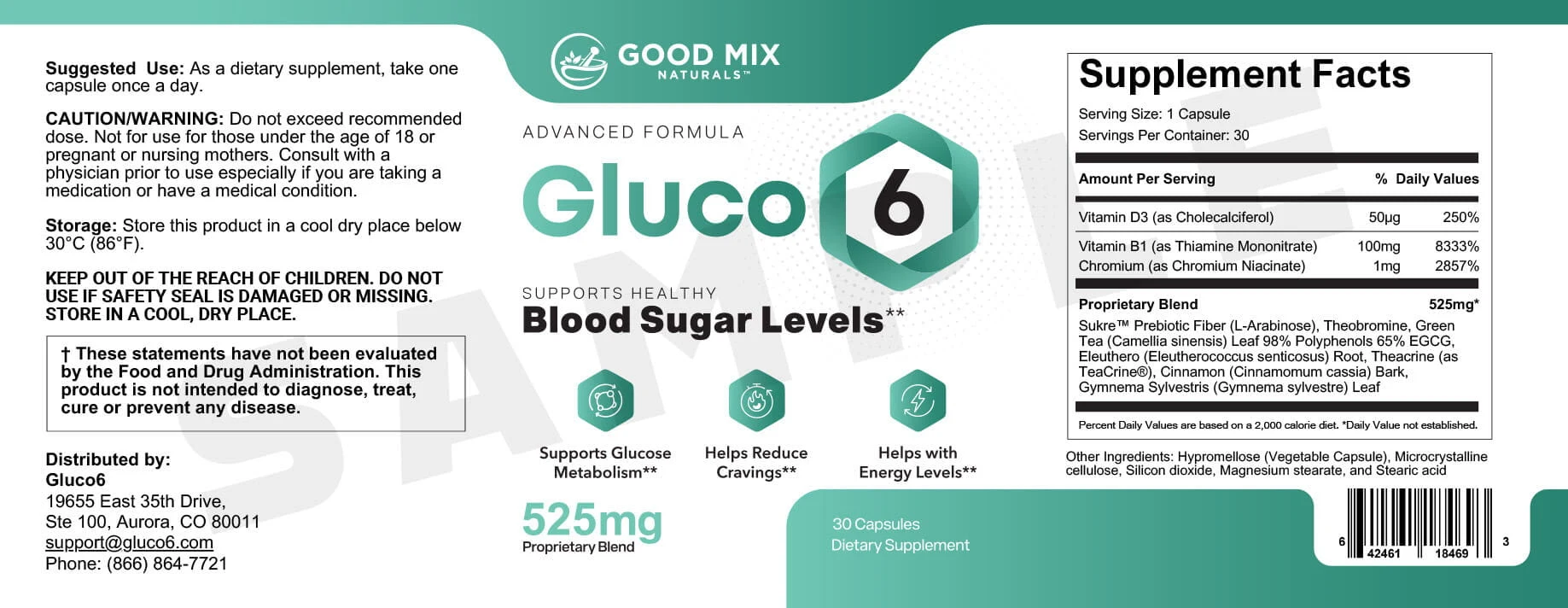
This ingredient review expands the main Gluco6 review. It separates three disclosed nutrient quantities from seven ingredients inside a 525 mg proprietary blend and five listed excipients. The current manufacturer artwork is marked SAMPLE; it describes that published label, rather than independently confirming a delivered batch or its measured contents.
| Ingredient | Category | Label quantity | Form / standardization | Evidence and dose finding |
|---|---|---|---|---|
| Vitamin D3 | Active | 50 mcg | Cholecalciferol | 2,000 IU; not proof of glucose benefit |
| Vitamin B1 | Active | 100 mg | Thiamine mononitrate | Nutritional function is not finished-formula efficacy |
| Chromium | Active | 1 mg | Chromium niacinate | 1,000 mcg; different form from picolinate RCT |
| Sukre | Blend active | Undisclosed | L-arabinose / prebiotic fiber | Cannot reach 3,000 mg within whole 525 mg blend |
| Theobromine | Blend active | Undisclosed | No further standardization given | Exposure cannot be quantified |
| Green tea | Blend active | Undisclosed | Leaf; 98% polyphenols; 65% EGCG | Percentages without extract mg do not give EGCG mg |
| Eleuthero | Blend active | Undisclosed | Eleutherococcus senticosus root | No dose-matched benefit established |
| Theacrine | Blend active | Undisclosed | TeaCrine | Safety research is not diabetes efficacy |
| Cinnamon | Blend active | Undisclosed | Cinnamomum cassia bark | Species identified; coumarin amount not given |
| Gymnema | Blend active | Undisclosed | Gymnema sylvestre leaf | Standardized extract equivalence unestablished |
| Hypromellose | Excipient | Not quantified | Vegetable capsule | Shell ingredient; no claimed glucose effect |
| Microcrystalline cellulose | Excipient | Not quantified | Cellulose | Formulation material |
| Silicon dioxide | Excipient | Not quantified | Silica | Processing ingredient |
| Magnesium stearate | Excipient | Not quantified | Stearate | Not a nutritional magnesium serving |
| Stearic acid | Excipient | Not quantified | Fatty acid | Formulation ingredient |
Label Disclosure and Proprietary Blend Math
The 525 mg figure belongs to the entire seven-ingredient blend, not each ingredient. Dividing it equally would invent seven doses. The three nutrients are listed separately. A defensible comparison uses the blend as an upper bound while recognizing that every component must share that same limited mass.
The published nutrient amounts should not be subtracted from 525 mg: the label lists them outside the proprietary blend. Conversely, 525 mg should not be described as the capsule’s complete fill weight, because separately listed actives and excipients also occupy space. This distinction avoids a misleading mass balance. [label]
This arithmetic does not identify a minimum effective dose, predict the capsule’s effect or justify taking extra capsules. The study context involved a sucrose drink, whereas a mixed-meal study did not reproduce the same beneficial responses. Dose, food matrix and timing all affect whether a comparison transfers. Halschou-Jensen et al. (2015) — PMID 25400106 [mixedmeal]
Ingredient Forms Matter as Much as the Numbers
Chromium is the clearest disclosed comparison: the sample label states 1 mg, equivalent to 1,000 mcg. A cited human trial tested chromium picolinate, while this panel specifies chromium niacinate. Matching the number alone does not establish equivalent absorption, clinical effects or suitability alongside diabetes medication.
For Sukre, the sample artwork supplies a chemical identity—L-arabinose—rather than merely a marketing name. That improves interpretability, but the individual quantity remains hidden. For Gymnema, identifying a leaf does not establish equivalence to a particular standardized extract used elsewhere in research. [label]
For green tea, 65% EGCG is a concentration statement. EGCG mass would equal the unknown extract mass multiplied by 0.65, assuming the label’s percentage basis. It is incorrect to multiply 65% by the entire 525 mg blend and present that result as the actual daily EGCG exposure. [green]
- D3: 50 mcg ×40 IU/mcg =2,000 IU; consider total intake from other products. [vitd]
- B1: 100 mg is a separately disclosed nutrient amount, not a clinical result. [b1]
- TeaCrine: the 200/300 mg research comparator concerns safety; it does not establish glucose control. Taylor et al. (2016) — PMID 26766930 [teacrine]
- Cassia cinnamon: retain the species name; do not silently substitute Ceylon. The historical trial record flags an Expression of Concern. Khan et al. (2003) — PMID 14633804 [cinnamontrial] See the 2025 Expression of Concern (PMID: 40834253) [correction].
Capsule Shell, Excipients and Allergen Screening
The sample label lists hypromellose, microcrystalline cellulose, silicon dioxide, magnesium stearate and stearic acid as other ingredients. These identify formulation materials rather than additional glucose-support doses. The published list does not independently establish allergen cross-contact controls, manufacturing purity or the composition of every delivered batch sold under this name.
Hypromellose is identified as the vegetable capsule shell. Magnesium stearate should not be counted as a separately quantified magnesium supplement. The five excipients have no masses listed, and the manufacturer’s front-page suitability statements are different from a lot-specific allergen declaration or laboratory certificate. [label]
- Match the batch number, expiration date and all active names on the physical bottle.
- Ask the seller about any personally relevant allergy and cross-contact process.
- Request a batch certificate identifying the laboratory, test date and tested analytes.
- Distinguish a recognizable certification from an unexplained manufacturing badge.
A legible label confirms what is represented, while an independent analytical report can address identity, potency or contaminants. Neither document alone proves a therapeutic outcome. Our ingredient hub explains why transparency, quality assurance and clinical efficacy should be assessed separately.
Questions to Bring to a Doctor or Pharmacist
Bring the actual Gluco6 bottle or a clear photograph of its full panel to a clinician. Highlight 1,000 mcg chromium, the seven undisclosed blend doses and other supplements already used. Ask whether the listed forms, total nutrient exposure and medical history make this specific combination appropriate for you.
- Does chromium niacinate fit my medication and monitoring plan? [chromium]
- Do my other products add vitamin D or chromium that changes total exposure?
- Does the label disclose enough green-tea information for my liver history?
- Would a targeted nutrient assessment answer my question better than a multi-ingredient blend?
- What measurements and follow-up would you recommend if you consider this formula appropriate?
For organ-specific warnings and interacting medicines, continue to the Gluco6 safety review. For trial design and endpoint interpretation, use the clinical evidence review and Dietary Supplements Guide. Commercial details stay in the main review’s purchase section rather than being repeated as an ingredient recommendation.
Gluco6 Ingredient FAQs
These five ingredient questions focus on the 525 mg blend, dose estimation, chromium form and the SAMPLE watermark. They explain what can be read directly from the published panel and what remains unknown. None supplies undisclosed ingredient amounts, confirms a delivered batch or establishes clinical benefit for the marketed formula.
Does 525 mg mean each Gluco6 ingredient contains 525 mg?
No. The sample panel assigns 525 mg to seven ingredients together. It supplies no separate amount for each blend component. Reading that number as seven individual doses would multiply the disclosed total incorrectly and would misrepresent what the manufacturer artwork actually states.
Can the seven blend doses be estimated by dividing equally?
An equal split is not disclosed and should not be presented as fact. The panel provides a combined mass rather than seven proportions. Use it only as an upper bound for a single component; it cannot support an exact L-arabinose, theacrine or green-tea quantity.
Is chromium niacinate the same study ingredient as chromium picolinate?
They are different named forms. The sample label lists niacinate, whereas the cited 1997 trial used picolinate. Both descriptions involve chromium, but identical microgram numbers alone cannot demonstrate equivalent formulation, absorption or clinical performance. A qualified professional should interpret the comparison for an individual.
Why keep the SAMPLE watermark in the label image?
The watermark identifies the document’s status and prevents the artwork being mistaken for an independently verified batch label. It is useful evidence of the manufacturer’s published representation. Compare the actual bottle with it and investigate any differences in ingredients, serving quantities or warnings before use.
Does a 65% EGCG statement reveal the daily EGCG amount?
No. A percentage describes the stated concentration of the green-tea ingredient, while its individual mass remains undisclosed inside the 525 mg blend. The daily EGCG amount cannot be calculated from that percentage alone. Ask for the green-tea mass and the basis of its standardization statement.
References
- Official manufacturer SAMPLE label
- Krog-Mikkelsen I et al. (2011). The effects of L-arabinose on intestinal sucrase activity: dose-response studies in vitro and in humans. Am J Clin Nutr. 94:472–478. DOI: 10.3945/ajcn.111.014225. PMID: 21677059.
- Halschou-Jensen K et al. (2015). A mixed diet supplemented with L-arabinose does not alter glycaemic or insulinaemic responses in healthy human subjects. Br J Nutr. 113:82–88. DOI: 10.1017/S0007114514003407. PMID: 25400106.
- Anderson RA et al. (1997). Elevated intakes of supplemental chromium improve glucose and insulin variables in individuals with type 2 diabetes. Diabetes. 46:1786–1791. DOI: 10.2337/diab.46.11.1786. PMID: 9356027.
- NIH ODS: Chromium
- NCCIH: Green Tea
- NIH ODS: Vitamin D
- NIH ODS: Thiamin
- Taylor L et al. (2016). Safety of TeaCrine®, a non-habituating, naturally-occurring purine alkaloid over eight weeks of continuous use. J Int Soc Sports Nutr. DOI: 10.1186/s12970-016-0113-3. PMID: 26766930.
- Khan A et al. (2003). Cinnamon improves glucose and lipids of people with type 2 diabetes. Diabetes Care. 26:3215–3218. DOI: 10.2337/diacare.26.12.3215. PMID: 14633804. Read with the 2025 Expression of Concern.
- American Diabetes Association (2025). Expression of Concern regarding Khan et al., Cinnamon Improves Glucose and Lipids of People With Type 2 Diabetes. Diabetes Care. 48:1646. DOI: 10.2337/dc25-ec09. PMID: 40834253.