
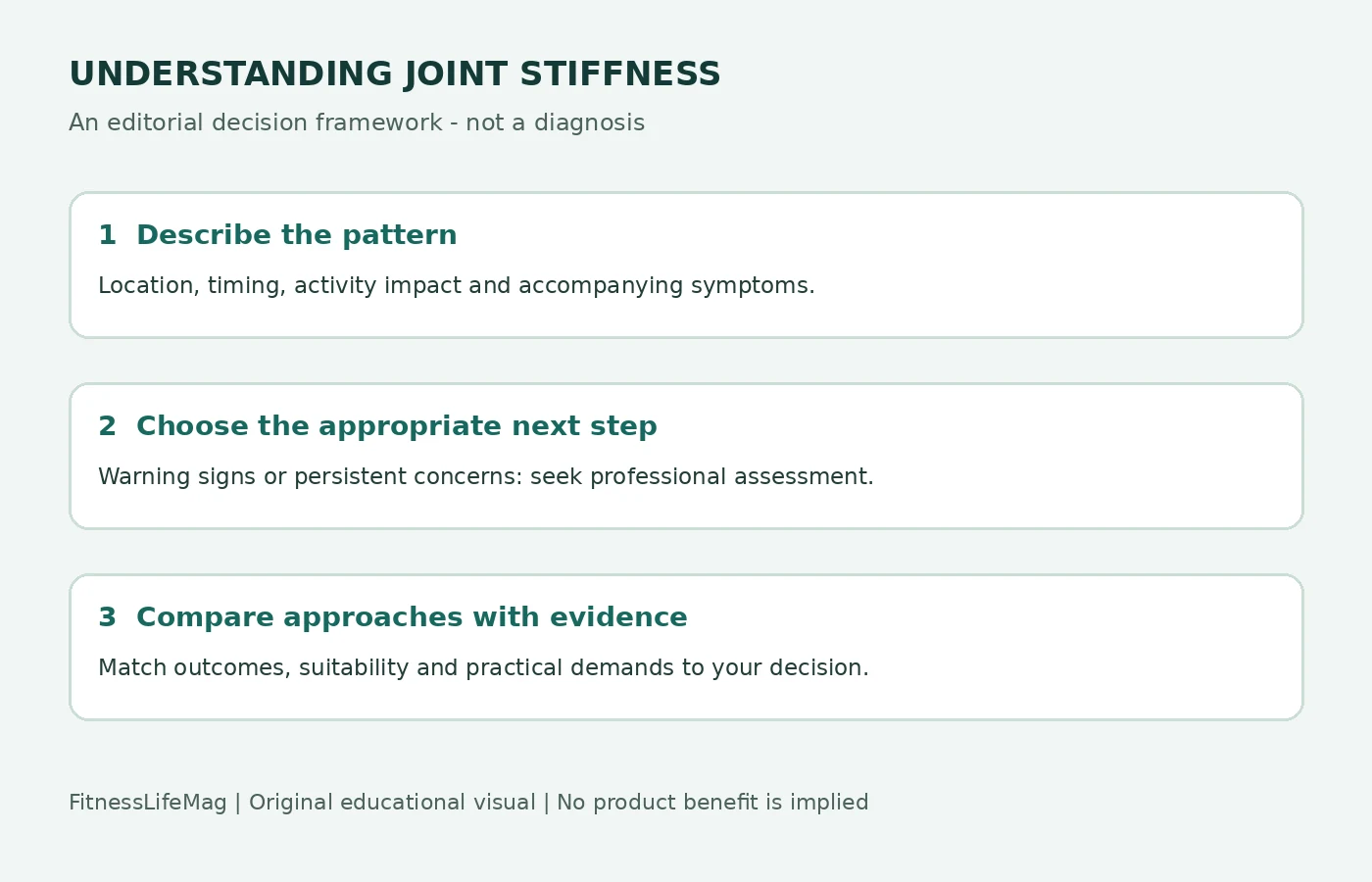
Joint stiffness is a symptom description, not a diagnosis. The useful starting point is the pattern of difficulty moving, accompanying symptoms and effect on ordinary activities. A supplement's lubrication story cannot establish the cause of that difficulty.
This joint stiffness guide helps you prepare for assessment, understand broad approaches and evaluate evidence. It does not diagnose arthritis from symptoms or tell you which product to take.
What do you mean by stiffness?
Describe the experience in your own terms: movement feels restricted, a joint takes time to loosen, or an activity is harder than usual. Record whether pain, swelling, warmth, instability or a recent injury is also present.
Separating those observations makes the conversation more useful than simply writing “bad joints.” Do not force your experience into a diagnosis suggested by an advertisement. Different concerns can need different evaluation, and a symptom pattern is information for a clinician rather than proof of a particular cause.
Why one explanation does not fit every reader
NIAMS describes osteoarthritis as involving changes in multiple joint tissues and notes that stiffness can occur after rest. That provides one context, not an explanation for every case of stiffness. NIAMS overview.
Injury and other conditions may also be involved. A clinician can use the history and examination, and sometimes further investigation, to distinguish possibilities. A webpage cannot do that from a product's intended audience or an age-related marketing story.
Be cautious when a sales page names one “root cause” for a broad symptom. Even a biologically relevant molecule does not show that its level explains your symptoms or that an oral supplement addresses the cause.
When assessment should come first
Seek prompt medical assessment for a hot swollen joint with systemic illness. Severe symptoms after injury, inability to bear weight, deformity or altered sensation also need urgent attention. Persistent or worsening problems, sleep/activity disruption or prolonged morning stiffness deserve review. NHS joint-pain guidance.
This source is UK guidance; use the appropriate local healthcare or emergency service in the United States rather than copying UK phone numbers. A warning list is not exhaustive and does not replace professional judgment.
If you are unsure how urgent a symptom is, contact a healthcare service. Do not wait for a supplement trial or refund deadline to determine when to obtain care.
Prepare a useful symptom record
| Observation | What to record | How it helps the discussion |
|---|---|---|
| Location | Which joint or joints are affected | Keeps the concern specific |
| Timing | When it starts and how long it lasts | Describes the pattern without diagnosing |
| Activity | Which ordinary task is affected | Shows practical impact |
| Accompanying changes | Pain, swelling, warmth, injury or other symptoms | Identifies issues to discuss promptly |
| Products and care | Medicines, supplements and recent treatment changes | Supports a complete safety/history review |
| Progression | Improving, unchanged, recurring or worsening | Makes follow-up more informative |
Use consistent descriptions rather than searching for a perfect score. Include what changed around the same time, and bring your medicine/supplement list. A useful record can be brief enough to maintain; it should not become a reason to postpone care.
What approaches may be discussed?
For diagnosed osteoarthritis, NIAMS describes individualized exercise, appropriate weight management and other care approaches, with medicine or further intervention depending on the person. NIAMS treatment guidance.
That does not mean every stiff joint needs the same program. Ask which approach fits the cause, what outcome to expect, what risks matter and when the plan should be reassessed. An exercise list or pain-reliever name from a webpage is not an individualized prescription.
The goal of choosing an approach is meaningful function and symptom management within a suitable plan. “Supports joint health” is too broad to determine whether an intervention answers your actual problem.
Care options answer different questions
For diagnosed osteoarthritis, NIAMS describes exercise, appropriate weight management, medicines and practical supports within individualized care. These address symptoms and function; no single option suits every reader. The assessment comes first when the cause is unclear. NIAMS care overview.
| Decision | Useful discussion | What to avoid |
|---|---|---|
| Movement feels difficult | Suitable activity and function goals | Copying an intensive program without assessment |
| Symptoms disrupt ordinary tasks | Management options and their tradeoffs | Assuming the longest ingredient list is better care |
| You are considering an additional product | Evidence, safety, practical burden and review point | Replacing the existing care plan on a marketing promise |
Ask how the plan fits your daily activities and what would prompt reassessment. A clinician or physical therapist can help adapt activity to the diagnosis and ability; this guide does not prescribe exercises or medicine.
A framework for comparing options
| Question | Why it matters |
|---|---|
| What problem is the option meant to address? | Avoids comparing interventions for different tasks |
| What outcome was measured? | Separates symptom, function and laboratory claims |
| Who was studied? | Tests relevance to your situation |
| What preparation or method was used? | Prevents transfer from a different product or route |
| What are the risks and practical demands? | Includes medicines, time, cost and follow-up |
| What would make us reconsider? | Establishes a review point rather than indefinite use |
You can use this framework for a supplement, a care program or a device without assuming they are interchangeable. The comparison should follow the decision you need to make, not the number of favorable claims on a sales page.
Where supplements fit in the discussion
A supplement can be considered as a product question after the symptom and care priorities are understood. It should not inherit the evidence of an unrelated preparation merely because the ingredient name matches.
Dietary supplements are not preapproved for safety and effectiveness in the same way as drugs. Discuss medicines and other products when evaluating an addition. FDA consumer guidance.
Joint Genesis is one product covered by FitnessLifeMag's separate review system. Its presence here is not an endorsement. The independent Joint Genesis review evaluates that capsule’s label, evidence and buying terms. Its product-specific assessment is separate from this symptom and care framework.
Mechanism, delivery route and meaningful benefit
An oral capsule, a topical product and a procedure differ in delivery, exposure and practical risks. Evidence from one route should not automatically be used to support another.
Similarly, a biological explanation is an early part of the evidence chain. Ask whether research demonstrates a change in an outcome that matters to the reader. A more persuasive mechanism description cannot substitute for a relevant outcome study.
This distinction helps you avoid both exaggerated enthusiasm and an equally unsupported blanket dismissal. The useful assessment can remain uncertain while still ruling out guarantees.
Questions to bring to an appointment
- What could account for this symptom pattern, and is further assessment needed?
- Which daily activities should we focus on improving?
- What approaches fit the diagnosis and my other conditions?
- Does my current medicine/supplement combination need review?
- What improvement would be meaningful, and when should we reassess?
- Which new symptoms should lead me to contact you sooner?
These questions prepare shared decisions. They are not instructions to demand a particular test, stop medicine or begin a supplement.
Common questions
Does morning stiffness prove arthritis?
It does not establish a diagnosis by itself. Describe its duration and accompanying symptoms to a clinician, especially if it persists or limits activities.
Should I try a supplement before seeing someone?
Assessment takes priority when warning signs, persistent symptoms or suitability questions are present. This guide cannot clear a supplement for your personal situation.
Is the product with the best lubrication story the best option?
A marketing mechanism is only one claim. Compare relevant outcome evidence, risks, practical demands and your actual care needs.
Is a money-back guarantee evidence of health benefits?
It concerns a transaction, not clinical efficacy. Return conditions and outcome evidence require separate checks.
Method and limitations
This guide uses public clinical/regulatory guidance and an original decision framework. It was prepared remotely by FitnessLifeMag's editorial identity, without an independent clinical reviewer or personalized assessment. It does not claim that a product was tested or that any reader has a specific condition.
The relevant next step is understanding the symptom and obtaining appropriate advice, then comparing options against a clearly defined decision.
Policies: Editorial Methodology, Sources Policy, Affiliate Disclosure. Corrections.
Educational information only. This guide is not a substitute for professional evaluation, diagnosis or treatment of joint symptoms or any other health condition.
Commercial relationship: FitnessLifeMag may earn commissions through marked purchase links on its product pages. Mentioning a product here does not endorse it; clinical references are not purchase links.