
TitanFlow Ingredients: Read the Five-Active Sample Label
Affiliate disclosure: We may earn a commission from purchases through our commercial links, at no extra cost to you. Views are independent of the seller. Disclosure policy.
Official Website Offer: Save on 3 & 6-Bottle Bundles + 180-Day Money-Back Guarantee.
What the TitanFlow panel actually lists
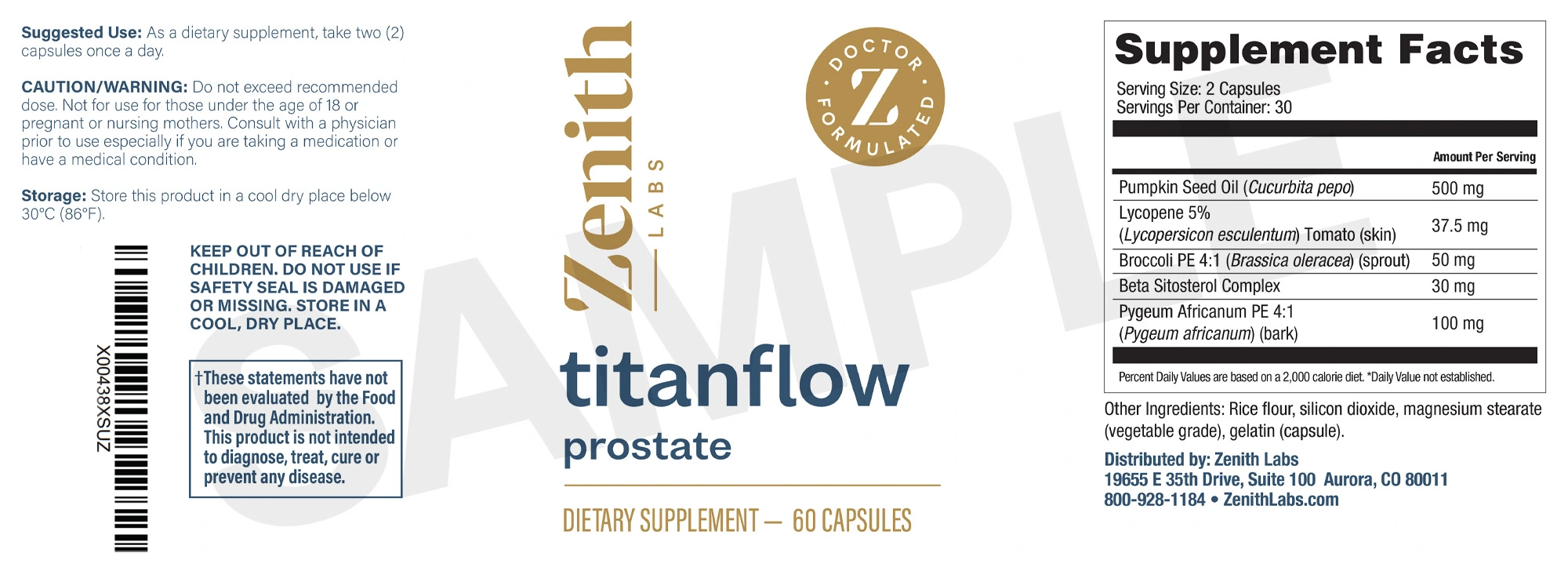
TitanFlow ingredients are separately quantified on the inspected sample panel, with five active ingredients and four other ingredients listed. This opening matrix distinguishes each declared role from its specification limits, so readers can interpret the formula without mistaking the seller’s proprietary wording for an undisclosed combined ingredient amount.
| Ingredient / group | Role | Per serving | Published specification | Interpretation |
|---|---|---|---|---|
| Pumpkin seed oil | Active | 500 mg | Cucurbita pepo oil | No full fatty-acid profile shown. |
| Lycopene material | Active | 37.5 mg | 5%; tomato skin | Constituent percentage changes the relevant comparison. |
| Broccoli sprout extract | Active | 50 mg | PE 4:1 | Glucoraphanin and myrosinase specifications are not on this panel. |
| Beta sitosterol complex | Active | 30 mg | Complex | The pure sterol fraction is unspecified on the panel. |
| Pygeum bark extract | Active | 100 mg | PE 4:1 | Extraction ratio is not complete phytochemical standardization. |
| Rice flour, silicon dioxide, magnesium stearate | Other ingredients | No quantities listed | Magnesium stearate described as vegetable grade | These support manufacturing or capsule fill. |
| Gelatin | Capsule | No quantity listed | Gelatin capsule | Not a vegetarian capsule format. |
Dose interpretation without hidden-blend assumptions
TitanFlow does not require an average-per-ingredient hidden-blend calculation because the inspected sample panel lists each active amount. The useful calculation is instead the lycopene constituent estimate, while the beta sitosterol complex and botanical extract ratios require careful interpretation before any comparison with a researched preparation is made.
If 5% denotes lycopene concentration, the nominal amount is 37.5 mg × 5/100 = 1.875 mg. That is one eighth of the 15 mg daily lycopene amount in the small six-month pilot, but the arithmetic is not an efficacy estimate or a reason to self-adjust the serving. Schwarz et al. (2008) [4]
The five listed active masses add to 717.5 mg per two-capsule serving. This is a sum of different materials, not a claim of equal active strength. The 30 mg complex cannot contain more than 30 mg of beta-sitosterol by mass; its actual fraction cannot be recovered from the word “complex.”
How the ingredients compare with human research
The TitanFlow ingredient evidence is most useful when the label and study are compared by preparation, amount and outcome together. Pumpkin oil, beta-sitosterol and pygeum have relevant human urinary-symptom research, whereas the lycopene and broccoli findings require especially careful separation from a promise of stronger urinary flow.
| Ingredient | Label dose per 2 capsules | Studied human preparation / dose | Buyer takeaway |
|---|---|---|---|
| Pumpkin seed oil | 500 mg | 320 mg/day oil in a small, 12-month trial. Hong et al. (2009) [1] | The listed mass is higher; oil composition and trial outcomes are not automatically equivalent. |
| Lycopene 5% material | 37.5 mg | 15 mg/day lycopene for six months in 40 men. Schwarz et al. (2008) [4] | At a 5% concentration, 37.5 mg corresponds nominally to 1.875 mg lycopene, not 37.5 mg pure lycopene. |
| Broccoli sprout PE 4:1 | 50 mg | 400 micromol glucoraphanin in a two-week drink study of 200 healthy adults. Kensler et al. (2005) [5] | Extract mass cannot be converted to that glucoraphanin exposure without standardization data. |
| Beta sitosterol complex | 30 mg | 60–195 mg/day non-glucosidic preparations in three review trials. Wilt et al. (1999) [2] | The complex mass is below those studied preparation amounts; its active sterol fraction is unspecified. |
| Pygeum bark PE 4:1 | 100 mg | Varied preparations in 18 short trials; mean duration 64 days. Wilt et al. (2002) [3] | A 4:1 extraction ratio does not establish equivalence to a standardized trial extract. |
Hong’s small four-arm study used pumpkin seed oil for 12 months; its symptom changes do not validate every claim about urethra-wall strength. The beta-sitosterol review covered several preparations over 4–26 weeks. Pygeum trials were mostly short, with limited reporting of allocation methods. These are different evidence profiles, not five equivalent clinical endorsements. Hong et al. (2009) [1] Wilt et al. (1999) [2] Wilt et al. (2002) [3]
For a fuller discussion of outcomes rather than ingredient specifications, read the effectiveness guide. The ingredient library is broader educational navigation, not a claim that every TitanFlow ingredient already has a dedicated site monograph.
Capsule ingredients, allergens and dietary preferences
TitanFlow’s inspected other-ingredient list contains rice flour, silicon dioxide, vegetable-grade magnesium stearate and gelatin. That gives a clear reason to distinguish capsule suitability from botanical effects: gelatin changes vegetarian compatibility, and a short ingredient list cannot certify absence of every allergen or cross-contact risk for a sensitive buyer.
The seller says the product avoids major allergens, but the inspected artwork does not supply an allergen-specific testing report. Someone with a severe allergy should ask about the actual ingredient source, shared-equipment controls and delivered-lot information before use. Tomato, pumpkin and broccoli are recognizable botanical sources, not a guarantee of individual tolerance.
Vegetable-grade magnesium stearate describes that ingredient, not the whole capsule. If gelatin or a particular botanical is unsuitable, choosing another format is more practical than trying to modify the capsules yourself.
Useful formula questions for your clinician
Bring the TitanFlow sample panel and your delivered label to a clinician or pharmacist so the discussion uses actual quantities rather than marketing highlights. The most useful questions concern your symptom assessment, duplicate ingredients, plant-sterol suitability and whether a two-capsule daily supplement fits the rest of your care plan.
- Has the cause of my urinary change been assessed before I add a supplement?
- Do my other products duplicate pygeum, lycopene or plant sterols?
- Does the beta sitosterol complex matter for my medical history?
- Would the gelatin capsule or any botanical source conflict with my needs?
- What changes should I record, and when should I seek reassessment?
See the safety guide for supported cautions and our Men’s Health Guide for broader assessment questions.
TitanFlow ingredient FAQs
These ingredient questions distinguish a declared mass from an active constituent and a sample label from batch evidence. For TitanFlow, those distinctions are especially useful when interpreting the 5% lycopene material, beta sitosterol complex and 4:1 extracts before comparing the formula with human research or combining supplements.
Are TitanFlow ingredient amounts hidden in a blend?
The inspected sample artwork lists separate amounts for all five actives per two capsules. The seller uses proprietary-formula language, but that does not make these listed amounts a hidden blend total. Some constituent specifications remain unclear, particularly the active fraction of the beta sitosterol complex.
Does 37.5 mg mean 37.5 mg of pure lycopene?
The panel says “Lycopene 5%” alongside 37.5 mg. If the percentage describes the ingredient’s lycopene concentration, the nominal lycopene amount is 37.5 multiplied by 0.05, or 1.875 mg. This interpretation is not a laboratory assay and should be confirmed against the delivered label.
Does a 4:1 extract prove clinical potency?
No. A 4:1 ratio describes the stated relationship between raw botanical input and extract mass. It does not specify every active constituent or establish equivalence to a trial preparation. That distinction matters for both broccoli sprout and pygeum when interpreting the TitanFlow panel.
What makes the sample label useful?
It lets readers inspect the declared serving, active amounts, capsule ingredients, storage instructions and warnings rather than rely only on marketing highlights. Because the artwork is marked SAMPLE, it should be used as published product information—not as a batch-specific certificate or a guarantee about a delivered bottle.
Should I add extra beta-sitosterol to match a study?
Do not build a higher-dose combination on your own from an ingredient comparison. Trial preparations differ from a mixed supplement, and adding another product can duplicate ingredients or create a different exposure. A clinician or pharmacist can assess the complete combination against your symptoms and medicines.
An ingredient-led decision
TitanFlow’s five disclosed active quantities make it possible to compare the published formula with research rather than rely only on ingredient names. The practical next step is to confirm the delivered label and your suitability, remembering that extract ratios, constituent percentages and a complex’s total mass do not establish matching clinical effects.
For a suitable adult who prefers two daily capsules, the formula is straightforward to read. Use the main review for the overall buying decision, and the effectiveness owner for expectations.
Affiliate disclosure: FitnessLifeMag may earn a commission if you buy through our commercial links, at no extra cost to you. The views expressed are our own and do not represent Zenith Labs or ClickBank. Read the disclosure policy.
References
- Hong et al. (2009). Pumpkin seed oil and saw palmetto oil in Korean men with symptomatic BPH. Nutr Res Pract. DOI:10.4162/nrp.2009.3.4.323.
- Wilt et al. (1999). Beta-sitosterols for benign prostatic hyperplasia. Cochrane review. DOI:10.1002/14651858.CD001043.
- Wilt et al. (2002). Pygeum africanum for benign prostatic hyperplasia. Cochrane review. DOI:10.1002/14651858.CD001044.
- Schwarz et al. (2008). Lycopene in patients with BPH: six-month pilot trial. J Nutr. DOI:10.1093/jn/138.1.49.
- Kensler et al. (2005). Broccoli sprout infusion and urinary carcinogen biomarkers. DOI:10.1158/1055-9965.EPI-05-0368.