
Does TitanFlow Work? Ingredient Evidence and Expectations
Affiliate disclosure: We may earn a commission from purchases through our commercial links, at no extra cost to you. Views are independent of the seller. Disclosure policy.
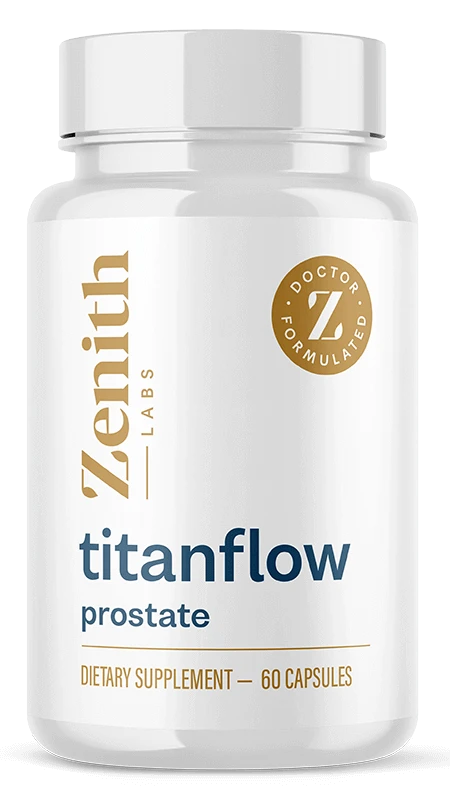
Official Website Offer: Save on 3 & 6-Bottle Bundles + 180-Day Money-Back Guarantee.
Which TitanFlow benefits have relevant evidence?
TitanFlow’s advertised urinary benefits have different levels of ingredient support, and its specific urethra-strengthening explanation should not be treated as an established human outcome. This matrix separates the seller’s stated goals from the preparations and endpoints actually inspected, helping readers set expectations without confusing a formula rationale with proven product results.
| Seller-claimed benefit | Relevant evidence | Match to TitanFlow | Practical expectation |
|---|---|---|---|
| Urinary-flow support | Beta-sitosterol and pygeum reviews. Wilt et al. (1999) [2] Wilt et al. (2002) [3] | Ingredient preparation and dose differences remain. | Possible support, not a predictable flow increase. |
| Less urgency / nighttime disruption | Symptom scores and nocturia in selected ingredient studies. Hong et al. (2009) [1] Wilt et al. (2002) [3] | Symptoms have multiple causes; product response unestablished. | Track impact with a clinician. |
| Strengthening urethral walls | Not an endpoint demonstrated by the inspected ingredient trials. | Seller mechanism is not established by the cited research. | Do not treat it as proven repair. |
| Toxin flushing / antioxidant support | Broccoli infusion trial measured urinary biomarkers. Kensler et al. (2005) [5] | Different extract, exposure and clinical question. | Not evidence of unobstructed urine flow. |
Formulation rationale versus urinary physiology
A urinary-support formula can have a plausible nutritional rationale without identifying the single cause of a man’s urinary symptoms. TitanFlow’s seller emphasizes urethral strength, but urinary flow also depends on prostate obstruction, bladder function and other factors that cannot be diagnosed from an advertisement or an ingredient list.
NIDDK describes several prostate-related problems and emphasizes medical assessment of urinary changes. A weak stream, repeated trips or incomplete-emptying sensation does not identify a particular tissue defect on its own. NIDDK [6]
The relevant ingredient findings concern symptom scales and flow measures, not a demonstration that TitanFlow rebuilds urethral walls. Antioxidant or laboratory activity can motivate research, but it cannot replace measurements of the claimed clinical outcome.
Human studies: what they can and cannot establish
The strongest reason to consider TitanFlow is the presence of ingredients with human urinary-symptom research, interpreted alongside their preparation differences. Small trials and older reviews offer useful signals, but their findings are not interchangeable: a symptom-score change, prostate-size measurement and urinary biomarker each answer a different question.
Targeted PubMed exact-name and ClinicalTrials.gov searches for TitanFlow on November 5, 2026, did not locate a standalone finished-formula trial. PubMed’s broader automatic mapping returned unrelated flow and technology records; those were not counted as TitanFlow evidence. This states the inspected search scope, not that no unpublished research exists.
Pumpkin seed oil
Hong et al. described a double-blind, placebo-controlled four-arm study: 62 men entered and 47 completed 12 months. Pumpkin oil was 320 mg/day. Symptoms improved from baseline by three months and flow by six months in that arm, but between-group differences were not statistically significant. Allocation by participation sequence, attrition and small groups limit causal confidence. Hong et al. (2009) [1]
Beta-sitosterol and pygeum
The beta-sitosterol review included 519 men in four placebo-controlled trials lasting 4–26 weeks. It found improved symptom and flow measures but no significant reduction in prostate size. The pygeum review included 18 trials and 1,562 men, with a mean duration of 64 days; variable preparations and reporting quality restrict precise predictions. Wilt et al. (1999) [2] Wilt et al. (2002) [3]
Lycopene and broccoli
Schwarz’s 40-man pilot used 15 mg lycopene daily for six months, with PSA as the primary endpoint and greater symptom improvement than placebo. Kensler’s 200-person broccoli study used a glucoraphanin drink for two weeks and measured carcinogen biomarkers; its urinary aflatoxin marker did not differ between arms. Neither validates the seller’s urethral-strength claim. Schwarz et al. (2008) [4] Kensler et al. (2005) [5]
The ingredient guide owns the detailed label-to-study amount comparison. Do not translate a trial dose into a personal prescription.
How long might an effect take?
The inspected TitanFlow ingredient studies evaluated outcomes over weeks to months, not an immediate response after a capsule. The seller’s one-to-three-month expectation is advertising context rather than a validated product timetable; whether a change occurs depends on the underlying symptom cause, preparation, routine and other changes in care.
| Evidence context | Observed assessment period | What it does not promise |
|---|---|---|
| Pumpkin oil trial | 12 months, with symptom change by 3 months and flow significance later. Hong et al. (2009) [1] | Not a guaranteed 90-day TitanFlow response. |
| Beta-sitosterol trials | 4–26 weeks. Wilt et al. (1999) [2] | Not proof of long-term complication prevention. |
| Pygeum review | 30–122 days; mean 64 days. Wilt et al. (2002) [3] | Not a reliable onset date for this 4:1 extract. |
If symptoms worsen, seek reassessment rather than wait for a supplement timetable. Keep refund timing in the main review’s purchase-terms section separate from a clinical expectation.
Why individual responses can differ
A TitanFlow response can differ because urinary symptoms, study preparations and daily routines differ—not simply because someone did or did not stay consistent. This makes a baseline symptom record more useful than assuming every change is a supplement effect, especially when fluid habits or prescribed treatments change at the same time.
- Cause: Similar symptoms may arise from different prostate, bladder or other health problems.
- Preparation: An ingredient name does not establish matching extraction, concentration or absorption.
- Other changes: Medicine, fluid and evening-routine changes can affect the same outcomes.
- Measurement: Record actual nighttime waking and daily disruption rather than a vague impression.
Use the Men’s Health Guide to prepare a clinical discussion. Do not increase the labeled serving to pursue a trial result or treat a lack of improvement as proof of a specific diagnosis.
TitanFlow effectiveness FAQs
These effectiveness questions focus on what a study actually measured and how far its findings can reasonably travel to TitanFlow. Ingredient mass, a university affiliation and a symptom improvement are different kinds of information; keeping them separate supports a more realistic trial of any clinician-approved wellness routine.
Does more pumpkin seed oil guarantee more benefit?
No. The TitanFlow label’s 500 mg oil amount exceeds the 320 mg daily amount in the small Hong trial, but mass alone does not establish matching oil composition, absorption or effect. The trial’s duration and participants also matter; its findings cannot be converted into a product response guarantee.
Can I expect a stronger stream within days?
The inspected human ingredient evidence does not establish a reliable days-long TitanFlow response. Some studies followed symptoms over weeks or months, and causes of a weak stream differ. Seek assessment for worsening symptoms rather than increasing the serving or waiting for an advertised timetable to pass.
Does the Johns Hopkins connection prove urethra strengthening?
A university connection is not an outcome. The inspected Johns Hopkins-affiliated broccoli trial measured urinary carcinogen-related biomarkers in healthy adults, not urethral wall strength or bladder emptying. It therefore cannot validate the specific urethra-strengthening explanation advertised for TitanFlow or establish clinical equivalence to its extract.
Does better symptom scoring prove prostate shrinkage?
No. Urinary symptom scores, urine-flow measurements, residual urine and prostate size are different outcomes. The beta-sitosterol review found symptom and flow improvements without significant prostate-size reduction. Keep those endpoints distinct when judging an advertisement or discussing a supplement alongside medical care.
How can I track whether the routine helps?
Discuss a baseline symptom record with your clinician, including daytime frequency, nighttime waking and how much symptoms interfere with daily life. Keep medicine and fluid changes in that record too. Improvement over time may reflect several factors and does not, by itself, prove that TitanFlow caused the change.
A realistic expectation for TitanFlow
TitanFlow is a possible supplementary wellness choice for suitable adults interested in researched urinary-support ingredients, provided expectations stay tied to the actual evidence. The constructive case is a convenient routine with an ingredient rationale, not a promised repair mechanism, a fixed response deadline or a substitute for established assessment and care.
Choose with your clinician’s guidance and use the main TitanFlow review to compare the practical offer.
Affiliate disclosure: FitnessLifeMag may earn a commission if you buy through our commercial links, at no extra cost to you. The views expressed are our own and do not represent Zenith Labs or ClickBank. Read the disclosure policy.
References
- Hong et al. (2009). Pumpkin seed oil and saw palmetto oil in Korean men with symptomatic BPH. Nutr Res Pract. DOI:10.4162/nrp.2009.3.4.323.
- Wilt et al. (1999). Beta-sitosterols for benign prostatic hyperplasia. Cochrane review. DOI:10.1002/14651858.CD001043.
- Wilt et al. (2002). Pygeum africanum for benign prostatic hyperplasia. Cochrane review. DOI:10.1002/14651858.CD001044.
- Schwarz et al. (2008). Lycopene in patients with BPH: six-month pilot trial. J Nutr. DOI:10.1093/jn/138.1.49.
- Kensler et al. (2005). Broccoli sprout infusion and urinary carcinogen biomarkers. DOI:10.1158/1055-9965.EPI-05-0368.
- NIDDK. Prostate Problems. Symptom assessment and urgent urinary retention guidance.