
What does the evidence actually answer?
Does 14 Day Rapid Soup Diet work? The strongest practical case is meal organization plus a soup strategy that may improve fullness. This page separates those ideas from the faster-result claims attached to the current Flat Belly Soup Diet offer. The main review covers contents, buying terms and the overall decision.
| Claim or goal | Evidence type | What it supports | Practical implication |
|---|---|---|---|
| Feel fuller with soup | Human meal experiment; Flood & Rolls (2007) [1]. | A low-energy-density preload reduced intake at a test lunch. | Choose the actual recipe thoughtfully; soup is not automatically low in energy. |
| Lose weight through a low-carb approach | Diet-pattern systematic review; Naude et al. (2022) [2]. | Low-carb and balanced-carbohydrate weight-reducing diets have similar average outcomes up to two years. | Consistency and fit matter more than a “keto” label alone. |
| Simplify meal decisions | Current seller describes guides and themed cookbooks. | A documented organizational feature, not a clinical endpoint. | Useful when it helps you plan and cook regularly. |
| Rapid belly-fat melting or detox | Seller marketing, not a directly applicable program trial. | No validated quantitative result established in this assessment. | Do not use the headline numbers as your personal target. |
How could soup help with meal intake?
A useful mechanism is food volume and energy density, rather than a special fat-flushing switch. In Flood & Rolls (2007) [1], the experiment compared several soup forms with no soup before lunch. A filling first course can change how much of the rest of a meal someone wants to eat.
The study does not mean that adding any soup to an unchanged day produces the same result. Cream, oils, noodles, serving size and what the soup replaces can change the meal. A guide is useful if it helps someone build satisfying meals that fit their needs, not because every ingredient becomes a proven metabolic treatment.
The sales presentation links soup to detox and extraordinary fat-burning claims. NCCIH’s research overview [7] does not find compelling support for detox diets as a method of toxin elimination or weight management. Ordinary digestion and meal intake are the relevant context here; a branded “glu-food” label does not establish a tested program mechanism.
What was studied, and what was not?
The most concrete soup result is an acute lunch finding in 60 adults. Participants attended five weekly lunch sessions; the soup conditions were compared with no preload, with the meal offered 15 minutes after the soup was served. Total lunch energy was lower by about 20%, averaging 134 ± 25 kcal. Flood & Rolls (2007) [1].
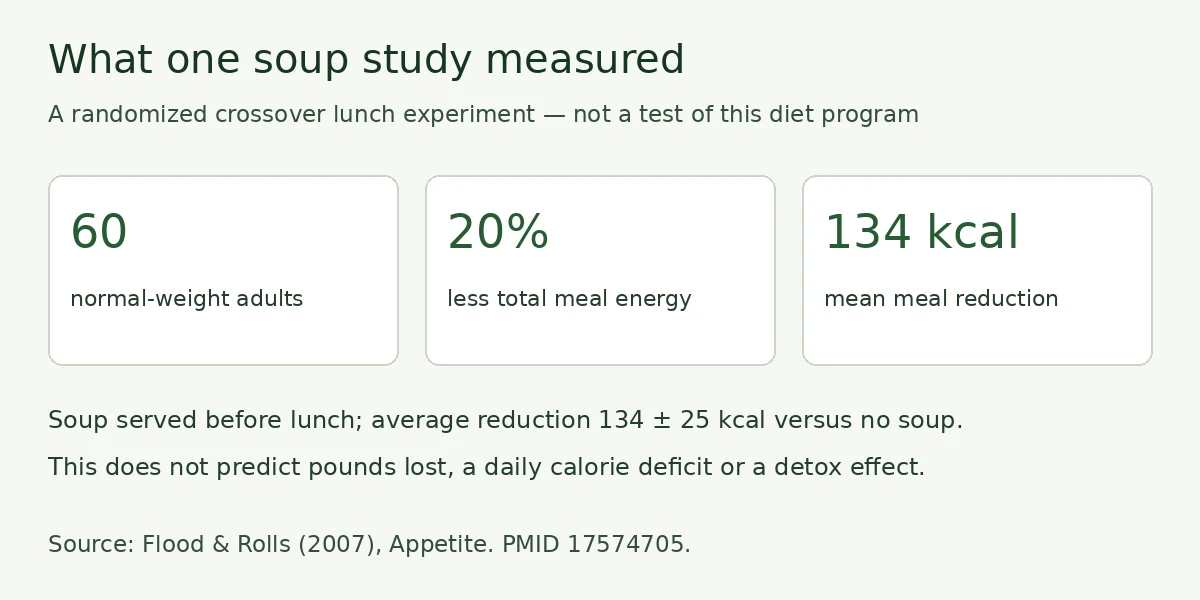
This is evidence for that meal strategy under experimental conditions, not for the exact commercial recipes, an all-day calorie reduction, adults with every medical condition, or long-term weight maintenance. The abstract was inspected; the full paper was not available through the research route used here.
Our November 7, 2026 product-name searches in PubMed-focused and ClinicalTrials.gov-focused web results did not locate a clinical trial of the complete branded program. That bounded search result belongs here; it does not establish that a useful recipe resource cannot help. It means the guide’s actual convenience and a sustainable eating routine should be evaluated separately from its numerical health promises.
Naude et al. (2022) [2] also found probably little to no average difference between low-carb and balanced-carbohydrate weight-reducing diets over follow-up up to two years. That broader review cannot establish which specific recipe version a buyer receives or how they will respond.
What is a realistic timeline for results?
Fullness at a meal, a change on a scale and sustained fat loss are different outcomes. The soup experiment measured lunch intake that day. It cannot be multiplied into a guaranteed two-week weight loss or used to validate the seller’s rapid-result testimonials.
| Observation window | Useful thing to assess | What it cannot establish |
|---|---|---|
| First meals | Do you enjoy the recipes and feel adequately fed? | A comfortable meal does not prove body-fat loss or a detox effect. |
| First two weeks | Can you shop, cook and maintain a suitable routine? | An early scale change is not a measurement of fat alone. |
| Longer term | Can you keep appropriate habits and obtain support when needed? | A short challenge does not itself prove maintenance. |
CDC (2025) [4] describes gradual loss of about 1–2 pounds weekly as more likely to be maintained. This is general guidance, not a promised rate from the guide. Discuss an appropriate goal and follow-up with your care team when health conditions or medicines affect the decision.
What makes this approach more or less useful?
The crucial variable is what the recipes help you do consistently. A soup collection can solve recipe boredom, but it cannot do the grocery shopping, guarantee appropriate portions or replace individualized care. If it simply adds extra food without changing an unsuitable overall pattern, the same outcome should not be expected.
- Taste and variety: pick meals you can enjoy beyond the initial challenge.
- Nutrition: check that the day supports your individual needs rather than assume “soup” means balanced.
- Preparation: account for time, storage and household preferences.
- Support: seek a more comprehensive program if ongoing monitoring or coaching is what you need.
For background on sustained habits, see our weight-loss research guide and NIDDK’s program-selection guidance [3]. For medicine and nutrition suitability, use the focused safety page.
Effectiveness conclusion
The current guide is most defensible as a practical recipe and planning aid. Soup research makes the fullness strategy plausible, while low-carb evidence allows several workable eating patterns. Consider the purchase if organized soup meals solve a real cooking problem for you, with expectations based on habits rather than headline pounds lost.
The full review covers the current offer, contents and broader buyer-fit assessment. You can check the current digital package below without treating its marketing claims as a personal forecast.
Frequently asked questions
Does blending soup make it work better?
The inspected experiment compared several forms, including chunky and pureed versions, and did not find a significant difference in total meal energy between soup forms. It does not establish a special blending method for this commercial program. Choose a texture you enjoy while checking the ingredients and complete meal.
Can I calculate two-week weight loss from the 134-kcal result?
No. That number was the average reduction at a controlled lunch, not a measured daily deficit or long-term change in body fat. Repeating or multiplying it assumes unchanged behavior and metabolism outside the experiment. The study did not test this purchased two-week program or guarantee a weight-loss total.
Does a low-carb recipe mean ketosis is guaranteed?
No. A low-carb label does not reveal your total daily carbohydrate intake or prove ketosis, and the current paid menus were not inspected here. More importantly, ketosis is not a guarantee of sustained weight loss. A suitable, maintainable eating pattern matters more than obtaining a particular label.
Do the testimonials establish typical results?
They do not. The seller selects the stories on its own page, and the people, adherence and other changes are not controlled as they would be in a trial. Testimonials can describe experiences, but they cannot supply a reliable average loss, success probability or causal estimate for another buyer.
Is the guide useful even without rapid weight loss?
It may be useful if the delivered recipes help you plan meals, cook more consistently and find foods you enjoy. Those are practical outcomes worth assessing separately. If the main goal is a specific medical or weight outcome, discuss appropriate targets and support rather than judge only a short-term scale change.
Explore this research series
References
- Flood & Rolls (2007). Soup preloads in a variety of forms reduce meal energy intake. Appetite. PMID 17574705. Abstract inspected.
- Naude et al. (2022). Low-carbohydrate versus balanced-carbohydrate diets for reducing weight and cardiovascular risk. Cochrane review summary.
- NIDDK. Choosing a Safe & Successful Weight-loss Program. Accessed November 7, 2026.
- CDC (2025). Steps for Losing Weight.
- NCCIH. Detoxes and Cleanses: What You Need To Know. Accessed November 7, 2026.