
EndoPeak Ingredients: Full Label, Amounts & Research Context
Affiliate disclosure: We may earn a commission through commercial links at no extra cost to you. Disclosure policy.
Official Website Offer: Save on 3 & 6-Bottle Bundles + 60-Day Money-Back Guarantee.
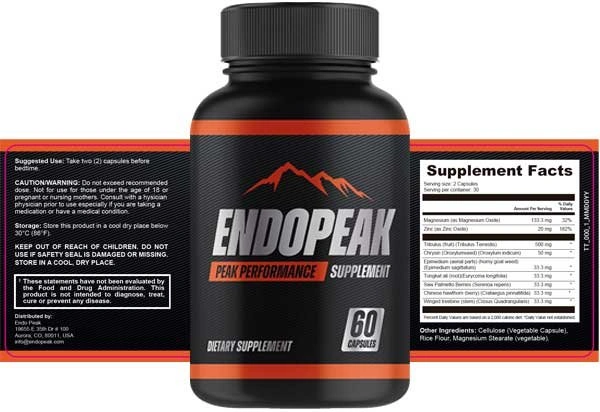
The complete EndoPeak ingredients panel
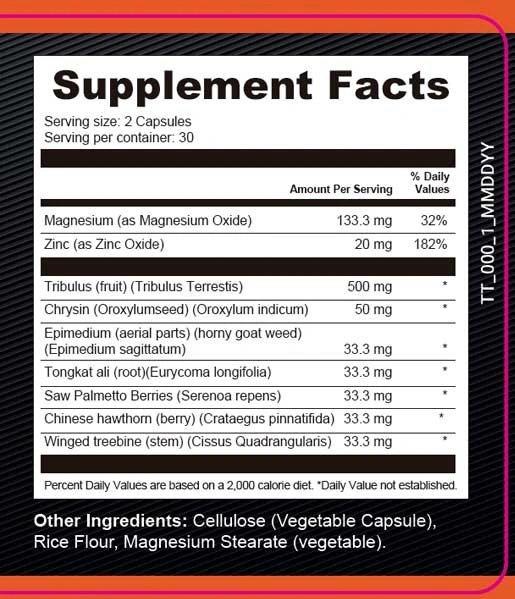
EndoPeak ingredients comprise nine dietary entries plus three other ingredients. Amounts below are per two-capsule serving, not per capsule. For the overall buying assessment, prices and score, see the EndoPeak reviews.
| Entry | Amount | Category | Printed form / part | What to check |
|---|---|---|---|---|
| Magnesium | 133.3 mg | Mineral | magnesium oxide | Review total supplemental intake. |
| Zinc | 20 mg | Mineral | zinc oxide | Nutrition support differs from hormone treatment. |
| Tribulus fruit | 500 mg | Botanical / named constituent | Tribulus terrestris | Preparation and amount matter. |
| Chrysin / Oroxylum material | 50 mg | Botanical / named constituent | label says “Chrysin (Oroxylumseed) (Oroxylum indicum)” | The panel does not quantify a standardized chrysin percentage. |
| Epimedium aerial parts | 33.3 mg | Botanical / named constituent | Epimedium sagittatum | An herb amount is not an icariin dose. |
| Tongkat ali root | 33.3 mg | Botanical / named constituent | Eurycoma longifolia | This root listing is not the studied extract. |
| Saw palmetto berries | 33.3 mg | Botanical / named constituent | Serenoa repens | Urinary outcomes are different from sexual performance. |
| Chinese hawthorn berry | 33.3 mg | Botanical / named constituent | Crataegus pinnatifida | Discuss use if taking heart medicines. |
| Winged treebine stem | 33.3 mg | Botanical / named constituent | Cissus quadrangularis | Do not infer a benefit from the botanical name alone. |
| Cellulose, rice flour, magnesium stearate | Amounts unspecified | Other ingredients | Vegetable capsule and excipients | Match personal sensitivities to the full label. |
How the ingredients relate to research
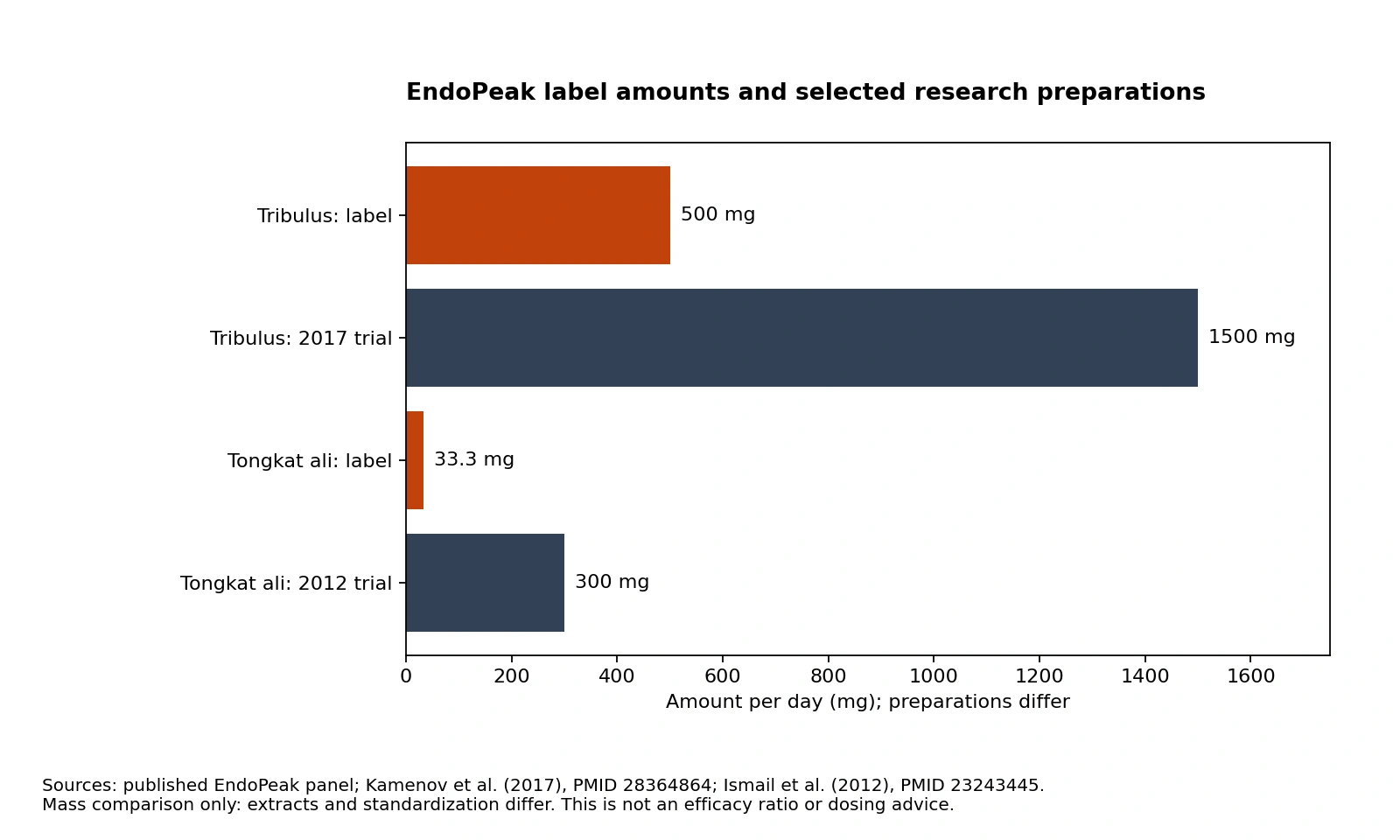
Amounts are transparent, but matching research also requires the same preparation. A milligram figure measures mass; it does not establish extract strength, absorbed exposure or an equivalent clinical effect. This is especially relevant to the two botanicals with the clearest sexual-wellbeing trial connection.
Tribulus and tongkat ali: useful comparisons
The panel’s 500 mg tribulus fruit differs from the 1,500 mg/day standardized herba extract in Kamenov’s 12-week trial of 180 men. Santos studied 800 mg/day for 30 days in 30 men without finding an advantage over placebo. The respective outcomes support careful comparison rather than a universal dose threshold. Kamenov (2017) [1] Santos (2014) [2]
The 33.3 mg tongkat ali root entry differs from 300 mg/day PHYSTA water extract in Ismail’s 12-week, 109-man trial. The printed mass is about one ninth of that extract’s mass, but raw-root and standardized-extract quantities are not potency equivalents. Do not increase the capsule serving to reproduce a trial. Ismail (2012) [3]
Mineral forms and the chrysin wording
Magnesium oxide and zinc oxide are identified directly, making total-intake checks possible. The amounts are nutrient quantities listed by the panel; they should not be read as evidence that every user needs more of either nutrient. NIH ODS: zinc [4] NIH ODS: magnesium [5]
The unusual “Chrysin (Oroxylumseed) (Oroxylum indicum)” row provides 50 mg of the listed material, without an extract ratio or standardized percentage. It should not automatically be described as 50 mg of isolated chrysin. Walle’s seven-volunteer study concerned isolated chrysin absorption, not EndoPeak or a testosterone outcome. Walle (2001) [10]
The remaining botanical roles
Epimedium is listed as aerial parts rather than a quantified icariin extract. Saw palmetto berries, Chinese hawthorn berry and Cissus stem each contribute 33.3 mg. Those identities help with suitability questions, but findings from different plant parts, species, extracts or health outcomes cannot simply be transferred. Cui (2015) [11] NCCIH: hawthorn [6] NCCIH: saw palmetto [7]
Capsule shell and other ingredients
The other-ingredients list names cellulose, rice flour and vegetable magnesium stearate. Cellulose is identified as the vegetable capsule. These are formulation components rather than additional declared sexual-wellbeing actives, and their separate quantities are not printed.
A vegetable capsule does not by itself establish a comprehensive vegan, allergen-free or independently certified product claim. If you have a specific sensitivity, send support the exact ingredient or allergen question and compare the reply with the bottle you receive.
Useful questions to take to a pharmacist
Bring the whole panel, rather than only the headline herb. That allows a medication review to consider the minerals and botanicals together. The safety guide explains the relevant tolerability and interaction context.
- Does this combination overlap with my multivitamin, magnesium or zinc supplement?
- Do my heart, blood-pressure, antibiotic or other medicines change its suitability or timing?
- Do my symptoms need assessment before I choose a wellness supplement?
Use the ingredient library for background and the men’s health guide for the broader care decision.
What the label means for your choice
The panel is useful because it permits an ingredient-by-ingredient decision. Its strongest transparency feature is the separate quantities. The next step is matching the actual plant preparations and your existing routine, rather than treating every printed amount as interchangeable with a research extract.
Frequently asked questions
Are the amounts per capsule or per serving?
Does EndoPeak contain a proprietary blend?
Is the chrysin row the same as purified chrysin?
Does the capsule contain gelatin?
Can I use study amounts to adjust the serving?
Explore the EndoPeak research series
Author and assessment method
Educational information only; not medical advice. A dietary supplement does not replace diagnosis or prescribed treatment.
We may earn a commission from purchases through commercial links at no extra cost to you. Read our affiliate disclosure.
References
- Kamenov et al. (2017). Tribulus randomized trial; PMID 28364864. Abstract assessed.
- Santos et al. (2014). Tribulus versus placebo; PMID 24630840. Abstract assessed.
- Ismail et al. (2012). PHYSTA trial in men; PMID 23243445. Abstract assessed.
- NIH Office of Dietary Supplements. Zinc: Health Professional Fact Sheet.
- NIH Office of Dietary Supplements. Magnesium: Health Professional Fact Sheet.
- NCCIH. Hawthorn: Usefulness and Safety.
- NCCIH. Saw Palmetto: Usefulness and Safety.
- Walle et al. (2001). Chrysin disposition in seven volunteers; PMID 11259985. Abstract assessed.
- Cui et al. (2015). Urologist’s guide to sexual-health nutraceutical ingredients; PMID 26531010. Abstract assessed.