
Explore the Oral Health Research Library
This pillar gives you the complete overview. Use the focused cluster guides below when you want a deeper explanation of one oral-health topic. Each guide is designed around a distinct search intent so it can expand the subject without repeating this pillar.
Choose a focused topic below for more detail, then return to this guide for the overall prevention and care pathway.
1. What Is Oral Health?
Oral health refers to the health and function of the teeth, gums, mouth and wider oral-facial system. A healthy mouth supports chewing, speaking, smiling and everyday comfort. It cannot be judged by tooth color alone.
Oral Health Is an Ecosystem
A useful model is teeth + gums + saliva + oral microorganisms + diet + hygiene + lifestyle + professional care. These systems interact continuously. Foods can alter the chemical environment, plaque organisms can produce acids, saliva helps buffer and clear acids, and preventive care can shift conditions toward protection.
2. Why Oral Health Matters
Tooth decay and periodontal disease can progress from subtle early changes to pain, infection, tissue destruction or tooth loss. Oral disease may also affect eating, speech and quality of life. Importantly, absence of pain does not guarantee absence of disease, which is why prevention combines home care with appropriate professional assessment.
3. A Brief History of Oral Health and Dentistry
Humans have used chewing sticks, powders, scraping tools and plant materials for oral cleaning for thousands of years. Modern dentistry developed as anatomy, microbiology, materials science, epidemiology and preventive medicine advanced.
From Repair to Prevention
Dental care gradually expanded beyond treating pain and extracting damaged teeth toward preventing disease through plaque control, fluoride, dietary guidance, periodontal care and routine assessment.
The Fluoride and Microbiome Eras
Twentieth-century research helped establish fluoride as a major caries-prevention tool. More recently, molecular methods have transformed understanding of the mouth from a simple collection of “good” and “bad” bacteria into a complex microbial ecosystem.
4. Anatomy of the Mouth
Teeth and Their Layers
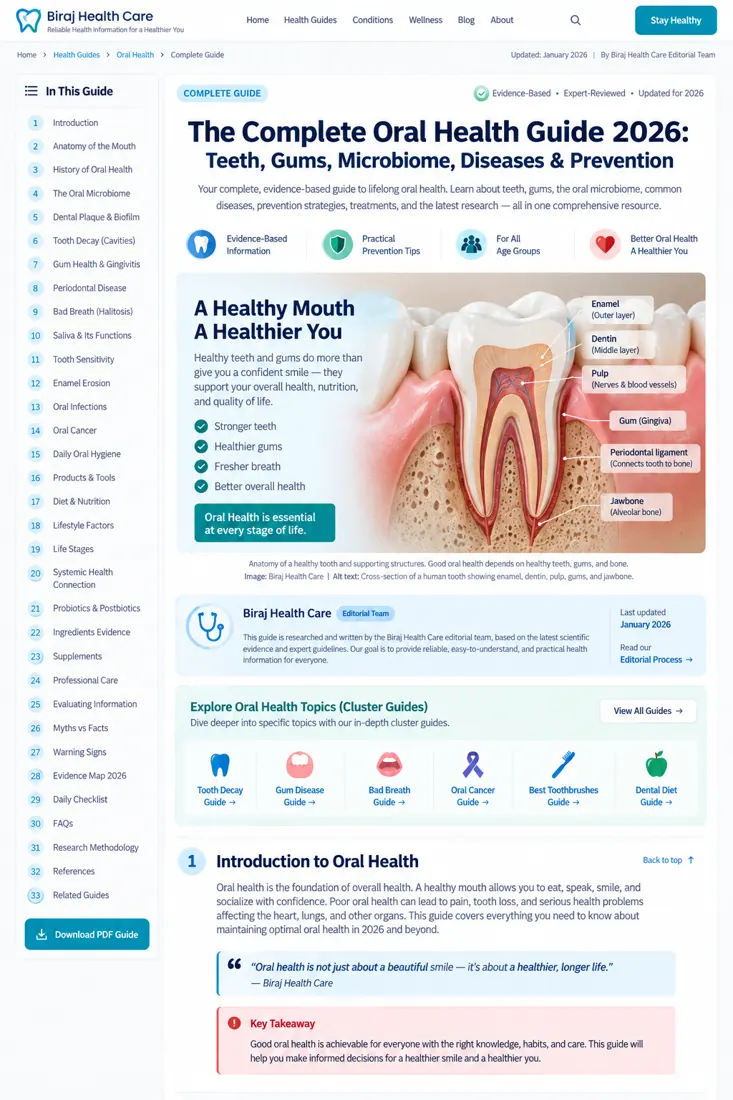
Incisors cut, canines tear, and premolars and molars crush and grind. The crown is protected by highly mineralized enamel. Beneath it lies dentin, while the pulp contains nerves, blood vessels and connective tissue. Roots anchor teeth below the gumline.
Gums, Tongue and Saliva
Gums and deeper periodontal tissues surround and support teeth. The tongue contributes to taste, chewing, swallowing and speech while providing a microbial habitat. Saliva lubricates tissues, clears food residues, buffers acids and supports the mineral environment around teeth.
5. Teeth Through the Lifespan
Oral-health needs change from primary teeth in childhood to permanent teeth, adulthood and aging. Children develop hygiene skills; teenagers may face orthodontic and dietary challenges; adults accumulate caries and periodontal exposures; and older adults may experience recession, dry mouth, medications, dexterity limitations, restorations or dentures.
6. The Oral Microbiome
The mouth contains complex communities of bacteria, fungi, viruses and other microorganisms living on teeth, the tongue, gums, saliva and oral tissues.
Not All Oral Bacteria Are Harmful
A healthy mouth naturally contains microorganisms. Disease reflects interactions among microbial communities, host factors and environmental conditions rather than the mere presence of bacteria.
Dysbiosis and Commercial Claims
Dysbiosis generally describes an unfavorable microbial shift associated with disease. Claims that a product “balances,” “resets” or “restores” the oral microbiome require clinical evidence. Evidence for one strain, dose or delivery system cannot automatically be generalized to another.
7. Dental Plaque, Biofilm and Tartar
Dental plaque is an organized microbial biofilm, not simply food stuck to teeth. A simplified progression is clean surface → microbial attachment → colonization → maturing biofilm → accumulated plaque.
Plaque vs Tartar
Plaque can be disrupted by effective daily cleaning. Tartar, or calculus, is mineralized hardened buildup and generally requires professional removal.
8. Tooth Decay and Cavities
What the dental exam needs to establish
A white spot, stain or sensitive tooth cannot be diagnosed from a photograph alone. A dentist assesses lesion activity, whether the surface is intact, its location and your overall risk; X-rays may help when clinically indicated. Treatment decisions depend on those findings, not simply whether the tooth hurts.
Prevention, arrest and repair are different goals
Early intact lesions may be managed through fluoride and changes in risk factors. Depending on the site, a clinician may offer varnish, sealants or resin infiltration. Some cavitated lesions can be arrested with silver diamine fluoride, which can permanently darken decayed areas; informed consent and follow-up matter. Other lesions need restorations. These options do not mean a tablet can regrow missing tooth structure, and a root canal or extraction decision requires an examination. [ADA caries guideline]
Certain plaque microorganisms metabolize fermentable carbohydrates and produce acids. Repeated acid challenges can cause mineral loss from enamel.
Fermentable carbohydrates → microbial metabolism → acids → lower local pH → mineral loss → early caries lesion → structural cavity.
Early mineral changes and an established cavity are not the same. Preventive measures may arrest or reverse early mineral loss, while a cavity with lost tooth structure may require restorative treatment.
9. Demineralization and Remineralization
Demineralization occurs when acidic conditions favor mineral loss. Remineralization describes mineral return to weakened tooth surfaces when conditions become more protective. Saliva and fluoride can support this process. Caries risk rises when repeated mineral loss exceeds repair.
10. Fluoride and Dental Health
Use the right delivery and amount
Fluoride toothpaste and swallowed fluoride supplements are different interventions. ADA guidance advises a rice-grain-sized smear from the first tooth until age 3, and a pea-sized amount at ages 3–6, with caregiver supervision. Adults brush twice daily for about two minutes. Follow the product label and your dentist’s advice; do not swallow toothpaste. Higher-strength prescription products are selected for particular risks, not automatically better for everyone.
Excess swallowed fluoride during tooth development can cause fluorosis. Fluoride supplements need a clinician’s assessment of age, caries risk and fluoride in the main drinking water. They should not be added casually to an existing routine. Questions about water policy do not make topical fluoride toothpaste and unrestricted ingestion interchangeable. [ADA fluoride guidance]
Fluoride is one of the most established tools for caries prevention. It can support remineralization and increase resistance to future acid-related mineral loss. It is commonly delivered through fluoride toothpaste and, depending on context, mouth rinses, professional applications or fluoridated water.
Fluoride is part of a preventive system rather than a replacement for plaque control, interdental cleaning, dietary management and professional care.
11. Gum Health
Plaque accumulation around the gumline can contribute to inflammation. Possible signs include redness, swelling, tenderness and bleeding. Persistent bleeding—particularly with recession, bad breath, discomfort or mobility—deserves attention.
12. Gingivitis vs Periodontitis
Why a periodontal examination matters
Diagnosis combines gum examination, pocket measurements, attachment assessment, medical history and, when needed, X-rays of supporting bone. A home bleeding check cannot determine disease stage. Treatment may include professional cleaning below the gumline, instruction in suitable home tools and regular maintenance; advanced cases may need specialist or surgical care. A rinse or supplement does not remove hardened deposits or replace that care. The aim is to control disease and preserve teeth, rather than promise that lost supporting tissue automatically grows back. Smoking, diabetes and other risk factors affect the plan. [NIDCR periodontal care]
Gingivitis primarily involves gum inflammation and can be reversible with effective plaque control and appropriate care. Periodontitis is more serious and involves destruction of tooth-supporting tissues, including bone loss.
| Feature | Gingivitis | Periodontitis |
|---|---|---|
| Gum inflammation | Yes | Yes |
| Bleeding may occur | Yes | Yes |
| Supporting bone loss | No | Yes |
| Reversibility | Generally reversible | Damage is not simply reversed; disease can be managed |
| Professional assessment | May be needed | Required for diagnosis/management |
13. Bad Breath
Halitosis may be temporary or persistent. Potential contributors include tongue coating, plaque, gum disease, dry mouth, tobacco, foods, dental problems and some non-oral conditions. Mints and cosmetic rinses may mask odor without addressing its cause.
14. Saliva and Dry Mouth
Find the cause before buying a breath product
Persistent dryness is not an inevitable part of aging. Bring a medication and supplement list to your dentist or doctor; they may assess causes and salivary flow. Sip water as appropriate, consider sugar-free gum if you can chew safely, and ask about saliva substitutes and additional caries prevention. Avoid treating dryness with frequent sugary sweets. Do not stop prescribed medicines yourself. Sores, recurrent fungal infection, trouble swallowing or rapid new decay make assessment more important. A product that briefly moistens the mouth may improve comfort without correcting the underlying problem. [NIDCR dry mouth]
Saliva supports lubrication, swallowing, clearance, acid buffering, oral-tissue protection and the mineral environment around teeth. Reduced salivary flow can increase oral-health challenges. Medications, health conditions and other factors may contribute to persistent dry mouth.
15. Tooth Sensitivity
Sensitivity may be associated with exposed dentin, recession, decay, erosion, cracks or dental procedures. Desensitizing products may help some people, but persistent or unexplained sensitivity deserves assessment because symptom relief does not identify the cause.
16. Tooth Erosion and Wear
Grinding and jaw symptoms need assessment too
Bruxism can contribute to tooth wear, fractures or jaw muscle symptoms. A dental examination can assess damage and possible contributors; a guard may protect teeth without proving that the grinding has stopped. Stress-related care and sleep assessment may be relevant in selected cases. Snoring with breathing pauses needs its own evaluation, rather than being treated as ordinary clenching. [NIDCR bruxism] · Sleep & Stress Guide
Acid exposure needs its own plan
Reflux, repeated vomiting and dietary acids can contribute to erosion. Sugar-free acidic drinks can still damage tooth surfaces through this route. Reduce prolonged sipping and swishing, rinse with water after acid exposure, and avoid brushing immediately after vomiting or acidic drinks. Repeated vomiting or reflux also deserves medical care. Cleaning harder does not restore tooth shape already lost to wear; a dentist can assess protective and restorative options. [ADA erosion guidance]
Not all tooth-surface loss is decay. Erosion involves chemical loss from non-bacterial acids; attrition involves tooth-to-tooth wear; and abrasion involves external mechanical forces. These processes can coexist.
17. Common Oral Diseases and Conditions
Dental Caries
Progressive mineral and structural damage associated with acid-producing plaque activity.
Gingivitis and Periodontitis
Inflammatory periodontal conditions ranging from reversible gum inflammation to destructive disease involving supporting tissues.
Tooth Loss, Infections and Trauma
Advanced caries, periodontal disease, infections and trauma can threaten tooth retention and may require prompt professional treatment.
Oral Ulcers and Candidiasis
Many ulcers resolve, but persistent or unusual lesions require evaluation. Oral candidiasis is a fungal condition that can arise under particular circumstances.
18. Oral Cancer Awareness
Use a clear time threshold: NIDCR advises evaluation when an unexplained sore, patch, lump or related symptom persists for more than two weeks. Seek help sooner for progressive or serious symptoms; do not wait for a deadline if swallowing or breathing is affected. These signs often have other explanations, but a supplement, mouthwash or self-check cannot rule out cancer. Ask about an oral tissue examination even if you have no natural teeth. [NIDCR symptom guidance]
Internet checklists cannot diagnose oral cancer. Persistent sores, unexplained patches, lumps, bleeding, numbness, swallowing difficulty or other unexplained tissue changes should be professionally evaluated. Tobacco and alcohol are important modifiable risk factors.
19. Daily Oral Hygiene
A routine you can actually follow
- Brush twice daily, including before bed, with fluoride toothpaste and a soft brush. Clean the outer, inner and chewing surfaces gently for about two minutes.
- Spit out excess toothpaste. NHS guidance recommends avoiding an immediate water rinse to preserve fluoride; use any prescribed rinse according to its own instructions.
- Clean between teeth daily with a tool that fits your spaces and dexterity. Ask for a demonstration rather than forcing an oversized brush.
- If breath is a concern, clean the tongue gently and investigate persistent odor, bleeding or dryness.
Choose a manual or powered brush you can use consistently. A powered device does not replace technique, and pressure should not cause repeated tissue injury. [NHS brushing guidance]
Recommendation strength and trial certainty are different
Interdental cleaning is a standard component of dental guidance, but comparative outcome evidence is less certain than broad marketing suggests. A 2019 Cochrane review included 35 studies and 3,929 adults: floss or interdental brushes may reduce gingivitis alongside brushing, with mostly low or very-low certainty evidence. No included trial evaluated caries, and long-term severe-disease outcomes were sparsely studied. Choose a feasible tool with professional guidance rather than assume one device is proven best for everyone. [Cochrane review]
Brush Effectively
Brush twice daily with an appropriate toothbrush and fluoride toothpaste, using gentle, systematic cleaning rather than aggressive scrubbing.
Clean Between Teeth
Floss, interdental brushes, water flossers or other appropriate devices can reach areas a toothbrush may miss. The best method can depend on spacing, dexterity, restorations, orthodontics and periodontal needs.
Tongue and Professional Care
Gentle tongue cleaning may help with coatings and breath odor. Home care does not replace professional assessment or calculus removal.
20. Toothpaste, Mouthwash and Oral-Care Products
Whitening is a separate goal: surface-stain removal and peroxide bleaching differ, and neither diagnoses dental health. ADA notes insufficient safety and benefit evidence for charcoal whitening methods. Avoid acid-based DIY whitening; sensitivity or irritation is a reason to review the plan. [ADA whitening evidence]
Choose by the problem, not the advertising adjective
Cosmetic rinses mainly freshen temporarily; therapeutic rinses contain active ingredients for specific outcomes. Fluoride, CPC, essential oils and prescribed chlorhexidine serve different purposes. Children under 6 should not use rinses unless a dentist directs them. Follow dose and timing instructions, do not swallow, and discuss staining, irritation or an unsuitable taste with your dental team. A stronger antimicrobial rinse is not automatically the best long-term choice. [ADA mouthrinse guidance]
Different products have different purposes. Fluoride toothpaste targets caries prevention; sensitivity formulations use specific desensitizing mechanisms; whitening toothpastes mainly address external stains; and hydroxyapatite products are studied for mineralization-related applications.
Marketing Claim vs Evidence
“Natural” does not automatically mean safer or more effective.
“Clinically studied ingredient” does not mean the finished product was clinically tested.
“Microbiome-friendly” needs evidence relevant to the actual formulation and outcome.
21. Diet and Oral Health
Amount and frequency both matter
WHO advises keeping free sugars below 10% of daily energy, with a further reduction below 5% offering additional caries protection. Free sugars include added sugars plus those in honey, syrups and fruit juice; juice is not equivalent to intact fruit. On a 2,000-calorie example, 10% equals about 50 g and 5% about 25 g—illustrations, not an individualized diet prescription. Replacing all-day sweet-drink sipping with water is a practical starting step. A low-sugar claim does not answer whether a drink is acidic. [WHO sugar guidance]
Frequent exposure to free sugars and fermentable carbohydrates can support repeated acid production and caries development. Frequency matters because repeated exposures create repeated acid challenges. Acidic beverages can also contribute to erosion through a different mechanism. Water is generally a better routine beverage choice than sugar-sweetened drinks.
22. Tobacco, Vaping and Lifestyle Factors
Smoking is strongly associated with periodontal disease and is a major oral-cancer risk factor. Smokeless tobacco can also harm oral health. Evidence on long-term vaping outcomes continues to develop, so established findings should be separated from emerging evidence. Alcohol exposure also matters in oral-cancer risk.
23. Oral Health Through Different Life Stages
Start dental care early: ADA advice places the first visit after the first tooth appears and no later than the first birthday. Caregiver help and supervised brushing matter; do not wait for pain or school age to seek preventive advice. [ADA first dental visit]
Pregnancy, dentures and extra support
Pregnancy is not a reason to postpone necessary dental treatment. ADA guidance supports preventive, diagnostic and restorative care throughout pregnancy, including needed urgent care. Tell the dentist about pregnancy and medical complications so medicines and procedures can be coordinated. After vomiting, rinse rather than brush immediately. [ADA pregnancy guidance]
For dentures, continue cleaning oral tissues and remaining teeth. Remove dentures overnight unless your dentist advises otherwise, use a denture-compatible cleaning method and have painful or loose dentures assessed. Abrasive toothpaste can damage dentures. Implants, bridges and orthodontic appliances also require a cleaning plan suited to their design; none makes surrounding tissues immune to disease. [NHS denture care]
Children: early preventive habits and care for primary and newly erupted permanent teeth matter. Teenagers: diet, orthodontics, sports and tobacco/vaping exposure can introduce new risks. Adults: caries and periodontal disease remain relevant. Pregnancy: oral conditions may change and preventive care remains important. Older adults: recession, root caries, dry mouth, medications, dexterity and dentures may require tailored care.
24. Oral Health and General Health
Diabetes: a treatment question with clinical outcome data
A 2022 Cochrane review of periodontal treatment included 35 trials with 3,249 participants, mostly with type 2 diabetes and periodontitis. Moderate-certainty evidence found an average HbA1c reduction of about 0.43 percentage points at 3–4 months compared with no active treatment or usual care. Its evidence search ended in September 2021. This concerns professional periodontal treatment, not an oral supplement, and does not replace diabetes medicines or medical follow-up. It also does not prove that treating gum disease prevents every cardiovascular outcome. [Cochrane diabetes review]
Oral and general health interact, but association should not be confused with causation. Diabetes and periodontal health have clinically important relationships. Associations with cardiovascular disease have been observed, but they do not prove that periodontal disease directly causes cardiovascular events. Medications can also affect the mouth, particularly by reducing salivary flow.
25. Oral Probiotics, Prebiotics and Postbiotics
What newer reviews add—and what they cannot establish
A 2024 network meta-analysis included 33 articles involving 1,290 patients and found potential benefits from some probiotic interventions used with professional periodontal treatment. Its trial search ran through November 2023; an adjunctive finding is not proof that supplements alone treat periodontitis. [2024 network review]
A 2025 scoping review mapped 66 clinical studies, more than 30 probiotics and 18 delivery methods. Doses, durations, delivery and outcomes varied substantially. Mapping a literature is different from producing a reliable pooled treatment estimate; the authors considered that variability a barrier to recommending a uniform protocol. Compare the exact strain and formulation, not just a species name or a large CFU number. [2025 scoping review]
Under the ISAPP consensus, a postbiotic preparation must contain inanimate microorganisms or their components and demonstrate a health benefit. A purified metabolite alone is not automatically a postbiotic. The definition is not a clinical recommendation for oral disease or evidence for a particular branded blend. Non-living also does not guarantee that every preparation is harmless. [ISAPP consensus]
Probiotics
Live microorganisms intended to provide a health benefit when appropriately administered. Oral evidence may depend on strain, dose, delivery, duration, population and outcome.
Prebiotics
Substrates selectively used by microorganisms in ways intended to provide health benefits. Oral applications are developing.
Postbiotics
Preparations of inanimate microorganisms and/or their components with a demonstrated health benefit. Oral applications remain an emerging area; a category label alone is not proof for a commercial formula.
Evidence for one strain or ingredient is not automatically evidence for every commercial formula containing something similar.
26. Oral-Health Ingredients: Evidence Overview
Two useful examples of evidence limits
Hydroxyapatite: an 18-month adult randomized trial compared a specific fluoride-free toothpaste with 1,450 ppm fluoride toothpaste; 189 adults entered the intention-to-treat analysis. It reported noninferiority for its primary caries endpoint using a predefined 20% margin. Noninferiority under that design is not superiority, regrowth of missing enamel or proof for every formulation. Several authors had manufacturer research affiliations; that context belongs in the interpretation. [2023 toothpaste trial]
Xylitol: the 2015 Cochrane review found low-quality evidence for one xylitol-containing fluoride toothpaste comparison in children, while evidence for many other xylitol products was insufficient. Its age matters, and its narrow result should not become a universal supplement claim. Sugar-free gum can support saliva, but a xylitol label alone does not guarantee cavity prevention. [Cochrane xylitol review]
| Ingredient/Approach | Common Intended Use | Evidence Context | Key Limitation |
|---|---|---|---|
| Fluoride | Caries prevention/remineralization | Established | Formulation and appropriate use matter |
| Hydroxyapatite | Mineralization-related uses | Growing research | Products/formulations vary |
| Xylitol | Caries-related prevention | Mixed/context dependent | Dose and exposure protocols differ |
| CPC | Plaque/breath applications | Product dependent | Formulation and outcome matter |
| Zinc compounds | Breath/plaque applications | Product dependent | Cannot generalize to every formula |
| Potassium nitrate | Sensitivity | Established use | Does not diagnose the cause |
| Oral probiotics | Microbiome applications | Emerging/growing | Highly strain-specific |
| Oral postbiotics | Microbiome applications | Emerging | Product-specific evidence may be limited |
27. Supplements and Oral-Health Claims
Higher-risk users need individualized advice: NCCIH notes that probiotic harms may be more likely in people with severe illness or compromised immunity, while detailed safety data are limited. Discuss an oral probiotic with the treating clinician in those circumstances; “natural” and “beneficial bacteria” are not safety guarantees. A non-living preparation also needs its own formulation and safety evidence. [NCCIH probiotic safety]
Supplements may contain vitamins, minerals, herbal extracts, probiotics, postbiotics or other specialty ingredients. The presence of an ingredient alone does not establish finished-product effectiveness.
Mechanism → laboratory evidence → human evidence → relevant dose/form → finished-product clinical evidence. These are different evidence levels.
28. How to Evaluate an Oral-Health Product
1. Identify the Exact Ingredient
Look for the actual strain, compound, form or preparation.
2. Check the Amount
Determine whether dose or concentration is disclosed.
3. Check the Delivery Route
Evidence from a swallowed capsule cannot automatically be transferred to a topical dental product, or vice versa.
4. Look for Human Evidence
Laboratory and animal studies can support mechanisms but cannot establish human clinical effectiveness alone.
5. Look for Finished-Product Evidence
Ask whether the actual commercial formula was studied or only selected ingredients.
6. Examine Safety
Consider warnings, adverse effects, allergies, interactions and populations needing professional guidance.
7. Compare Claims With Evidence
Check whether the marketing conclusion is stronger than the research supports.
Continue Exploring Oral Health
Choose the path that matches what you want to explore next. Use the Oral Health section for broader educational content, or browse the dedicated reviews hub when you want to research oral-health products.
This guide remains educational; individual product reviews are organized separately so new reviews can be added over time without changing the pillar structure.
29. Common Oral-Health Myths
White teeth always mean healthy teeth.
Tooth color alone cannot establish oral health.
Bleeding gums are always normal.
Persistent bleeding can indicate inflammation and should not simply be ignored.
Mouthwash replaces brushing.
Mouthwash does not replace effective mechanical plaque removal.
Every oral bacterium is harmful.
Microorganisms naturally inhabit the mouth.
Natural means safer.
Safety depends on the substance, dose, formulation, individual circumstances and evidence.
A clinically studied ingredient makes a product clinically proven.
Ingredient-level and finished-product evidence are different.
30. When to See a Dentist
Urgent dental contact: severe pain, facial swelling, fever with dental symptoms, trauma or a knocked-out permanent tooth.
Arrange assessment: persistent bleeding, dryness, bad breath, sensitivity, loose teeth or an unexplained lesion; lesions lasting over two weeks require evaluation.
Antibiotics are not a substitute for treating the tooth
ADA guidance recommends dental treatment rather than antibiotics for most pulpal or localized periapical problems in immunocompetent adults. Systemic signs such as fever or malaise can change that decision. A dentist must assess the situation; do not use leftover antibiotics or postpone necessary drainage or tooth treatment. [ADA antibiotic guideline]
A knocked-out tooth is time-sensitive
For a permanent tooth, handle the crown rather than the root, keep it moist and seek immediate dental help. If immediate safe replantation is not possible, milk is a practical transport medium. Do not let it dry out or scrub the root. Never replant a knocked-out baby tooth. If you are unsure which tooth it is, contact emergency dental care immediately; do not put a loose tooth in a young child’s mouth. [IADT emergency advice]
Do I need a check-up every six months?
Recall is individualized. NHS guidance allows routine intervals from 3 months to 2 years for adults according to risk, with shorter maximum intervals for children. That is a risk-based model, not a reason to delay new symptoms or a replacement for treatment and periodontal-maintenance appointments. Ask your dentist what your own interval is and why. [NHS recall guidance]
Seek professional evaluation for persistent or severe tooth pain, oral/facial swelling, infection signs, persistent gum bleeding, loose permanent teeth, significant recession, broken teeth, unexplained sensitivity, persistent dry mouth, unresolved sores/tissue changes, swallowing difficulty, unexplained bleeding or persistent bad breath.
31. FitnessLifeMag Oral Health Evidence Map 2026
| Topic | Evidence Category | Practical Interpretation |
|---|---|---|
| Regular toothbrushing | Established | Core plaque-control practice |
| Fluoride toothpaste for caries prevention | Established | Core preventive measure |
| Interdental cleaning | Recommended in guidance; comparative trials mostly low certainty | Fit the tool to the person; long-term trial outcomes are limited |
| Limiting frequent free-sugar exposure | Established | Important caries-prevention strategy |
| Tobacco avoidance | Established | Important for periodontal and broader oral health |
| Hydroxyapatite products | Growing | Evaluate formulation and comparative evidence |
| Oral probiotics | Emerging/growing | Strain and outcome specific |
| Oral postbiotics | Emerging | Avoid generalizing early evidence |
| Broad “microbiome balancing” claims | Insufficient without product evidence | Examine actual formula and trials |
32. Practical Oral-Health Checklist
Your next two weeks: improve the routine, not self-diagnose
Today: check warning signs first, list medicines and supplements, and identify one barrier to brushing or interdental cleaning.
This week: make the daily routine feasible, replace repeated sweet-drink sipping with water, and ask a dental team to demonstrate a suitable tool if needed.
Over the next two weeks: note persistent bleeding, dryness, pain or lesions and arrange assessment rather than repeatedly changing products. Improvement in taste or breath does not prove cavities or periodontitis are resolved.
Every Day
☐ Brush effectively twice daily with fluoride toothpaste.
☐ Clean between teeth regularly.
☐ Limit frequent free-sugar exposure.
☐ Choose water routinely.
☐ Notice persistent changes.
☐ Avoid tobacco.
Over Time
☐ Replace worn toothbrushes or brush heads.
☐ Maintain professional care appropriate to your needs.
☐ Discuss persistent dry mouth or sensitivity.
☐ Reassess oral care when medications or health circumstances change.
☐ Use protective equipment for relevant sports/activities.
33. Frequently Asked Questions
Can a supplement repair a cavity or remove tartar?
No supplement should be relied on to restore a structural cavity or remove hardened calculus. Early lesion arrest and remineralization are different from regrowing lost tooth structure; professional assessment determines the treatment.
Should I stop fluoride toothpaste when trying an oral probiotic?
Do not replace established preventive care solely because a supplement is marketed as microbiome-friendly. If a product conflicts with your dental treatment or instructions, ask the dental team rather than discontinue care yourself.
Is a postbiotic just any bacterial extract?
No. The consensus definition requires the relevant inanimate microorganisms or components and a demonstrated health benefit. A category label does not establish a branded oral formula’s effectiveness.
Can I wait until my next check-up if my mouth hurts?
Routine recall intervals do not apply to new concerning symptoms. Contact dental care sooner; spreading swelling or trouble breathing or swallowing needs emergency attention.
What is the best way to maintain good oral health?
Build around effective twice-daily brushing with fluoride toothpaste, interdental cleaning, limiting frequent sugar exposure, avoiding tobacco and appropriate professional care.
What causes cavities?
Caries develops when repeated acid production contributes to mineral loss faster than protective processes can compensate.
Can early tooth decay be reversed?
Early mineral loss may sometimes be arrested or reversed; established cavities with lost tooth structure are different and may need restoration.
Why do gums bleed?
Plaque-related inflammation is common, but persistent bleeding deserves professional assessment.
Is gingivitis the same as periodontitis?
No. Gingivitis primarily involves gum inflammation; periodontitis involves destruction of supporting tissues and bone.
What is the oral microbiome?
It is the collection of microbial communities occupying different habitats throughout the mouth.
Are all oral bacteria bad?
No. Microorganisms naturally inhabit a healthy mouth.
Do oral probiotics work?
Evidence varies by strain, outcome, dose, population and product; one probiotic cannot be generalized to all others.
What are oral postbiotics?
They generally involve preparations of inanimate microorganisms and/or their components intended to provide health benefits; oral applications remain emerging.
Does mouthwash replace brushing or flossing?
No. It may serve specific purposes but does not replace mechanical plaque control.
Is fluoride useful for teeth?
Fluoride is well established for caries prevention and supporting remineralization.
Does sugar cause cavities?
Frequent fermentable-carbohydrate exposure contributes to acid production in plaque and the caries process.
Can supplements replace brushing?
No. Supplements do not replace plaque control, evidence-based preventive care or necessary professional treatment.
34. How We Research Oral Health
FitnessLifeMag uses an evidence-first approach. Foundational claims prioritize established public-health and professional guidance. Intervention questions prioritize systematic reviews, randomized trials and relevant human research. Laboratory evidence is used to explain mechanisms, not as proof of human clinical benefit.
Evidence Hierarchy
Clinical guidance → systematic reviews/meta-analyses → randomized controlled trials → other human research → mechanistic/laboratory evidence → manufacturer claims.
Our core rule: Claim → Evidence → Limitation → Practical Meaning.
Manufacturer information may verify ingredients, directions, pricing or guarantees, but is not treated as independent proof of efficacy.
Evidence review: October 8, 2026. This is a focused editorial review of selected public-health guidance, clinical guidelines, systematic and scoping reviews, and trials. It is not an exhaustive systematic review or independent clinician peer review. Publication dates and the original reviews’ search dates are distinguished; new publication does not guarantee high-certainty evidence. Read our editorial methodology and sources policy.
35. References and Further Reading
This guide prioritizes authoritative public-health and dental sources for foundational claims. More specialized cluster guides should add systematic reviews and human clinical studies specific to their narrower topic.
- World Health Organization — Oral Health — global burden, major oral conditions and modifiable risk factors.
- NIDCR — Tooth Decay — caries process, early demineralization, remineralization and treatment.
- NIDCR — Oral Hygiene — plaque control, brushing, interdental cleaning and tartar.
- NIDCR — Periodontal (Gum) Disease — plaque, tartar, risk factors, symptoms and treatment.
- CDC — Periodontal (Gum) Disease — gingivitis versus periodontitis and bone loss.
- CDC — About Fluoride — fluoride mechanism and cavity prevention.
- NIDCR — Fluoride & Dental Health — fluoride sources, enamel and early decay.
Clinical guidance and research added in this review
- ADA: fluoride use and toothpaste amounts
- NHS: toothbrushing and fluoride retention
- Cochrane 2019: interdental devices
- ADA 2018: nonrestorative caries treatment
- NIDCR: dry mouth
- NIDCR: oral cancer symptoms
- ADA: dental erosion
- ADA: mouthrinse
- WHO: sugars and dental caries
- ADA: pregnancy and dental care
- Cochrane 2022: periodontal treatment and diabetes
- Mendonça et al. 2024: probiotic network meta-analysis
- 2025 scoping review: probiotic delivery and heterogeneity
- ISAPP 2021: postbiotic consensus definition
- Paszynska et al. 2023: hydroxyapatite toothpaste trial
- Cochrane 2015: xylitol and caries
- NHS: risk-based dental recall
- ADA 2019: dental pain, swelling and antibiotics
- IADT: knocked-out tooth emergency advice
- NHS: dentures care