
Yu Sleep Honest Review 2026: Does This Natural Sleep Supplement Really Work?
If you’ve been lying awake at night wondering why you’re exhausted but still can’t seem to switch your brain off, you’ve probably come across dozens of sleep supplements promising deeper rest, faster sleep, and better mornings.
The problem is that sleep supplements are not all created equal.
Some rely almost entirely on melatonin. Others combine herbs and amino acids without clearly explaining why each ingredient is included. And some make impressive claims while providing very little information that allows consumers to evaluate those claims.
That raises a reasonable question:
Does Yu Sleep actually deserve a place in your nighttime routine, or is it simply another sleep supplement with better marketing?
That’s what this Yu Sleep honest review is designed to answer.
Rather than treating the manufacturer’s marketing claims as proof, we’ll look at what Yu Sleep is, what the current formula contains, what individual ingredients are known for, where the scientific evidence is strong or limited, how to take it, possible side effects, how it compares with a basic melatonin approach, what the current offer looks like, and which type of person may — or may not — want to consider it.
One important limitation should be clear from the beginning: evidence supporting individual ingredients is not the same as clinical evidence proving that the finished Yu Sleep formula works as advertised.
That distinction matters with almost every multi-ingredient supplement.
Table of Contents
Quick Verdict
TL;DR:
- Multi-ingredient formula (melatonin, L-theanine, GABA, 5-HTP, tart cherry, B6, B12) instead of melatonin alone
- Individual ingredients have research behind them; the finished formula does not have a published clinical trial
- Exact per-ingredient dosages are not fully public, making it hard to compare to studied amounts
- Not a treatment for diagnosed insomnia or sleep disorders
- Best viewed as an add-on to good sleep habits, not a replacement for them
Yu Sleep is a legitimate sleep-support supplement with a reasonably interesting multi-ingredient formula, but it should not be treated as a clinically proven treatment for insomnia.
Its biggest strength is the combination of melatonin, L-theanine, GABA, 5-HTP, tart cherry, and B vitamins.
Its biggest weakness is limited publicly available information about the exact amount of each active ingredient in the current formula, which makes it difficult to compare the product directly with clinical study doses.
Our overall take: Worth researching for adults looking for additional nighttime sleep support, but expectations should remain realistic.
Want to see the full ingredient panel and current pricing for yourself before reading further?
What Is Yu Sleep?
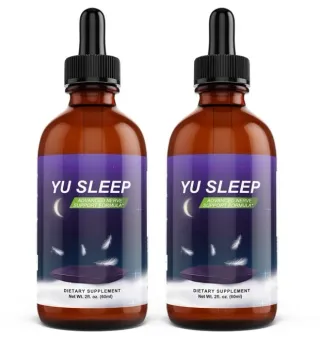
Yu Sleep is marketed as a natural dietary supplement intended to support nighttime relaxation and healthy sleep.
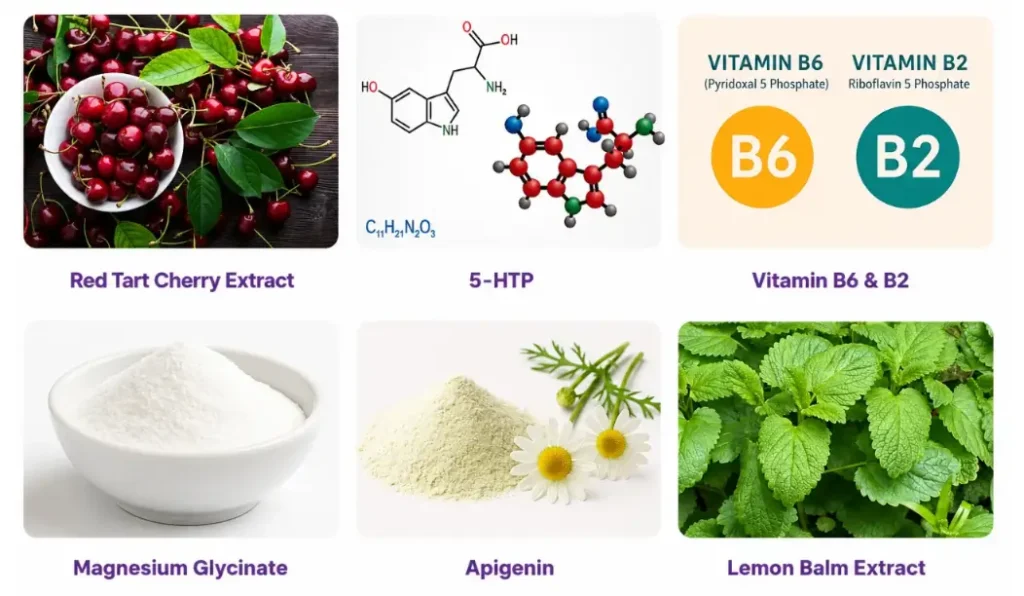
The current official ingredient information describes a formula built around several different types of ingredients rather than relying on melatonin alone. These include:
- Red Tart Cherry Extract
- 5-HTP
- L-Theanine
- GABA
- Vitamin B6
- Vitamin B12
- Melatonin
The basic idea behind the formula is understandable.
Sleep isn’t controlled by one single mechanism.
Your sleep-wake cycle involves timing signals, neurotransmitters, relaxation, environmental cues, and daily habits. Yu Sleep therefore attempts to approach nighttime support from several directions rather than using only one ingredient.
That doesn’t automatically mean the combination is superior.
A multi-ingredient formula can be useful, but it also makes it harder to determine which ingredients are responsible for any perceived effect.
And most importantly, research on an individual ingredient does not prove that the complete Yu Sleep formula will produce the same result. The official ingredient page itself makes this distinction.
What Is Inside Yu Sleep?
This is probably the most important section of the review.
Instead of simply saying “Yu Sleep contains natural ingredients,” let’s look at what those ingredients are actually doing.
1. Melatonin
Melatonin is the most recognizable sleep-related ingredient in the formula.
Your body naturally produces melatonin, particularly as darkness increases. It functions as part of the biological system that helps regulate the sleep-wake cycle.
Supplemental melatonin isn’t a traditional sedative in the same sense as prescription sleeping medications. Its main role is more closely connected to sleep timing and signaling.
Research suggests melatonin can be useful for certain sleep-related circumstances, although its effects aren’t identical for everyone.
This is important because people often assume: more melatonin = better sleep. That’s not necessarily true. The useful amount and timing can vary depending on the individual and the reason they’re having trouble sleeping.
So while melatonin gives Yu Sleep a logical sleep-related ingredient, it shouldn’t be interpreted as proof that the product will automatically make someone sleep deeply throughout the entire night.
2. L-Theanine
L-Theanine is an amino acid naturally found in tea leaves.
It’s particularly interesting in sleep formulas because it is generally associated with relaxation rather than heavy sedation.
This makes it potentially relevant for people whose main problem is: “My body is tired, but my brain won’t switch off.”
A 2025 systematic review examining L-theanine supplementation found promising effects across several sleep-related outcomes, while also noting that more high-quality research is needed.
That makes L-theanine one of the more interesting ingredients in Yu Sleep.
But again, there’s an important distinction: evidence that L-theanine can influence sleep-related outcomes does not prove that Yu Sleep itself will produce the same result. The amount of L-theanine in the finished Yu Sleep product also matters.
3. GABA
GABA stands for gamma-aminobutyric acid.
It is an inhibitory neurotransmitter involved in regulating neuronal activity.
In simple language, you can think of GABA as being involved in the body’s ability to reduce excessive nervous-system activity.
That’s why GABA appears in many relaxation and sleep-support products.
There is some human research investigating oral GABA and sleep, but the evidence isn’t strong enough to describe GABA supplements as a proven treatment for insomnia.
A systematic review of human studies concluded that evidence for sleep benefits from oral GABA was still limited and that more research was necessary.
So in Yu Sleep, GABA makes sense from a formulation perspective, but it shouldn’t be marketed as a guaranteed sleep solution.
4. 5-HTP
5-HTP is short for 5-hydroxytryptophan.
It is involved in the biochemical pathway used to produce serotonin.
Serotonin itself is involved in numerous physiological processes, and it is also connected to the biochemical pathway leading to melatonin production.
This gives 5-HTP a reasonable theoretical place in a sleep-support formula.
However, this is exactly where supplement marketing can become misleading.
A biochemical pathway does not automatically mean: take ingredient → increase neurotransmitter → sleep perfectly.
Human physiology is much more complicated.
NCCIH notes that evidence for 5-HTP as a sleep aid is not established well enough to draw strong conclusions.
So I would classify 5-HTP in Yu Sleep as an interesting but not conclusively proven sleep ingredient.
5. Red Tart Cherry Extract
Red tart cherry is another interesting addition.
Tart cherries have naturally occurring compounds that have been investigated in relation to melatonin and sleep.
Some research has reported positive findings, including changes in melatonin-related measures and sleep outcomes.
But the evidence isn’t universally positive.
More recent research has failed to find significant improvements in some sleep measures with tart cherry supplementation. The current Yu Sleep ingredient information also acknowledges that research is mixed.
That makes tart cherry a good example of why an honest review should avoid saying: “Tart cherry improves sleep.”
A more accurate statement is: tart cherry has been studied for its potential relationship with sleep, but clinical findings are mixed.
That’s a much more trustworthy way to look at the ingredient.
6. Vitamin B6
Vitamin B6 is an essential nutrient involved in numerous biochemical processes.
It also participates in neurotransmitter metabolism, including pathways involving 5-HTP and serotonin.
That gives it a logical role in a formula containing 5-HTP.
But there’s a major difference between supporting normal nutritional processes and directly improving sleep.
If someone already gets enough vitamin B6 from their diet, taking additional B6 doesn’t automatically mean they’ll sleep better.
So I wouldn’t consider B6 the primary reason to buy Yu Sleep.
7. Vitamin B12
Vitamin B12 is another essential nutrient included in the formula.
It plays important roles in:
- Normal neurological function
- Red blood cell formation
- Cellular metabolism
B12 has also been investigated in relation to circadian biology and sleep patterns.
However, B12 should not be treated as a standalone sleep medication.
Its presence makes more sense as a nutritional component of a broader formula.
How Does Yu Sleep Work?
The manufacturer’s formulation appears to take a multi-pathway approach rather than relying entirely on sedation.
A simplified way to understand it:
- Melatonin — Supports sleep-wake timing.
- L-Theanine + GABA — Associated with relaxation and reduced nervous-system excitability.
- 5-HTP + Vitamin B6 — Participate in neurotransmitter-related pathways.
- Tart Cherry — Provides plant-derived compounds that have been studied in relation to melatonin and sleep.
- B12 — Provides nutritional support related to neurological and metabolic function.
That formulation logic is reasonable.
But there’s a line we shouldn’t cross.
Yu Sleep has ingredient-level scientific rationale. That is not the same as having a clinical trial proving that the finished Yu Sleep product improves sleep.
I couldn’t identify a published randomized controlled trial testing the complete current Yu Sleep formulation itself.
That is a significant limitation.
Does Yu Sleep Really Work?
This is where the review needs to be honest.
The answer is: it may help some people, but there isn’t enough product-specific clinical evidence to guarantee that it will work.
There are several reasons.
First, some individual ingredients have research supporting potential sleep or relaxation effects.
Second, the formula targets several different aspects of nighttime support.
Third, sleep problems vary enormously between individuals.
Someone struggling because of occasional schedule disruption is very different from someone dealing with chronic insomnia, sleep apnea, restless legs, medication effects, or severe anxiety.
A supplement can’t reasonably be expected to solve every one of those problems.
If you’d like to weigh this yourself, it’s worth checking what’s currently included in the formula and how it’s positioned on the official page.
How to Take Yu Sleep
The manufacturer’s label instructions should always be your primary reference, since exact serving size and timing can change between production batches. As a general guide for this type of formula:
- Take the serving indicated on the label, typically as capsules or a chewable/gummy format, depending on how the product is currently sold
- Most melatonin-containing sleep formulas are taken 30–60 minutes before your intended bedtime, not right as you get into bed
- Avoid pairing with alcohol, since alcohol can interfere with sleep architecture and may amplify drowsiness-related side effects
- Try to take it at a consistent time each night rather than irregularly — this matters more for the melatonin component than most people realize, since melatonin is partly about timing signals, not just sedation
- Give it a fair trial period (see the “How Long Should You Give a Sleep Supplement” section) rather than judging it after a single night
- Do not exceed the labeled serving in hopes of a stronger effect — more is not automatically better, especially with melatonin and 5-HTP
If you’re on any medication or have a health condition, confirm timing and dosage with a doctor or pharmacist first rather than relying on general guidance like this.
Yu Sleep Side Effects
Because Yu Sleep combines several active ingredients rather than just one, it’s worth understanding the types of side effects associated with its components individually, since product-specific side-effect data isn’t published.
Commonly reported effects associated with these ingredient categories include:
- Melatonin — grogginess or “sleep hangover” the next morning, vivid or unusual dreams, mild headache, dizziness
- 5-HTP — nausea, stomach upset, and — importantly — a risk of serotonin-related interactions if combined with antidepressants or other serotonergic medications
- GABA — generally well tolerated in available research, though some people report mild drowsiness or tingling sensations
- L-Theanine — considered one of the better-tolerated ingredients in the formula, with headache or nausea reported only occasionally
- Tart Cherry — generally well tolerated, though it may cause mild digestive upset in some people
- B6 / B12 — typically well tolerated at normal supplemental doses; very high, prolonged B6 intake has been associated with nerve-related issues in some cases, which is another reason full dosage transparency matters
Because the finished Yu Sleep formula hasn’t been through its own published safety trial, you won’t find a formal, product-specific side-effect profile — only what’s known about the individual ingredients. If you notice any new or worsening symptoms after starting the supplement, stop use and speak with a healthcare provider.
Who May Want to Think Twice About Yu Sleep?
This is an important part of any honest supplement review.
You should be more cautious if you:
- Take prescription medications
- Use other sleep supplements
- Take antidepressants or medications affecting serotonin
- Are pregnant or breastfeeding
- Have a diagnosed sleep disorder
- Have significant medical conditions
- Experience persistent or severe insomnia
The presence of 5-HTP and melatonin makes it particularly important to consider possible medication interactions.
FDA also recommends discussing dietary supplement use with a doctor, pharmacist, or other healthcare professional, especially because supplements can interact with medications and aren’t evaluated like prescription drugs before marketing.
Is Yu Sleep FDA Approved?
This is one area where supplement marketing can easily confuse consumers.
No dietary supplement should be described as “FDA approved” for treating insomnia.
The FDA explicitly states that it does not approve dietary supplements for safety and effectiveness before they are marketed in the same way it approves drugs.
That doesn’t automatically mean a supplement is bad. It means the regulatory framework is different.
So if you see a sleep supplement advertised as “FDA Approved Sleep Supplement,” you should be skeptical.
For Yu Sleep, it’s more accurate to describe it as a dietary supplement, not an FDA-approved treatment for insomnia.
Ingredient Evidence Table
Here’s the simplest way to look at the formula:
| Ingredient | Why It's Included | Evidence Perspective |
|---|---|---|
| Melatonin | Sleep-wake timing | Relatively well studied for certain sleep situations |
| L-Theanine | Relaxation | Promising, but more research needed |
| GABA | Relaxation / inhibitory signaling | Human evidence remains limited |
| 5-HTP | Serotonin-related pathway | Sleep evidence is not established |
| Tart Cherry | Melatonin-related compounds | Mixed research |
| Vitamin B6 | Nutritional / neurotransmitter metabolism | Important nutrient, not a standalone sleep aid |
| Vitamin B12 | Neurological/metabolic support | Not established as a direct sleep treatment |
This is why I wouldn’t call Yu Sleep a “miracle formula.”
But I also wouldn’t dismiss it as a random collection of ingredients.
The formula has a reasonable biological rationale; the bigger question is whether the exact finished product delivers the right amounts to produce meaningful results.
And that’s where transparency becomes important.
Ingredient Dosage Limitation
This is probably the biggest thing I’d want to see improved.
The current Yu Sleep ingredient information identifies the ingredients, but the publicly available page does not provide a complete per-ingredient dosage breakdown for every active ingredient.
Why does this matter?
Because research doesn’t simply say “L-theanine works.” It investigates specific doses, populations, durations, and formulations. The same applies to melatonin, GABA, 5-HTP and other compounds.
Without knowing exactly how much of each active ingredient is present, it becomes difficult to answer: “Does Yu Sleep contain the amount used in research?”
That doesn’t prove the product doesn’t work. It simply means we can’t independently verify the formulation against studied doses as confidently as we could with a fully transparent Supplement Facts panel.
That’s a legitimate criticism.
Pros and Cons
Yu Sleep Pros
- Multi-ingredient approach — Yu Sleep doesn’t depend entirely on melatonin. It combines several ingredients associated with different aspects of sleep and relaxation.
- Contains ingredients with scientific research behind them — Melatonin, L-theanine, GABA, tart cherry and 5-HTP have all been studied independently. The quality and strength of evidence varies, but they aren’t completely unsupported ingredients.
- Designed around nighttime support — The formula is specifically positioned around sleep and nighttime relaxation rather than being a general wellness supplement.
- Could appeal to people who don’t want melatonin alone — Some consumers prefer a combination formula instead of taking a single ingredient.
- Convenient approach — A combination formula can be simpler than purchasing multiple individual supplements.
Yu Sleep Cons
- Product-specific clinical evidence is limited — This is the biggest issue. Research on ingredients doesn’t equal research on the finished Yu Sleep formula.
- Full ingredient dosage transparency is limited — Without exact quantities for every active ingredient, comparing the product directly with clinical research is difficult.
- Results will vary — Sleep is influenced by dozens of factors, including stress, caffeine, schedule, environment, age, health and existing sleep disorders.
- It isn’t a treatment for diagnosed insomnia — People with persistent insomnia shouldn’t assume a supplement is sufficient.
- Some ingredients deserve medication-interaction consideration — Especially when a formula includes melatonin and 5-HTP.
Weighing these pros and cons for your own situation? The official product page breaks down the full formula and current terms.
Yu Sleep vs. Regular Melatonin
This is one of the most useful comparisons for potential buyers.
Regular Melatonin — A basic melatonin supplement gives you one primary active ingredient. Its main appeal is simplicity. You know what you’re taking, and you can also compare the dose more directly across products.
Yu Sleep — Yu Sleep takes a broader approach. Instead of relying exclusively on melatonin, it combines melatonin with ingredients associated with relaxation, neurotransmitter pathways and nutritional support.
| Regular Melatonin | Yu Sleep | |
|---|---|---|
| Active ingredients | 1 (melatonin) | 7 (melatonin, L-theanine, GABA, 5-HTP, tart cherry, B6, B12) |
| Dose comparability | Easy — single ingredient, usually clearly labeled | Harder — full per-ingredient breakdown not fully public |
| Best suited for | Simplicity, sleep-timing issues | People wanting a broader relaxation + timing approach |
| Clinical evidence on finished product | Varies by brand, often simpler to verify | Not currently available |
Which is better? There isn’t a universal winner.
If you want simplicity and easier dose comparison, standalone melatonin may make more sense.
If you want a multi-ingredient approach, Yu Sleep may be more interesting.
But don’t assume that “more ingredients” automatically means “better.” Sometimes simplicity is an advantage.
Yu Sleep vs. Natural Sleep Habits
This is even more important.
Before buying any sleep supplement, ask yourself: have I fixed the basics?
The National Heart, Lung, and Blood Institute recommends habits such as maintaining consistent sleep and wake times, limiting caffeine and nicotine close to bedtime, staying active during the day, and keeping the bedroom quiet, cool and dark.
So your ideal approach isn’t: Yu Sleep → hope for better sleep.
It’s: better sleep habits → consistent routine → sleep-friendly environment → additional support if appropriate.
If you want practical strategies, our guide to natural ways to sleep better covers relaxation techniques, bedtime routines, caffeine timing and sleep-friendly habits.
Price and Where to Buy
According to the current official Yu Sleep website, the product is offered in different supply packages.
The current listed options include:
- 2 bottles: $138 total
- 3 bottles: $177 total
- 6 bottles: $234 total
The official website also advertises a 60-day money-back guarantee, with larger packages including additional offers/bonuses.
Prices, promotions, shipping and bundle availability can change, so readers should verify the current offer before purchasing.
Important: I would not recommend buying the largest package simply because the per-bottle price is lower. If you’re genuinely interested, the smarter consumer approach is to understand the product first, review the current terms, and only purchase an amount you’re comfortable testing.
Does Yu Sleep Have a Money-Back Guarantee?
The current official website advertises a 60-day money-back guarantee.
That’s useful because supplements are inherently individual. One person’s experience doesn’t guarantee another person’s result.
However, a money-back guarantee should be viewed as purchase protection, not proof that the product works.
Those are two completely different things.
A guarantee answers: “What happens if I’m not satisfied?”
It does not answer: “Does the formula have strong clinical evidence?”
You still need to evaluate those separately.
Is Yu Sleep a Scam or Legit?
Based on the information currently available, I would not label Yu Sleep a scam simply because it is sold through an online direct-response model.
The product is commercially available and has an identifiable product website and stated ingredient information.
However, “legitimate product” and “proven effective” are not synonyms.
That’s where I think consumers should be careful.
What looks reasonable?
- Identifiable ingredient list
- Clear sleep-support positioning
- Multiple ingredients with existing research
- Current website with product information
- Stated money-back guarantee
What deserves caution?
- Limited product-specific clinical evidence
- Incomplete public dosage transparency
- Marketing claims that can go beyond what ingredient-level evidence proves
- Customer testimonials that should not be treated as clinical evidence
The FDA’s position is also important here: dietary supplements are not pre-approved by the FDA for safety and effectiveness before marketing.
My conclusion: Yu Sleep appears to be a real dietary supplement, but I would classify the evidence for the finished product as limited rather than proven.
That’s a more accurate conclusion than calling it either a miracle or a scam.
What About the Customer Reviews?
This is another area where consumers need to think critically.
Testimonials can be useful for understanding how people say they experienced a product.
But testimonials aren’t controlled clinical trials.
If a customer says “I slept better after taking Yu Sleep,” that’s an experience. It doesn’t establish that Yu Sleep caused the improvement.
Sleep naturally varies from night to night. People also change other habits at the same time. And expectations can influence subjective sleep ratings.
Therefore, I would treat testimonials as anecdotal evidence, not scientific proof. This is particularly important with health supplements.
How Long Should You Give a Sleep Supplement?
There’s no scientifically valid universal number such as “Yu Sleep will definitely work in 3 days.”
Individual response varies.
Some ingredients, particularly melatonin, can influence sleep timing relatively quickly in appropriate circumstances. Other effects may be more difficult to notice. And if your sleep problem is caused by an underlying condition, taking the supplement longer doesn’t necessarily solve the underlying issue.
So instead of focusing entirely on a promised timeline, track practical outcomes:
- How long does it take you to fall asleep?
- How often do you wake up?
- How do you feel in the morning?
- Are you maintaining a consistent sleep schedule?
- Are you still relying heavily on caffeine?
- Are you sleeping enough hours?
This gives you much better information than simply asking “Did I feel something after one night?”
Who Is Yu Sleep Best For?
Based on the current formulation and positioning, Yu Sleep may be worth considering for:
Adults looking for additional sleep support — Especially people who have already tried improving basic sleep habits.
People interested in a combination formula — Rather than taking melatonin alone.
People who want relaxation-oriented ingredients — L-theanine and GABA make the formula particularly relevant from that perspective.
People who understand that supplements aren’t guaranteed — This is probably the most important qualification. If someone expects “one dose will completely fix years of poor sleep,” they’re setting themselves up for disappointment.
Who Should Avoid Self-Experimenting?
Don’t treat a supplement as a substitute for medical evaluation if you have symptoms that may indicate an underlying sleep disorder.
For example, seek professional advice if you regularly experience:
- Loud snoring
- Breathing pauses during sleep
- Severe daytime sleepiness
- Persistent insomnia
- Unexplained frequent awakenings
- Significant restless-leg symptoms
- Sleep problems that are affecting your daily functioning
A supplement may support a routine, but it shouldn’t become an excuse to ignore a potentially treatable sleep disorder.
If this sounds like a fit for your situation, it may be worth a closer look at what’s currently on offer.
My Honest Rating
If I were evaluating Yu Sleep strictly on the information currently available, I’d separate the rating into categories rather than giving it one misleading “5-star” number.
- Formula concept: 8/10 — The ingredient combination has a reasonable rationale.
- Ingredient research: 7/10 — Several ingredients have human research behind them, but evidence varies considerably.
- Product-specific evidence: 4/10 — This is where the product loses points. There isn’t enough publicly available clinical evidence showing that the complete current Yu Sleep formula produces the same effects suggested by the individual ingredients.
- Transparency: 5/10 — The ingredient identities are disclosed, but full per-ingredient dosage transparency would make the evaluation much stronger.
- Convenience: 8/10 — A combined formula is simpler than managing multiple individual ingredients.
- Value: 6/10 — The current pricing is not necessarily unreasonable for a multi-ingredient supplement, but the value becomes harder to judge when exact ingredient amounts aren’t fully disclosed.
Overall: 7/10 — Worth Considering, But Not Proven
That’s the rating I’d be comfortable putting my name behind.
Not: “This definitely works.”
And not: “It’s a scam.”
Instead: Yu Sleep has a reasonable formulation and several ingredients with scientific rationale, but the evidence for the finished product is not strong enough to guarantee results.
Frequently Asked Questions About Yu Sleep
Is Yu Sleep legit?
Yu Sleep appears to be a commercially available dietary supplement with a current product website and published ingredient information. However, legitimate availability does not mean the finished formula has been clinically proven to work.
Does Yu Sleep really work?
It may help some people, but there is currently not enough product-specific clinical evidence to guarantee effectiveness. Several individual ingredients have research supporting potential sleep or relaxation effects.
What are the ingredients in Yu Sleep?
The current official ingredient information lists Red Tart Cherry Extract, 5-HTP, L-Theanine, GABA, Vitamin B6, Vitamin B12 and Melatonin.
Does Yu Sleep contain melatonin?
Yes. Melatonin is included in the current formula.
Does Yu Sleep contain 5-HTP?
Yes. 5-HTP is one of the ingredients listed in the current formula.
Is Yu Sleep better than regular melatonin?
Not necessarily. Yu Sleep offers a broader multi-ingredient approach, while regular melatonin offers greater simplicity. Which approach is more appropriate depends on the individual’s sleep situation.
Can Yu Sleep replace good sleep habits?
No. A sleep supplement shouldn’t replace a consistent sleep schedule, healthy bedtime routine, appropriate caffeine timing and a sleep-friendly environment.
Can I take Yu Sleep with medications?
You should ask a doctor or pharmacist before combining a sleep supplement with prescription medications. FDA specifically advises consumers to discuss dietary supplement use with healthcare professionals because supplements can interact with medications.
Is Yu Sleep safe?
Safety depends on the exact formulation, amounts, individual health conditions and medications. Because the current formula contains ingredients such as melatonin and 5-HTP, anyone taking medications or managing a medical condition should seek professional advice before using it.
What are the side effects of Yu Sleep?
There’s no published side-effect profile for the finished product, but ingredient-level data suggests possible grogginess, vivid dreams, or mild headache (melatonin), nausea (5-HTP), or mild digestive upset (tart cherry) in some users.
How much does Yu Sleep cost?
The current official website lists different supply packages, with pricing changing according to the package selected. At the time of this review, the listed options included 2-, 3- and 6-bottle packages.
Does Yu Sleep have a money-back guarantee?
The official website currently advertises a 60-day money-back guarantee. Always confirm the current terms before purchasing.
References
- National Center for Complementary and Integrative Health (NCCIH) — sleep disorders, melatonin, 5-HTP, and complementary approaches to sleep.
NCCIH — Sleep Disorders and Complementary Health Approaches - U.S. Food & Drug Administration (FDA) — dietary supplement regulation, safety, and guidance on discussing supplements with healthcare professionals.
FDA — Questions and Answers on Dietary Supplements - FDA — Information for Consumers on Using Dietary Supplements — explains that FDA does not approve dietary supplements for safety and effectiveness before marketing and advises consumers to consult healthcare professionals.
FDA — Information for Consumers on Using Dietary Supplements - National Heart, Lung, and Blood Institute (NHLBI) — healthy sleep habits, including consistent sleep schedules, quiet time before bed, and sleep-friendly environments.
NHLBI — Healthy Sleep Habits - NHLBI — Sleep Disorder Treatments — additional guidance on healthy sleep habits, melatonin, OTC products, and talking with healthcare providers about supplements.
NHLBI — Sleep Disorder Treatments
Final Verdict: Is Yu Sleep Worth Trying in 2026?
After looking at the current formula, ingredient rationale, available evidence, transparency and practical considerations, here’s the honest conclusion:
Yu Sleep is more interesting than a basic “mystery blend” sleep supplement, but it isn’t a clinically proven cure for sleep problems.
The formula contains several ingredients with legitimate scientific backgrounds.
Melatonin provides sleep-timing support. L-theanine offers a reasonable relaxation angle. GABA is included for its inhibitory role. 5-HTP participates in serotonin-related pathways. Tart cherry has been investigated for its relationship with melatonin and sleep. B6 and B12 provide nutritional support.
That’s a coherent formulation.
But the weaknesses are equally important.
We don’t have strong clinical evidence demonstrating that the complete Yu Sleep formula produces the results promised by its marketing.
And without full dosage transparency for every active ingredient, it’s difficult to determine whether the formula provides amounts comparable to those used in research.
So if you’re looking for a miracle solution, I wouldn’t recommend buying Yu Sleep based on that expectation.
If you’re an adult looking for an additional sleep-support option and you’re already taking your sleep habits seriously, Yu Sleep may be worth researching further.
The smartest approach is to treat it as one component of a broader sleep strategy — not as a replacement for healthy sleep habits or professional medical care.
My final verdict: Yu Sleep — Worth Considering, But Keep Your Expectations Realistic.
If you’re curious about the formula and want to check the current offer, ingredients and guarantee for yourself: