
Finessa Ingredients: What the Published Label Actually Discloses
Finessa ingredients include four blends and separate Akkermansia powder. The label lists a 450 mg liver blend, 755 mg gut blend and 5 billion CFU at manufacture, but individual botanical doses remain hidden. The 50-serving panel conflicts with a 30-day offer; verify the current label before trying to match research or calculate exposure.
Read the full price and return audit →
Affiliate links may earn a commission at no extra cost to you. Disclosure. Educational information; not medical advice.
Finessa ingredients are easier to judge from the published facts panel than from the sales list. This page separates named ingredients, shared blend weights and hidden doses, then explains what those details allow you to compare. For the overall decision, package prices and return process, start with the Finessa review rather than treating this label analysis as a product endorsement.
| Panel group | Entries / amount | Dose detail | Identity detail | Unresolved point |
|---|---|---|---|---|
| Polyphenol Blend | Nine entries / 1,000 mg. | Individual weights are hidden. | Fruit and root powders plus acai extract. | The artwork associates purple carrot with Raphanus sativus; ask for corrected botanical identity. |
| Gut Health | Five entries / 755 mg. | Individual weights are hidden. | Cinnamon, ginger, cascara 10:1, DGL licorice and FOS. | Cascara quantity and active standardization are absent. |
| Liver Health Blend | Five entries / 450 mg. | Individual weights are hidden. | Dandelion, turmeric, milk thistle, artichoke and silymarin. | Two milk-thistle-related entries need clear separation. |
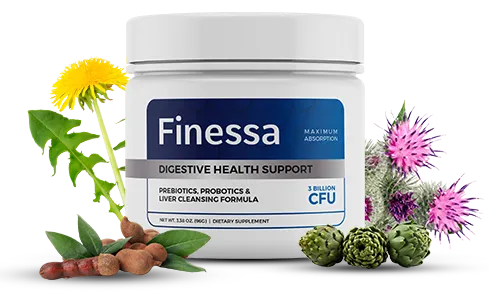
| Probiotic Blend | 52.5 mg / 5 billion CFU at manufacture. | Per-strain CFU are not clearly supplied. | BC99, LA85, Bla80 and LR08 plus a mixed species list. | Front tub artwork says 3 billion CFU. |
| Akkermansia powder | 2 mg. | Mass is given; viable count is not. | AH39 is printed. | Live or inactivated status is not established by mass. |
| Other ingredients | Six listed excipients. | No amounts given. | Resistant dextrin, flavors, citric acid, sea salt, stevia and silicon dioxide. | Flavor composition and allergen cross-contact need clarification. |
What the blend numbers actually mean
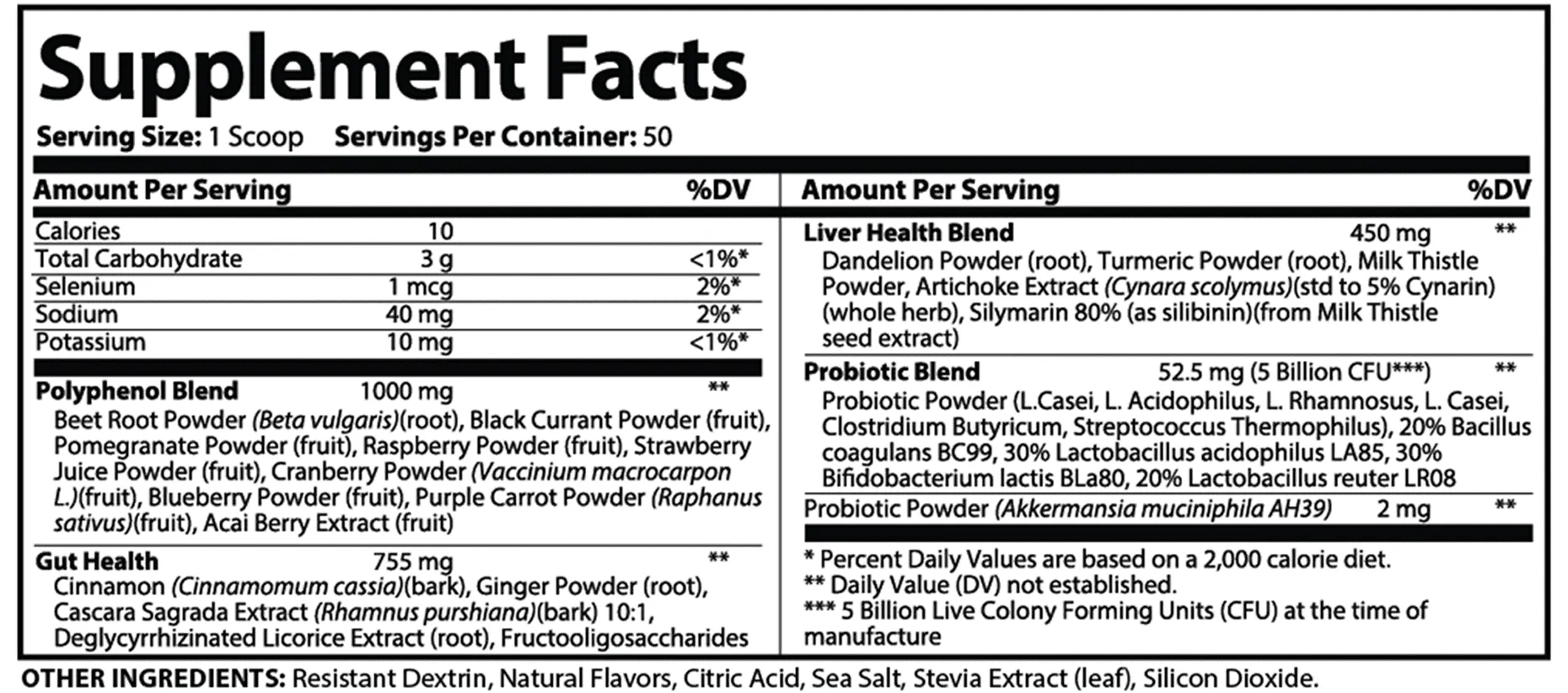
Four blend totals add to 2,257.5 mg, with another 2 mg of Akkermansia powder listed separately. This produces 2,259.5 mg of named blend and powder mass, not the scoop’s total mass. Nutrients and excipients must not be silently omitted when estimating scoop weight or interpreting the product’s carbohydrate declaration.
The manufacturer-published panel [1] lists 10 calories, 3 g carbohydrate, selenium 1 mcg, sodium 40 mg and potassium 10 mg. These declarations are distinct from the proprietary-blend totals. Adding carbohydrate grams to blend mass would also risk double-counting ingredients that contain carbohydrate.
| Group | Equal-share arithmetic | Valid conclusion |
|---|---|---|
| Polyphenol | 1,000 ÷ 9 = 111.1 mg. | An illustrative average, not a disclosed amount. |
| Gut | 755 ÷ 5 = 151 mg. | An illustrative average, not cascara exposure. |
| Liver | 450 ÷ 5 = 90 mg. | An illustrative average, not the artichoke dose. |
The maximum mass of any one component cannot exceed its entire blend. In practice, other ingredients occupy part of that total. Neither an average nor a ceiling identifies the actual amount. Do not calculate a daily glycyrrhizin or cascaroside dose from these figures: the required composition data are missing.
Supply creates another arithmetic problem. The facts image declares 50 servings per container; marketed purchase cards describe a 30-day tub. One scoop daily cannot make those two statements equivalent. A corrected current label and a scoop mass in grams are needed before deriving actual cost per serving.
Dose matching: artichoke provides a useful test
The 450 mg liver blend cannot hold 1,920 mg of the artichoke extract used in a published dyspepsia trial. Dividing 450 by 1,920 gives a 23.4% mass ceiling. Actual artichoke mass is lower because other ingredients share the blend, and different extracts cannot be assumed equivalent even at identical weights.
| Ingredient / preparation | Published amount per scoop | Human comparison | Interpretation |
|---|---|---|---|
| Artichoke extract | Part of 450 mg liver blend; standardized to 5% cynarin. | 1,920 mg/day commercial leaf extract for six weeks. Holtmann (2003), PMID: 14653829 [2] | Whole blend ceiling is 23.4% of trial extract mass; extract equivalence is unestablished. |
| Cascara sagrada bark extract 10:1 | Part of 755 mg gut blend; individual dose absent. | LiverTox describes short-term use, generally less than one week. NIH LiverTox (2017) [3] | This is a safety duration benchmark, not a dose-matched efficacy trial. |
| Probiotic blend | 52.5 mg; 5 billion CFU at manufacture. | Trials used different preparations. Dimidi (2014), PMID: 25099542 [4] | No justified conversion from total CFU to the effect of this mixture. |
| Turmeric and milk thistle | Share the 450 mg liver blend with other ingredients. | No matched Finessa preparation trial identified in the reviewed sources. | Powder mass, extract mass and active constituent mass are different measures. |
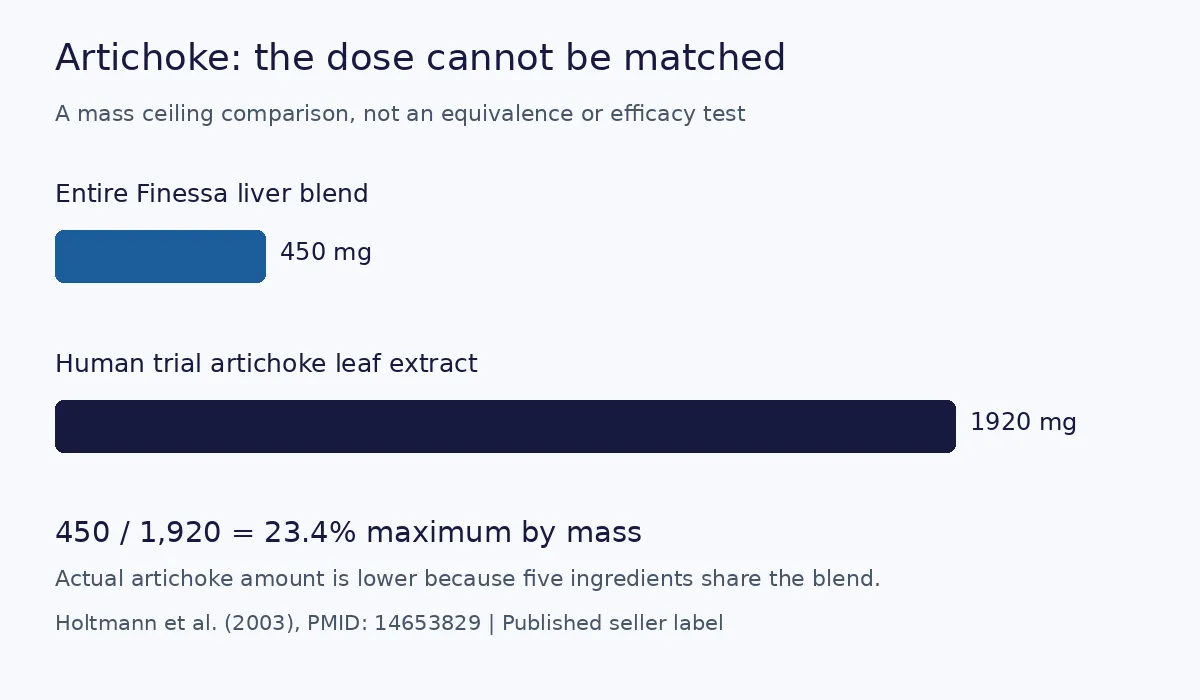
Holtmann (2003) studied a defined leaf extract and a defined symptom condition. PMID: 14653829 [2]. Finessa describes whole-herb artichoke standardized to 5% cynarin. A whole-herb preparation and a trial leaf extract are not interchangeable just because both carry the same plant name. The comparison establishes a matching problem, not a precise estimate of how much benefit is lost.
If all 450 mg hypothetically were the stated 5% artichoke extract, the arithmetic ceiling would be 22.5 mg cynarin. That is not the delivered cynarin dose, because the blend includes four other entries. It also does not establish a clinical target: the trial outcome cannot be reduced to one marker percentage.
Milk thistle powder and silymarin 80% appear as separate entries. The latter’s percentage describes that ingredient, not 80% of the full liver blend. Turmeric powder likewise should not be described as a known curcumin dose. Read the effectiveness page for why preparation differences matter.
Strain codes do not resolve every probiotic question
The panel is more specific than a generic probiotic claim, but still leaves essential questions. It prints BC99, LA85, Bla80 and LR08, then a separate AH39 entry. Its 5 billion CFU footnote applies at manufacture, while the front tub artwork shows 3 billion CFU. Neither image explains the discrepancy or confirms end-of-shelf-life potency.
The probiotic section also contains a mixed species list, including a repeated L. casei entry. Preserve that wording when auditing rather than silently correcting it into a cleaner formula. The percentages alongside four strains add to 100%, but the panel does not explain whether they refer to mass, viable count or another basis.
- Ask for total viable CFU guaranteed at expiry.
- Request CFU per strain and the basis of the printed percentages.
- Ask whether AH39 is live or inactivated and how it is standardized.
- Confirm storage requirements and the current artwork version.
Dimidi (2014) pooled different probiotic preparations in constipation trials. PMID: 25099542 [4]. A total CFU count and a shared species name do not establish that Finessa reproduces a particular strain-specific outcome. Greater numerical strength also is not automatically greater clinical usefulness.
Other ingredients and allergen questions
The other-ingredient list contains resistant dextrin, natural flavors, citric acid, sea salt, stevia extract and silicon dioxide. Amounts are not supplied. That list does not establish an allergen-free product or explain each excipient’s source. Readers with a relevant allergy need specific seller information rather than an assumption based on a short ingredient list.
Ask about flavor composition, dextrin source and manufacturing cross-contact when an allergy or dietary restriction is relevant.
The panel’s DGL description matters. NCCIH licorice guidance [5] distinguishes glycyrrhizin-containing licorice from deglycyrrhizinated products. The label still does not disclose residual glycyrrhizin, individual dose or a finished-product safety study. Read the safety analysis before deciding that DGL settles the entire mixture’s risk.
What to ask before using this label
Bring the panel and the front tub image together so a clinician can see the discrepancies. The questions are the 50-serving versus 30-day supply, 3-billion versus 5-billion CFU statements, hidden cascara dose and duration. A useful review also needs your medicines, symptoms and the reason you want a digestive supplement.
- Which current label will be supplied, and what is the scoop mass?
- What is the cascara amount and cascaroside standardization?
- Is prolonged use appropriate with my symptoms and treatment?
- Is a simpler, fully measured option suitable for my goal?
FDA explains that a supplement label and manufacturing claim do not establish premarket approval of effectiveness. FDA supplement questions [6]. Ask for an identifiable independent test report covering the current product and relevant analytes. A general facility badge is not the same as verification of this formula’s identity, strength or contaminants.
For broader context, use the dietary supplements guide, ingredient library and Dietary Supplement Reviews. The complaints page explains what records help resolve a labeling or return dispute.
Frequently asked questions
How many ingredients are in Finessa?
Does 450 mg mean 450 mg artichoke?
Does the panel disclose probiotic strains?
Is the licorice deglycyrrhizinated?
Can I use several scoops to match a trial?
Request the current Finessa label and directions →
Explore the Finessa audit series
References
- Manufacturer-published Supplement Facts artwork, accessed October 29, 2026
- Holtmann G, Adam B, Haag S, et al. Efficacy of artichoke leaf extract in patients with functional dyspepsia. Aliment Pharmacol Ther. 2003;18:1099-1105. PMID: 14653829
- NIH LiverTox. Cascara. Updated January 23, 2017
- Dimidi E, Christodoulides S, Fragkos KC, Scott SM, Whelan K. The effect of probiotics on functional constipation in adults: systematic review and meta-analysis. Am J Clin Nutr. 2014;100:1075-1084. PMID: 25099542
- NCCIH. Licorice Root: Usefulness and Safety
- FDA. Questions and Answers on Dietary Supplements