
Finessa Review 2026: Four Blends, Hidden Doses and Refund Terms
Finessa is a digestive-support powder advertised at $39–$59 per tub. Our editorial score is 3.4/10: four blends disclose totals but hide individual botanical doses. No matching finished-formula randomized trial was identified in the reviewed sources. Conflicting supply and CFU artwork, plus cascara duration questions, make label clarification essential before buying.
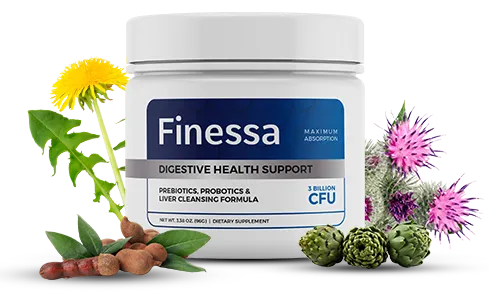
Verify Finessa availability and label details →
Affiliate links may earn a commission at no extra cost to you. Disclosure. Educational information; not medical advice.
Finessa review: what the audit found
Finessa offers a convenient powder, but its documents leave important questions unresolved. Four blend totals are printed, individual botanical quantities are hidden, and the tub image and facts panel disagree on CFU. The immediate buying decision is whether those uncertainties justify a $39–$59 tub before shipping and tax.
| Audit attribute | Finding |
|---|---|
| Product | A drink-mix digestive supplement marketed to adults. |
| Supply | Package cards describe 30 days; the published facts panel says 50 servings. |
| Blend disclosure | Four named blends total 2,257.5 mg, plus 2 mg Akkermansia powder. |
| Botanical quantities | Individual botanical doses are not supplied. |
| Probiotic amount | Facts artwork says 5 billion CFU at manufacture; tub artwork says 3 billion. |
| Strain detail | Four blend strain IDs and AH39 appear, alongside a less specific mixed-species list. |
| Clinical evidence | No finished-product randomized trial was identified in the sources reviewed. |
| Central safety issue | Cascara is a stimulant laxative ingredient. |
| Price | Marketed packages are $59, $147 and $234. |
| Guarantee | 180 days is advertised, with conflicting start-date wording. |
| Returns | All bottles are requested, including empty ones; buyer pays postage. |
| Quality | Facility claims do not establish independent finished-product certification. |
Label findings use the published facts artwork [1]. Package details use seller offer information [2].
Five-dimension editorial score: 3.4 / 10
The 3.4/10 score reflects documentation, evidence and buying clarity rather than a predicted medical outcome. Each category has a fixed maximum, totaling 10 points. Hidden doses and inconsistent label artwork reduce confidence, while the published ingredient panel and stated return process provide some useful information for a buyer to examine.
| Dimension | Maximum | Awarded | Reason |
|---|---|---|---|
| Finished-product clinical evidence | 3.0 | 0.0 | No matching randomized formula trial identified. |
| Ingredient research and plausibility | 2.5 | 1.3 | Some ingredient evidence exists, but preparations and outcomes differ. |
| Label, strain and dose transparency | 2.0 | 0.8 | Blend totals and some strain IDs appear; individual doses and artwork consistency fall short. |
| Safety, tolerability and warnings | 1.5 | 0.5 | Cascara duration concerns limit suitability for routine prolonged use. |
| Checkout, pricing and refund fairness | 1.0 | 0.8 | Package arithmetic is clear, but shipping and policy wording need confirmation. |
| Total | 10.0 | 3.4 | 0.0 + 1.3 + 0.8 + 0.5 + 0.8 = 3.4. |
See the review methodology. These are editorial judgments, not formal clinical evidence grades.
Advantages and limitations
The strongest practical advantage is a powder format with several declared blend totals. The main limitations concern relevance and clarity: a six-tub purchase requires $234 upfront, the formula contains a stimulant laxative, and the public artwork does not give one consistent account of servings and probiotic strength for the marketed supply.
Advantages
- Mixes into a drink rather than requiring capsules.
- Four blend weights and some strain identifiers are available.
- A written return procedure exists.
Limitations
- No identified randomized trial of the finished formula.
- Hidden botanical amounts prevent ordinary dose matching.
- Cascara deserves a duration and medication review.
- Front artwork, facts panel and package supply need reconciliation.
Does Finessa really work?
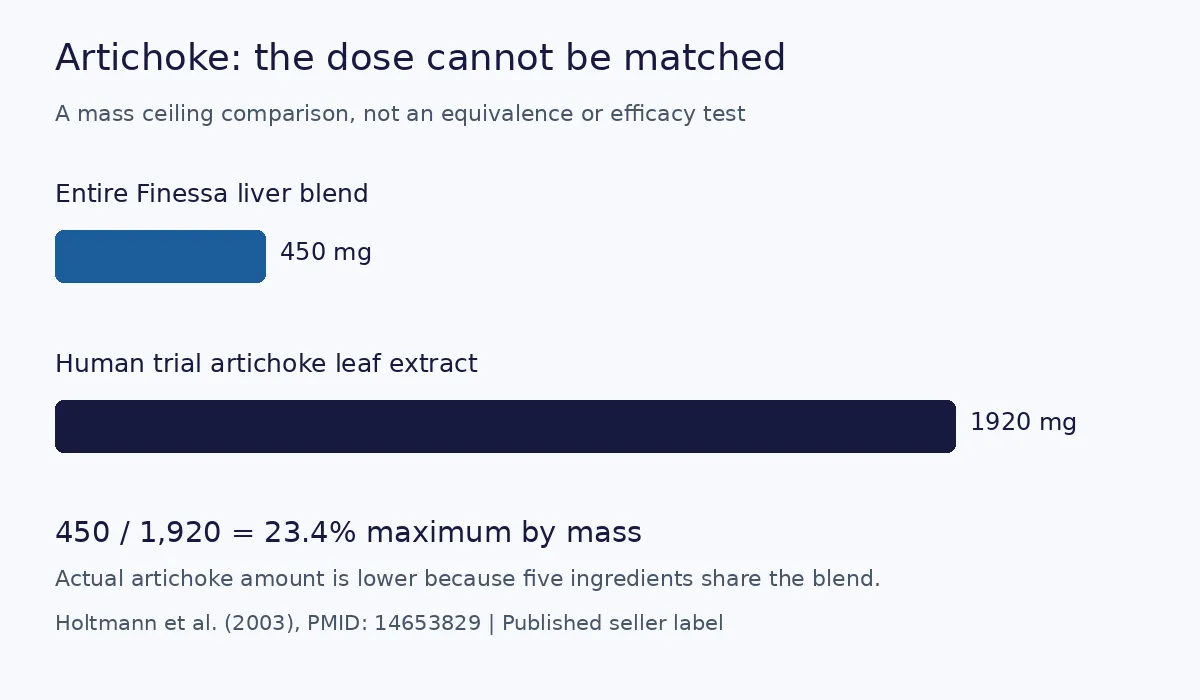
Ingredient research cannot establish the benefit of the finished Finessa mixture. A six-week artichoke trial used 1,920 mg/day of a specific extract, while Finessa shares only 450 mg across five liver-blend entries. That difference blocks a direct dose match and leaves advertised gut, liver and weight outcomes unproven for this product.
Holtmann (2003) evaluated functional dyspepsia rather than this formula or a general detox claim. PMID: 14653829 [3]. A statistical change in a dyspepsia scale cannot be translated into a promised weight change or a correction of every cause of constipation.
A separate probiotic synthesis pooled heterogeneous preparations and cannot predict this mixture’s result. Dimidi (2014), PMID: 25099542 [4]. Study populations, organisms and outcomes need to match. Read the effectiveness analysis and the dietary supplements guide.
Finessa ingredients and Supplement Facts
The public panel names four blends and an additional Akkermansia powder. Their combined listed mass is 2,259.5 mg per scoop, excluding separately listed nutrients and other ingredients. Botanical doses remain hidden, so 450 mg divided by five gives only a hypothetical 90 mg average, not an actual dose for artichoke or turmeric.
| Ingredient / preparation | Published amount per scoop | Human comparison | Interpretation |
|---|---|---|---|
| Artichoke extract | Part of 450 mg liver blend; standardized to 5% cynarin. | 1,920 mg/day commercial leaf extract for six weeks. Holtmann (2003), PMID: 14653829 [3] | Whole blend ceiling is 23.4% of trial extract mass; extract equivalence is unestablished. |
| Cascara sagrada bark extract 10:1 | Part of 755 mg gut blend; individual dose absent. | LiverTox describes short-term use, generally less than one week. NIH LiverTox (2017) [5] | This is a safety duration benchmark, not a dose-matched efficacy trial. |
| Probiotic blend | 52.5 mg; 5 billion CFU at manufacture. | Trials used different preparations. Dimidi (2014), PMID: 25099542 [4] | No justified conversion from total CFU to the effect of this mixture. |
| Turmeric and milk thistle | Share the 450 mg liver blend with other ingredients. | No matched Finessa preparation trial identified in the reviewed sources. | Powder mass, extract mass and active constituent mass are different measures. |
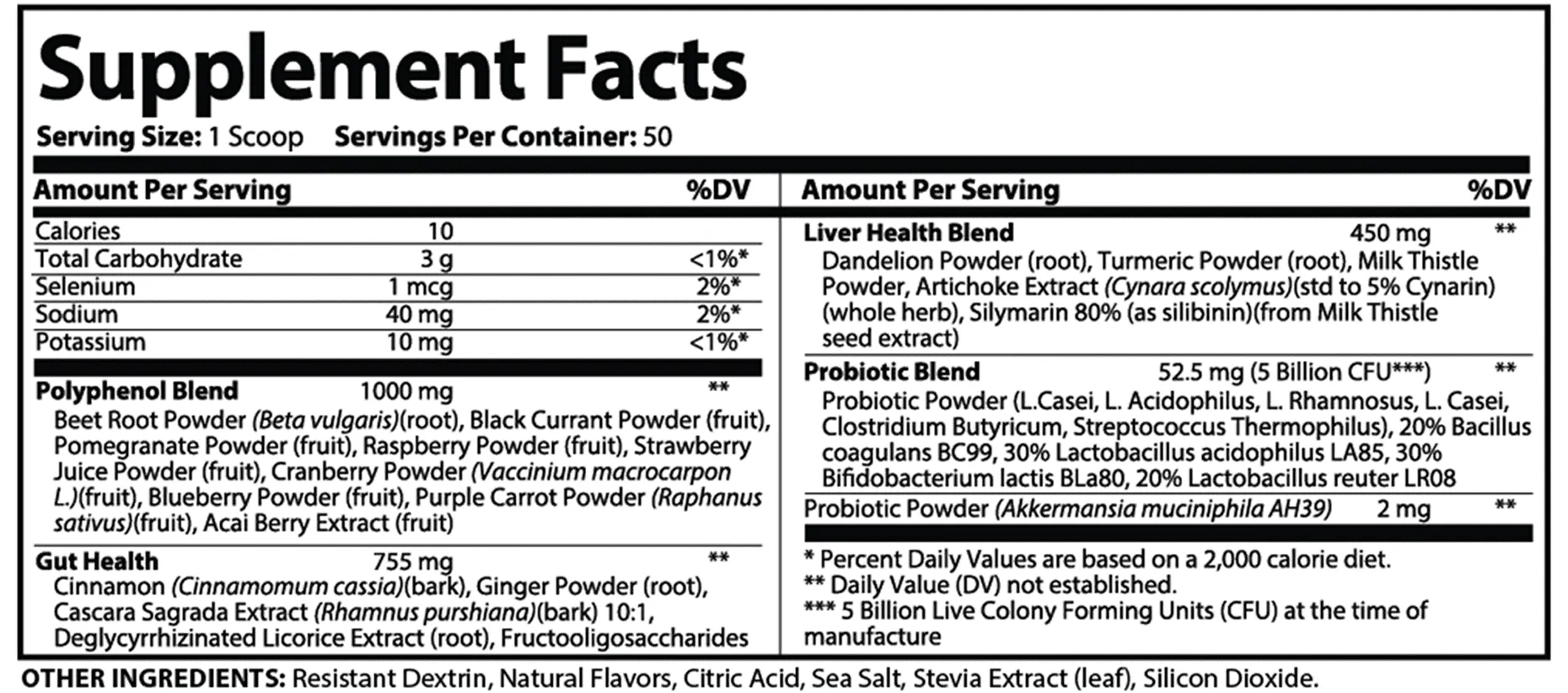
The 1,000 mg polyphenol blend has nine entries; the 755 mg gut blend has five. The panel lists deglycyrrhizinated licorice, which must be distinguished from ordinary licorice. Four strain codes appear in the probiotic blend, but the CFU statement is at manufacture rather than an explicit expiry guarantee. Manufacturer label artwork [1].
Inspect the full ingredient transparency analysis and ingredient library.
Finessa side effects and interactions
Cascara changes the safety assessment even when a product is marketed as natural. NIH LiverTox describes cramps, electrolyte imbalance and rare liver injury, especially with prolonged or excessive exposure. The amount within Finessa’s 755 mg gut blend is hidden, so routine months-long use needs professional review rather than automatic acceptance of sales advice.
NIH LiverTox (2017) [5] discusses short-term cascara use, generally under one week. This does not establish the incidence of harm from Finessa, but it gives a concrete reason to question a long uninterrupted course. Loose stools are not evidence of liver cleansing.
The panel specifies DGL licorice. NCCIH licorice guidance [6] distinguishes glycyrrhizin-containing products from DGL; it would be misleading to assign ordinary licorice exposure to this hidden dose. Ask a pharmacist to review medicines and the complete label. See the safety page.
Finessa reviews and complaints
The most defensible concerns here come from document mismatches, not an invented complaint count. The public facts panel says 50 servings and 5 billion CFU, while the offer describes a 30-day supply and front artwork says 3 billion. These differences deserve a written seller explanation before a buyer orders multiple tubs.
No verified complaint-frequency dataset or purchaser survey was assembled for this review. A selected testimonial cannot show how often people improve, discontinue or obtain refunds. Likewise, an isolated negative review cannot establish an overall fraud rate. The complaints and alternatives page separates buying friction from clinical failure.
- Ask which label version is supplied with the current order.
- Save dated copies of the offer and policies.
- Keep the receipt and all containers while deciding whether to return.
Price, bundles and net refund audit
At the marketed 30-day supply, Finessa costs about $1.30–$1.97 per day before applicable extras. The six-tub offer lowers the unit price but increases the initial payment to $234. Use the marketed supply for this comparison until the seller resolves the facts panel’s different 50-serving count and confirms the delivered directions.
| Package | Advertised total | Per tub | Cost/day at marketed supply | Shipping |
|---|---|---|---|---|
| 1 tub / 30 days | $59 | $59 | $1.97 | Default cart total $68.95; $9.95 above subtotal. |
| 3 tubs / 90 days | $147 | $49 | $1.63 | Default cart total $156.95; $9.95 above subtotal. |
| 6 tubs / 180 days | $234 | $39 | $1.30 | Default cart total $234; free US shipping advertised. |
Arithmetic: 3 × $49 = $147 and 6 × $39 = $234. A higher reference price does not establish typical market value. The offer header suggests free shipping with three or six tubs, but the three-tub card adds shipping; treat the final cart as the decisive amount.
The sales FAQ starts the 180-day window at ordering; the written refund policy [7] starts it at shipment and requires all bottles, including empties. Contact support first and keep return tracking. A refund is conditional on that process, not an automatic payment.
Illustration only: if the full $59 product price is refunded and tracked postage costs $8–$12, recovery after return postage is $47–$51. Any nonrefunded outbound charge reduces recovery further. Default US carts rendered $68.95 for one tub, $156.95 for three and $234 for six, each with $0 tax before address entry. The first two totals are $9.95 above their product subtotals. No address or payment was submitted; location-specific tax, optional extras and actual refund treatment remain untested.
Where to buy Finessa
Use the seller’s order route and check the merchant on the receipt before paying. Observed purchase links lead to a ClickBank payment domain, but the final cart terms remain a separate check. The seller says marketplace listings are unauthorized; that statement alone cannot authenticate or condemn every listing using the same product name.
Record the exact quantity, currency, shipping charge, billing model and support contact. Check whether a selected add-on or later offer changes the amount. No payment was placed during this review, and neither recurring billing nor its absence was independently confirmed at the final payment step.
A familiar logo or a marketplace review total is not a batch certificate. Compare the ingredient panel, seller identity and return route, and ask for evidence behind any independent testing claim. FDA consumer guidance [8] explains that dietary supplements do not receive FDA premarket approval for safety and effectiveness.
Directions and the duration question
The seller instructs adults to mix one scoop into water or another drink each morning. The published panel does not give the scoop’s mass and says 50 servings, while purchase cards use a 30-day supply. Confirm the directions on the delivered tub and ask about cascara duration before committing to a repeated daily routine.
Do not double scoops to imitate an unrelated ingredient trial. Doing so would also increase every other ingredient, including the hidden cascara amount. Powder format alone does not demonstrate superior absorption or a better clinical outcome. Seller directions [9].
- Bring the full label to a pharmacist if you use medicines.
- Stop and seek assessment for a new concerning reaction.
- Use clinician advice for persistent symptoms rather than extending use because more tubs remain.
Alternatives depend on the symptom
A transparent single-purpose approach can be easier to evaluate than a hidden multi-ingredient mixture. The 2023 AGA-ACG constipation guideline supports polyethylene glycol and conditionally supports fiber in suitable adults. These options address defined constipation questions; they do not validate a competing detox claim or establish that every bloated reader needs a laxative.
| Approach | Purpose | Evidence basis | Main constraint |
|---|---|---|---|
| Food and routine | Address intake and bowel habits. | NIDDK self-care guidance. | Symptoms may require assessment. |
| Psyllium fiber | A measured fiber option. | Conditional guideline support. | Tolerance and suitability matter. |
| Polyethylene glycol | Chronic idiopathic constipation care. | Strong guideline recommendation. | Use according to labeling and clinical context. |
| Finessa | Marketed multi-ingredient digestive support. | Ingredient extrapolation. | Hidden doses and cascara duration concern. |
Chang (2023), PMID: 37211380 [10]; NIDDK treatment guidance [11]. A current price or verified USP/NSF product was not established for these alternatives, so no fabricated low-cost comparison is presented.
Is Finessa worth buying in 2026?
Finessa is difficult to recommend as a first choice for prolonged daily digestive care. The 3.4/10 editorial score reflects incomplete dose matching, label inconsistencies and the need to review cascara exposure. A buyer who still prefers this format should obtain the current label and written return clarification before deciding on any package.
The strongest next step is a clearer record: current facts, expiry potency, scoop mass, expected supply and a medication review. Persistent constipation, recurrent diarrhea or unexplained bloating may need a diagnosis. A lower per-tub price does not resolve those questions, and a refund promise cannot substitute for appropriate care.
Frequently asked questions
Is Finessa FDA approved?
How much does it cost?
Does the guarantee remove the risk?
Is Finessa just a probiotic?
Can I use it for six months?
Will it treat constipation or liver disease?
Explore the Finessa audit series
References
- Manufacturer-published Supplement Facts artwork, accessed October 29, 2026
- Finessa sales page and package artwork, accessed October 29, 2026
- Holtmann G, Adam B, Haag S, et al. Efficacy of artichoke leaf extract in patients with functional dyspepsia. Aliment Pharmacol Ther. 2003;18:1099-1105. PMID: 14653829
- Dimidi E, Christodoulides S, Fragkos KC, Scott SM, Whelan K. The effect of probiotics on functional constipation in adults: systematic review and meta-analysis. Am J Clin Nutr. 2014;100:1075-1084. PMID: 25099542
- NIH LiverTox. Cascara. Updated January 23, 2017
- NCCIH. Licorice Root: Usefulness and Safety
- Finessa Refund & Return Policy, accessed October 29, 2026
- FDA. Questions and Answers on Dietary Supplements
- Finessa Contact / Frequently Asked Questions, accessed October 29, 2026
- Chang L, Chey WD, Imdad A, et al. AGA-ACG Clinical Practice Guideline: Pharmacological Management of Chronic Idiopathic Constipation. Gastroenterology. 2023;164:1086-1106. PMID: 37211380
- NIDDK. Treatment for Constipation