
Does Finessa Work? Ingredient Research and the Formula Evidence Gap
Finessa’s finished-formula effectiveness is not established by the reviewed sources. A 1,920 mg/day artichoke trial cannot be matched to its entire 450 mg liver blend, and probiotic category research cannot predict this mixture. Choose a defined symptom and relevant evidence before accepting broader digestion, liver or weight claims for the sold powder.
Read the full price and return audit →
Affiliate links may earn a commission at no extra cost to you. Disclosure. Educational information; not medical advice.
Does Finessa work is a question about a finished powder, not a list of promising ingredients. This analysis follows each claim back to its evidence type and explains the difference between a mechanism, a matching human trial and a testimonial. Read the main Finessa review for the combined buying judgment, package arithmetic, score and return terms.
| Advertised claim | Closest relevant evidence | Applicability to Finessa | What would change confidence |
|---|---|---|---|
| Digestive comfort | A specific artichoke extract trial in dyspepsia. | The product dose and extract do not match. | A randomized trial of the marketed formula. |
| Regularity | Constipation trials of various probiotics and established care options. | A category result cannot predict this mixture. | Strain, dose and symptom-specific product data. |
| Gut-liver support | Biological plausibility and ingredient research. | A mechanism does not establish a patient outcome. | Defined liver and digestive endpoints with harms reported. |
| Flatter belly / weight | Marketing language rather than matched product evidence. | Stool or fluid changes do not establish fat loss. | Controlled product studies with relevant measurements. |
A gut-liver explanation is a starting point
A plausible biological pathway does not tell you whether a commercial mixture helps a person. Finessa combines multiple botanical and probiotic entries, including a stimulant laxative ingredient. Improved stool frequency, reduced discomfort, a liver laboratory value and fat loss are separate outcomes, and a study supporting one cannot automatically support all four.
Start with the outcome you actually want. Feeling full after meals differs from hard stools, difficult evacuation, persistent diarrhea or diagnosed liver disease. A broad promise that sounds relevant to all of these may obscure the need to identify the cause. The same marketing phrase should not stand in for a diagnosis.
- Mechanism: a proposed way an ingredient could act.
- Ingredient trial: a test of a specific preparation in a specific population.
- Product trial: a test of the actual mixture and serving sold.
- Personal report: an experience without a controlled comparison.
The appropriate standard is a study whose formula, serving, duration and patient problem fit the question. A general discussion of microbiota cannot establish that this scoop has improved a clinically meaningful outcome. The supplement research guide explains this evidence ladder.
What the reviewed human evidence establishes
No finished-Finessa randomized trial was identified in the sources reviewed for this package. That finding does not prove that no unpublished or differently indexed study exists. The available ingredient evidence therefore needs to remain ingredient evidence, with the formula match and clinical endpoint stated explicitly before any benefit is attributed to the marketed powder.
Holtmann (2003) tested commercial artichoke leaf extract for six weeks in functional dyspepsia, using 1,920 mg daily. PMID: 14653829 [1]. That is a preparation-specific result. It does not establish this blend as a treatment for constipation, liver disease or weight concerns.
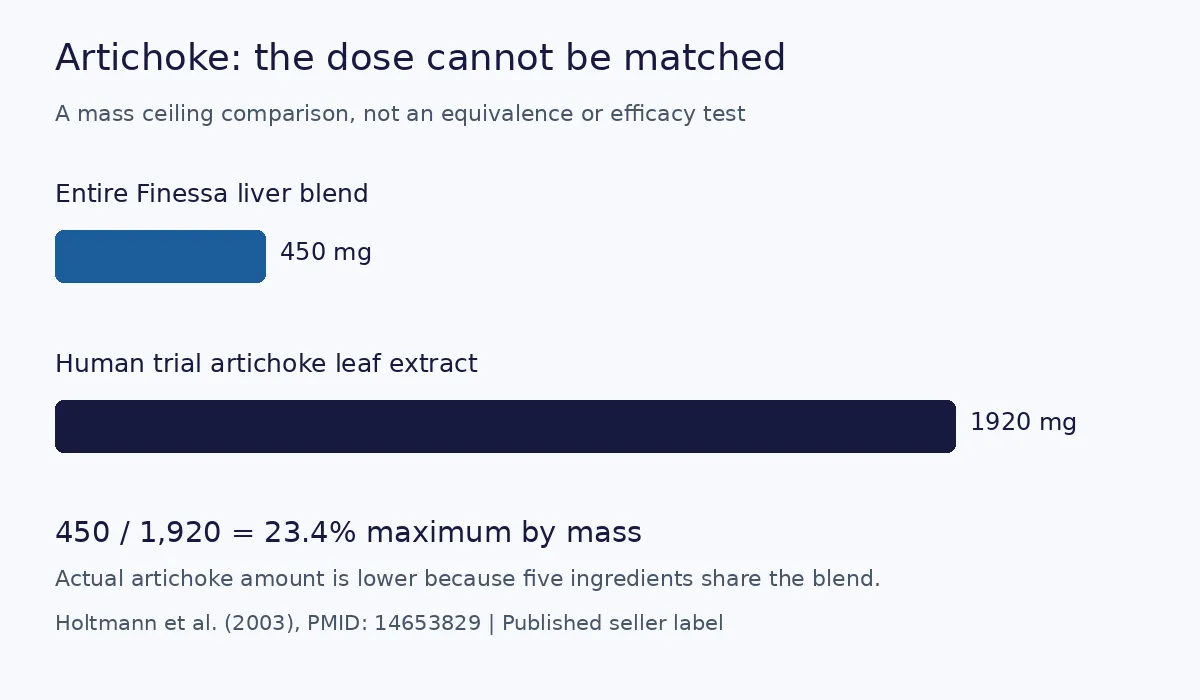
The whole Finessa liver blend is 450 mg. Its mass is at most 23.4% of that trial’s extract amount before allowing for its other components. Because extracts differ, this calculation is a limit on dose matching, not a dose-response equation. It cannot tell you that the product delivers exactly 23.4% of the benefit.
Dimidi (2014) evaluated probiotic trials with heterogeneous organisms and methods. PMID: 25099542 [2]. The authors’ caution about strain, dose and trial quality remains relevant. A product needs more than a large total CFU number to inherit the findings.
| Evidence question | Current answer |
|---|---|
| Was the sold Finessa mixture tested? | No matching randomized formula study was identified. |
| Can its hidden botanical doses be reproduced? | Not from the public panel alone. |
| Are commercial and study preparations equivalent? | Equivalence is not established. |
| Are adverse effects measured for this mixture? | No product trial was identified to estimate incidence. |
The public facts panel gives some strain codes but no clear per-strain viable counts. It also states 5 billion CFU at manufacture while the front image states 3 billion. Published facts artwork [3]. These inconsistencies need correction before a precise exposure comparison can be made.
How long should a buyer expect to wait?
No product-specific response timeline was established by the evidence reviewed. A six-week ingredient study does not define the onset of benefit from Finessa, and the seller’s long bundle recommendation is not a clinical stopping rule. Judge an optional supplement against a pre-agreed goal and safety review rather than waiting through worsening symptoms.
Choose an observable goal before use, such as a symptom diary agreed with a clinician. Record stool consistency, discomfort, other treatments and unwanted effects. A change after starting a product is useful information but does not by itself show causation, because meals, medicines, stress and natural symptom variation can change simultaneously.
- Do not extend use simply because a large bundle remains.
- Do not call diarrhea or cramping a necessary cleansing stage.
- Ask what benefit would justify continued use and when to reassess.
Cascara creates a separate duration issue. NIH LiverTox (2017) [4] discusses short-term use, generally less than one week. That safety context cannot be replaced with a marketing instruction to continue for months. The side-effects page explains the distinction without estimating an unmeasured Finessa-specific risk.
Why an individual result can differ
The reason for the symptom matters more than the breadth of a digestive-support claim. A hidden blend cannot reveal whether one scoop provides an appropriate exposure for you, and several ingredients make it hard to identify the cause of a change. The 50-serving label and 30-day offer also complicate reproducibility of the marketed regimen.
A person with difficult evacuation may need an assessment different from someone with low fiber intake. People taking constipating medicines need a medication review rather than an assumption that an herbal mixture offsets the drug. Do not stop a prescribed medicine to test a supplement.
| Factor | Question to ask |
|---|---|
| Symptom definition | Is the problem infrequent stool, hard stool, pain, bloating or incomplete evacuation? |
| Other treatments | What changed at the same time as the supplement? |
| Product exposure | Which label, scoop size and storage instructions apply? |
| Medical context | Could the symptom or a medicine require assessment? |
For chronic idiopathic constipation, Chang (2023), PMID: 37211380 [5] gives a condition-specific treatment framework. Guideline-supported options and an untested multi-ingredient supplement should not be presented as interchangeable on the strength of similar advertising.
An appropriate comparison may therefore be a measured fiber option, an osmotic laxative under its labeled and clinical conditions, or further assessment. It depends on the symptom and person. This is a clinical decision route, not a ranking based on which product has the largest ingredient list.
What would count as stronger proof?
A credible upgrade would be a randomized controlled study of the current formula at the sold serving. It should state the ingredient and strain specifications, include relevant patients, define an important outcome and report withdrawals and adverse events. A favorable testimonial, facility badge or 180-day return promise cannot fill those evidence requirements.
- A public protocol or registry record identifying the actual formula.
- A comparison group and a justified sample size.
- A complete report of benefits, harms and missing data.
- A current label that matches the tested preparation.
Until then, keep the conclusion narrow: some ingredients have research histories, but Finessa’s specific effectiveness remains unestablished by the reviewed material. FDA guidance also distinguishes supplements from approved medicines; manufacturing registration is not proof of treatment benefit. FDA supplement guidance [6].
Use the ingredient analysis to inspect the formulation and the alternatives comparison to decide what problem an alternative should address. Broader context appears in Dietary Supplement Reviews and the ingredient library.
Frequently asked questions
Does a published ingredient trial prove Finessa works?
Could a bowel movement show it is working?
Does the six-week artichoke study set my timeline?
Is more CFU always better?
What should I do if symptoms persist?
Examine Finessa’s current formula claims →
Explore the Finessa audit series
References
- Holtmann G, Adam B, Haag S, et al. Efficacy of artichoke leaf extract in patients with functional dyspepsia. Aliment Pharmacol Ther. 2003;18:1099-1105. PMID: 14653829
- Dimidi E, Christodoulides S, Fragkos KC, Scott SM, Whelan K. The effect of probiotics on functional constipation in adults: systematic review and meta-analysis. Am J Clin Nutr. 2014;100:1075-1084. PMID: 25099542
- Manufacturer-published Supplement Facts artwork, accessed October 29, 2026
- NIH LiverTox. Cascara. Updated January 23, 2017
- Chang L, Chey WD, Imdad A, et al. AGA-ACG Clinical Practice Guideline: Pharmacological Management of Chronic Idiopathic Constipation. Gastroenterology. 2023;164:1086-1106. PMID: 37211380
- FDA. Questions and Answers on Dietary Supplements