
Does Prosta Peak Work? 2 Trials & the Formula Question
This site uses affiliate links. Read the disclosure. Health education, not individualized medical advice.
Prosta Peak is promoted for prostate support, but this page evaluates the clinical reasoning behind that offer rather than its checkout value. The main Prosta Peak review covers the broader buying decision. Here, the decisive distinction is between human research on selected ingredients and evidence that the exact dose-defined commercial formula produces a meaningful benefit.
| Question or claim | Evidence inspected | What it supports | What it does not establish |
|---|---|---|---|
| Does the finished formula improve symptoms? | Named-product PubMed and ClinicalTrials.gov searches did not identify a matching randomized trial. | There is an unresolved product-specific evidence gap. | Search findings cannot prove universal ineffectiveness. |
| Does saw palmetto provide reliable relief? | Two substantial placebo-controlled trials and a 2023 systematic review were inspected. | The tested ingredient evidence is not a strong basis for a benefit promise. | The extracts studied are not verified matches to this blend. |
| Does pygeum research help? | An older systematic review found some favorable short-term outcomes. | There is limited ingredient-level rationale for further investigation. | It does not prove durable benefit from Prosta Peak. |
| Do testimonials establish a typical result? | Seller-selected stories are promotional evidence. | They show what the seller chooses to present. | They do not estimate a causal treatment effect or response rate. |
Plausible mechanisms are not measured benefits
A mechanism describes how a substance might influence biology; a trial asks whether people actually improve under controlled conditions. Prosta Peak’s six highlighted botanicals do not by themselves answer that second question. The missing dose and preparation information also prevents a reliable match between the marketed combination and laboratory or ingredient findings.
Urinary symptoms can have several causes. MedlinePlus explains how an enlarged prostate can compress the urethra, but symptom severity does not simply follow prostate size. A claim to support a “healthy prostate” therefore should not be read as a diagnosis, proof of reduced obstruction or evidence of fewer nighttime bathroom trips. MedlinePlus: enlarged prostate [1]
- Identify the clinical question: symptom burden, urinary flow and complication prevention are different outcomes.
- Identify the tested preparation rather than relying on a shared botanical name.
- Ask whether the comparison used placebo or an appropriate alternative.
- Check whether the magnitude and duration of improvement matter to patients.
FTC health-claim guidance emphasizes adequate scientific substantiation and the relevance of the tested formulation. An appealing account of inflammation, hormones or circulation cannot fill in unmeasured product outcomes. This is especially relevant when several botanicals are combined but their quantities and extraction details are not publicly established. FTC Health Products Compliance Guidance [2]
Finished-product searches and human trial findings
No published human randomized controlled trial on the finished Prosta Peak formula was found in the documented PubMed and ClinicalTrials.gov searches as of October 2026. That is a scoped search finding, not proof that no study could exist anywhere. The strongest inspected saw-palmetto trials nevertheless make a confident benefit promise difficult.
| Study | Population and comparison | Dose and follow-up | Outcome and boundary |
|---|---|---|---|
| Bent et al. (2006) PMID: 16467543 [3] | 225 men older than 49 with moderate-to-severe BPH symptoms received extract or placebo. | 160 mg twice daily was studied for one year. | No significant advantage was found in symptoms, flow or prostate size. |
| Barry et al. (2011) PMID: 21954478 [4] | 369 men aged at least 45 with lower urinary tract symptoms were randomized. | 320 mg/day increased to 640 and 960 mg/day over 72 weeks. | AUASI improved 2.20 points with saw palmetto and 2.99 with placebo, without superiority. |
| Franco et al. (2023) PMID: 37345871 [5] | 27 studies included 4,656 participants. | The review combined several studied preparations and follow-up periods. | Saw palmetto alone provided little to no benefit, while combination findings were more uncertain. |
| Ishani et al. (2000) PMID: 11099686 [6] | 18 pygeum trials involved 1,562 men. | Mean trial duration was 64 days, with a range of 30–122 days. | Some short-term improvements were reported, but methods and preparations varied. |
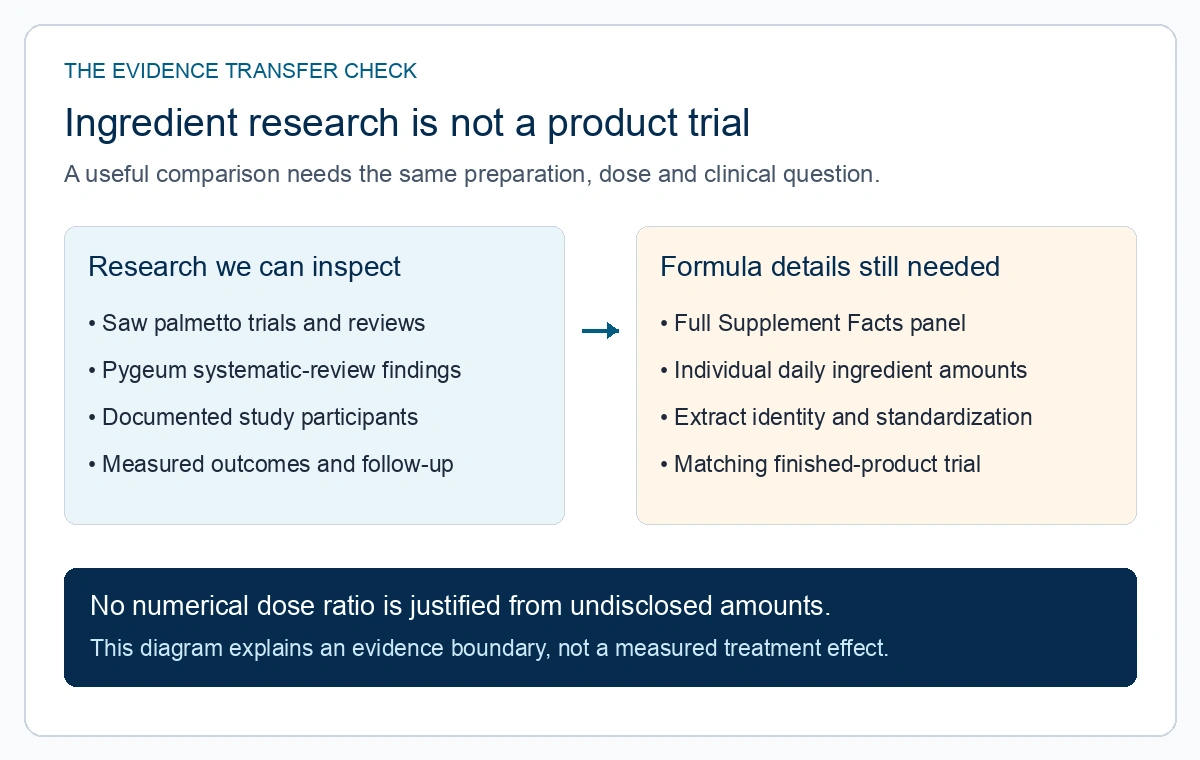
The two saw-palmetto trials are useful precisely because they included a placebo comparison. Symptoms improved in both groups in the later study. A before-and-after testimonial could attribute such improvement to the supplement, while a randomized comparison can reveal that the supplement did not outperform the control.
Pygeum research should not be dismissed as identical to saw palmetto research, but neither should it be inflated into proof of this formula. The inspected review was older and involved short follow-up. It does not establish that the current commercial product prevents retention, avoids surgery or provides a sustained benefit over years.
PubMed abstracts, not full study reports, were the primary trial records inspected for this assessment. The search also title-screened three unrelated targeted PubMed results; none was a matching formula trial. The ClinicalTrials.gov name query returned no matching registered study. Ingredient evidence remains separate from that search result.
Why no reliable product-response timeline can be promised
The inspected ingredient studies lasted from short follow-up to one year or 72 weeks, but those durations are not a Prosta Peak response schedule. A 30-day advertised bottle supply is a packaging claim. Without matching product data, there is no defensible promise that symptoms should improve by a particular week.
A study’s follow-up period describes when investigators measured an outcome, not necessarily when a treatment begins to work. In a negative trial, waiting until the final measurement does not transform the result into a recommendation to keep taking the extract. The same distinction applies to the seller’s suggestion of a longer course.
- Do not interpret a multi-bottle offer as a clinically established treatment duration.
- Do not increase a dose because symptoms have not improved by an advertised milestone.
- Do not delay evaluation of new or worsening urinary symptoms while waiting for a response.
- Discuss meaningful outcomes and follow-up with a clinician if a supplement is being considered.
The clinical priority changes if there is inability to urinate, pain, blood in urine or fever with urinary symptoms. Those situations call for medical assessment rather than a longer supplement trial. Routine tracking should never be used as a reason to postpone urgent care. MedlinePlus: enlarged prostate [1]
What would make future evidence more useful?
The most informative next evidence would test the exact marketed preparation against an appropriate control with transparent daily doses and meaningful urinary outcomes. Six botanical highlights cannot supply that design. A clear label would improve interpretability, but only a suitable human study could address the finished formula’s efficacy directly.
A useful report would identify the population, randomization, comparator, symptom scale, sample size, follow-up and adverse events. It would also show the size of the difference between groups, not merely a within-group improvement or a percentage of satisfied customers. Registration and a public protocol can help readers assess selective reporting.
Readers also need to know whether a study product matches the current bottle. A commercial name alone is not enough if doses or extracts change. The ingredient audit owns the detailed label comparison; the safety audit addresses the separate question of whether an individual can use the formula appropriately.
- Better disclosure would reduce uncertainty about what was tested.
- A randomized human trial would address clinical benefit more directly.
- Longer follow-up would be needed for durable outcomes or complication claims.
- Independent replication would strengthen confidence beyond a single favorable report.
Effectiveness questions answered
A careful answer separates absent evidence, negative evidence and uncertain transfer. Two negative saw-palmetto trials do not equal a direct trial of Prosta Peak, while a favorable pygeum review does not validate the blend. These distinctions matter more than a guaranteed timeline or a testimonial selected for promotional impact.
Does no matching trial mean the product is proved useless?
Why did symptoms improve in the placebo group?
Did the higher saw-palmetto dose solve the trial’s negative result?
Can a pygeum study establish fewer prostate complications?
What should a useful product trial report?
Sources and references
- MedlinePlus: enlarged prostate
- FTC Health Products Compliance Guidance
- Bent et al. (2006). Saw palmetto for benign prostatic hyperplasia. N Engl J Med. 354:557–566.
- Barry et al. (2011). Effect of increasing doses of saw palmetto extract on lower urinary tract symptoms. JAMA. 306:1344–1351.
- Franco et al. (2023). Serenoa repens for the treatment of lower urinary tract symptoms due to benign prostatic enlargement. Cochrane Database Syst Rev. CD001423.
- Ishani et al. (2000). Pygeum africanum for the treatment of patients with benign prostatic hyperplasia: a systematic review and quantitative meta-analysis. Am J Med. 109:654–664.