
Does ProNail Complex Work? 5% Label vs Nail Evidence
Affiliate disclosure: FitnessLifeMag may earn a commission if you purchase through the offer links, at no extra cost to you. Disclosure policy.
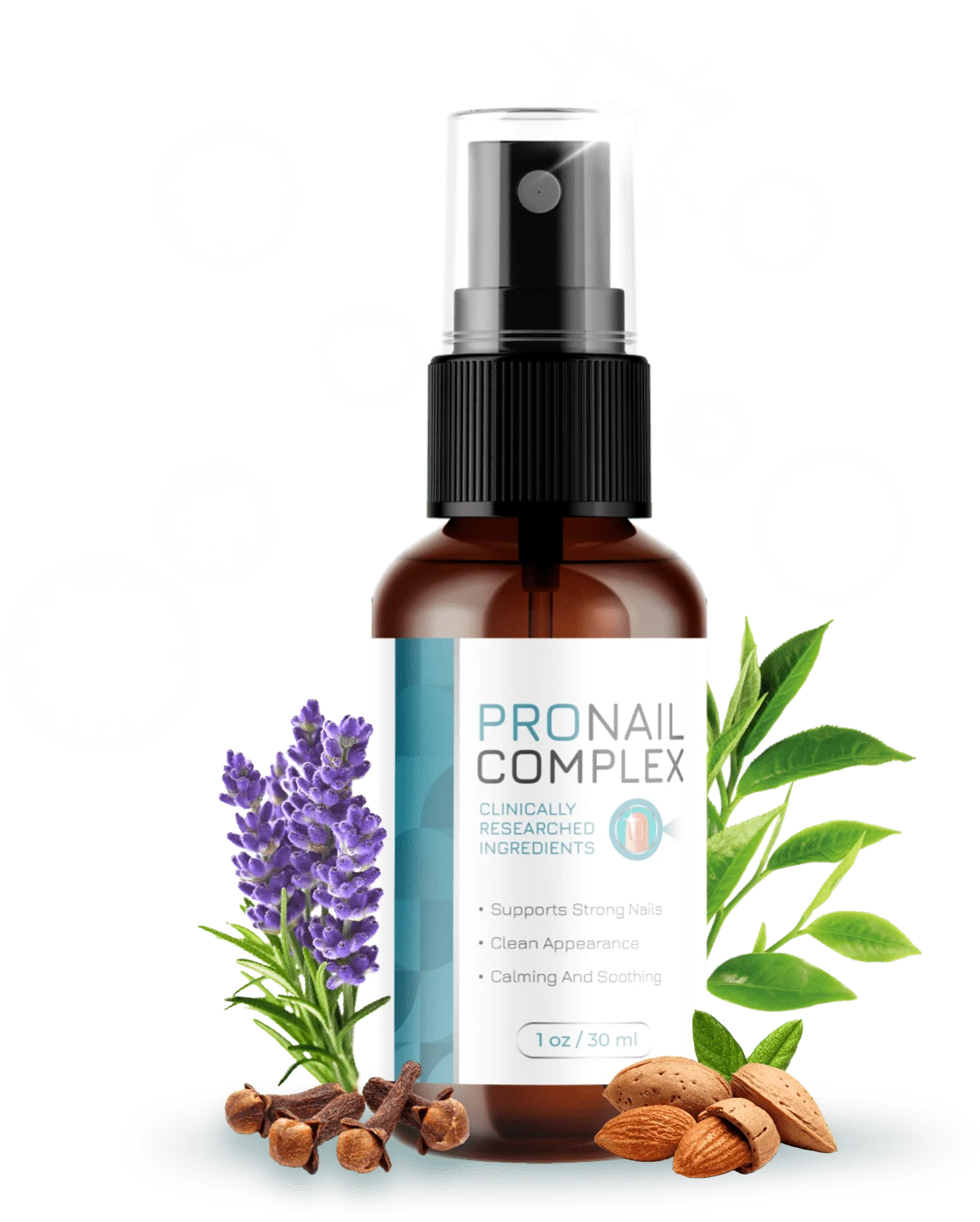
Educational assessment; no hands-on test or independent medical review.
Does ProNail Complex work for the outcome you actually need? This assessment separates the mist’s advertised benefits from laboratory mechanisms, ingredient trials and finished-formula evidence. It also distinguishes nail appearance from fungal clearance. The main review covers the full purchase decision; the matrix below identifies the clinical questions.
| Seller claim | Closest inspected evidence | Applicability | Reader decision |
|---|---|---|---|
| Fungus control | Tea tree RCT and acid laboratory study. | Neither tested this finished spray. | Do not assume a product cure rate. |
| Deep delivery | Mist description in seller copy. | No inspected human penetration measurement. | Ask for product-specific data. |
| Nail strength and appearance | Goals printed on the panel. | A cosmetic change is not fungal clearance. | Define the outcome you need. |
| Soothing | An oil-based topical format. | Product benefit and tolerability unquantified. | Consider individual skin sensitivity. |
Does a fine mist establish deep nail delivery?
Spray format describes delivery from the bottle, not penetration through the nail. ProNail’s claim that small particles reach deep needs measurements of the finished formulation, exposure and clinical outcome. Without that bridge, laboratory antifungal activity cannot establish treatment of organisms beneath a thick or damaged nail plate.
The seller’s micronized-delivery story is a hypothesis about this product. A convincing study would specify droplet characteristics, the formulation, nail penetration and a clinically relevant target-site exposure. The inspected product materials did not provide those measurements in an identifiable finished-spray human study.
| Evidence step | Why it matters |
|---|---|
| Laboratory activity | Shows what happens under controlled exposure, not necessarily on a human nail. |
| Penetration measurement | Would test whether the same formulation reaches the relevant site. |
| Clinical trial | Would test a defined outcome in people using that formulation. |
| Durable response | Would address recurrence and distinguish appearance from infection clearance. |
The FDA skin-antifungal framework includes a nail limitation; it cannot be used to validate this spray’s nail-treatment promise. FDA (2021) [4]
What the located research actually tested
Exact-name PubMed and ClinicalTrials.gov searches located no indexed or registered human trial of the complete ProNail mist. Ingredient findings remain useful context with major preparation limits. Research outside those searches may exist; the inspected material does not establish a finished-product cure rate or guaranteed benefit.
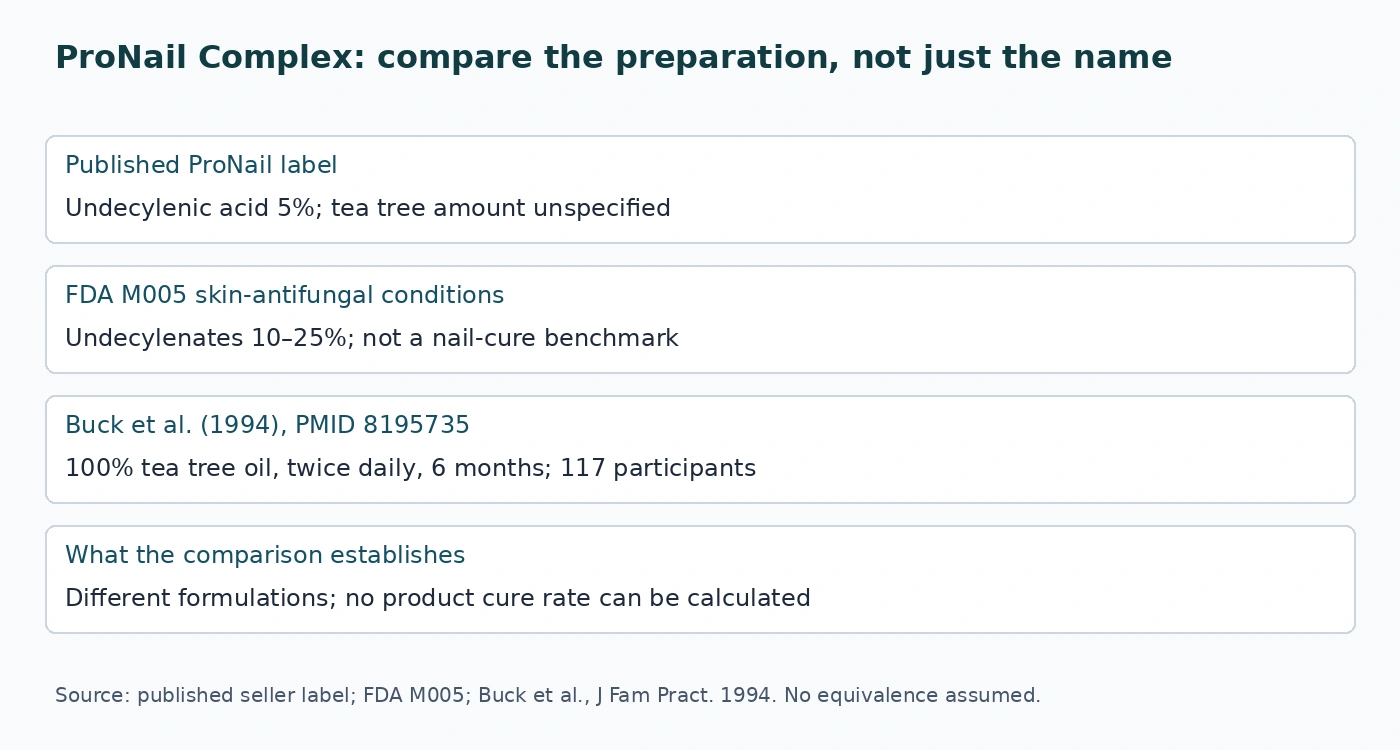
Buck et al. (1994) randomized 117 participants with culture-confirmed disease to 100% tea tree oil or 1% clotrimazole, twice daily for 6 months, with debridement. Culture cure was 18% versus 11%; partial/full clinical resolution was 60% versus 61%. Similar outcomes in that comparison do not prove equivalence to modern nail therapy or to ProNail. Buck et al. (1994) [PMID: 8195735] [1]
Shi et al. (2016) studied Candida biofilms in a laboratory, not people using ProNail on toenails. Its mechanism findings cannot supply a product clinical response percentage. Shi et al. (2016) [PMID: 26902505] [2]
| Benefit expectation | Defensible conclusion |
|---|---|
| Fungal-nail cure | Not established for this finished spray by the located evidence. |
| Improved appearance | Would need a product-specific outcome assessment; appearance alone cannot confirm mycological cure. |
| Immediate nail rebuilding | Not established; damaged nail has to grow out. |
| Convenient application | A spray can be convenient, but convenience is separate from efficacy. |
NCCIH considers the amount and quality of tea tree nail-fungus research insufficient for firm conclusions. NIH NCCIH [3]
When could a change be meaningful?
A ProNail bottle’s advertised 30-day supply is not a tested time-to-result. A smoother-looking surface, less discomfort and a clear fungal culture are different outcomes. The six-month tea tree study does not validate either a 30-day promise or the seller’s three-month purchase advice for this mixed spray.
Nail growth is slow, and a nail can remain abnormal while damaged material grows out. Conversely, visible improvement can happen without eradication. Discuss an appropriate assessment interval with a clinician rather than using the number of bottles as a biological timetable. American Academy of Dermatology (2025) [5]
- Record the specific concern and any confirmed diagnosis.
- Use consistent photos if monitoring appearance, without treating photos as a fungal test.
- Reassess new pain, rash or progression promptly.
- Keep the refund deadline separate from clinical outcome monitoring; see the buying-terms analysis.
What would change the decision?
The benefit question changes with diagnosis, nail involvement, formulation and concurrent care. ProNail cannot be assessed solely by whether an ingredient has an antifungal name. Thickened nail, a different organism, trauma or psoriasis may need a different approach, while irritation can make continued application counterproductive even when an ingredient is plausible.
| Factor | Buyer implication |
|---|---|
| Confirmed nail infection versus appearance damage | Choose evidence matching the diagnosis, rather than a broad nail-health promise. |
| Same preparation as the study | Unknown oil concentrations prevent direct matching. |
| Concurrent medicines or debridement | An outcome cannot automatically be attributed to the spray alone. |
| A new finished-spray trial | Relevant design, comparator, safety and outcome reporting could materially change this assessment. |
Use the existing fungal skin and nail guide for general treatment context and the formula audit for concentration-specific questions.
Effectiveness questions answered
A useful effectiveness answer names the tested preparation and the outcome it measured. For ProNail, that means keeping ingredient research separate from the complete spray and keeping appearance separate from fungal clearance. These questions address the most common ways a plausible mechanism becomes a stronger claim than the evidence permits.
Did the 117-person study test ProNail Complex?
Is killing fungus in a laboratory enough?
Would a prettier nail prove the fungus is gone?
Is no located trial proof that the spray cannot work?
What evidence would be most persuasive?
Explore the ProNail assessment series
References
- Buck et al. (1994). Tea tree oil versus clotrimazole for onychomycosis. PubMed abstract; PMID 8195735.
- Shi et al. (2016). Undecylenic acid and Candida biofilm. Laboratory study; PubMed abstract; PMID 26902505.
- NIH NCCIH. Tea tree oil: usefulness and safety.
- FDA (2021). OTC Monograph M 005, sections M 005.10 and M 005.50.
- American Academy of Dermatology. Nail fungus: diagnosis and treatment.