
DentaBiome Reviewed in 2026: What the Science Actually Supports (And What It Doesn't)
The Short Answer
Before we get into the ingredient science, here’s what you’ll find when DentaBiome is reviewed closely against the actual research: DentaBiome is a daily chewable supplement built around an oral postbiotic complex, a handful of bacterial strains, xylitol, a proprietary “BioFresh™ Clean Complex,” purple carrot powder, and cranberry extract. It’s marketed as support for a balanced oral microbiome, fresher breath, gum health, and general oral wellness — not as a cure for anything.
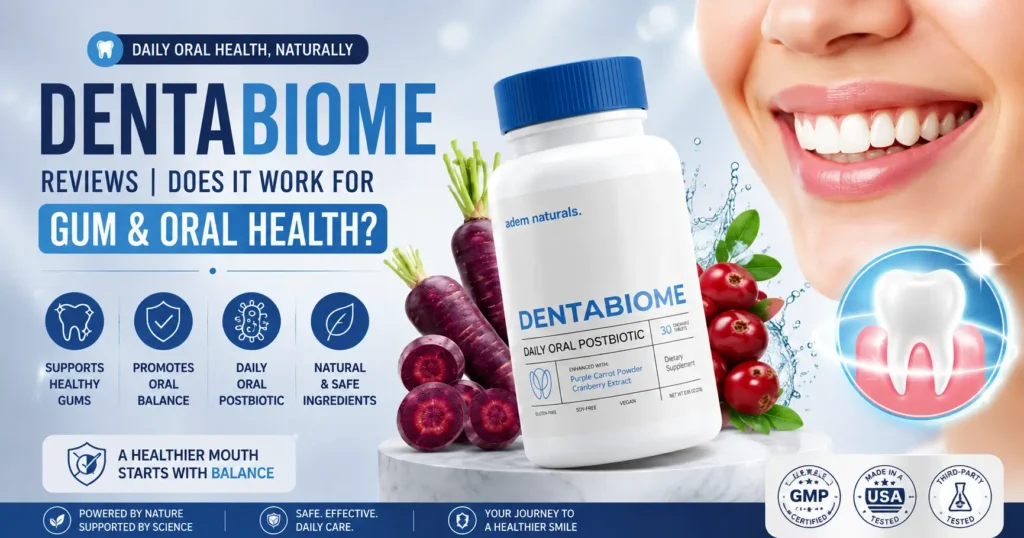
The underlying idea holds up scientifically to a point: the oral microbiome genuinely matters for oral health, and probiotic research does show some promising signals. But that research is highly dependent on strain, dosage, delivery method, and the population studied. What I couldn’t find was anything showing that the finished DentaBiome formula itself has been clinically tested — which means ingredient-level science shouldn’t be mistaken for product-level proof.
So — is DentaBiome the real deal? It looks like a genuine supplement: transparent-enough ingredient list, clear directions, a working checkout, and a 60-day refund window. But “real product” and “clinically validated for a specific result” are separate questions, and only one of them is answered here.
Where I land: treat DentaBiome as a possible add-on to a routine that already includes brushing, flossing, and dental visits — not a stand-in for any of them.

Table of Contents
What Exactly Is DentaBiome?
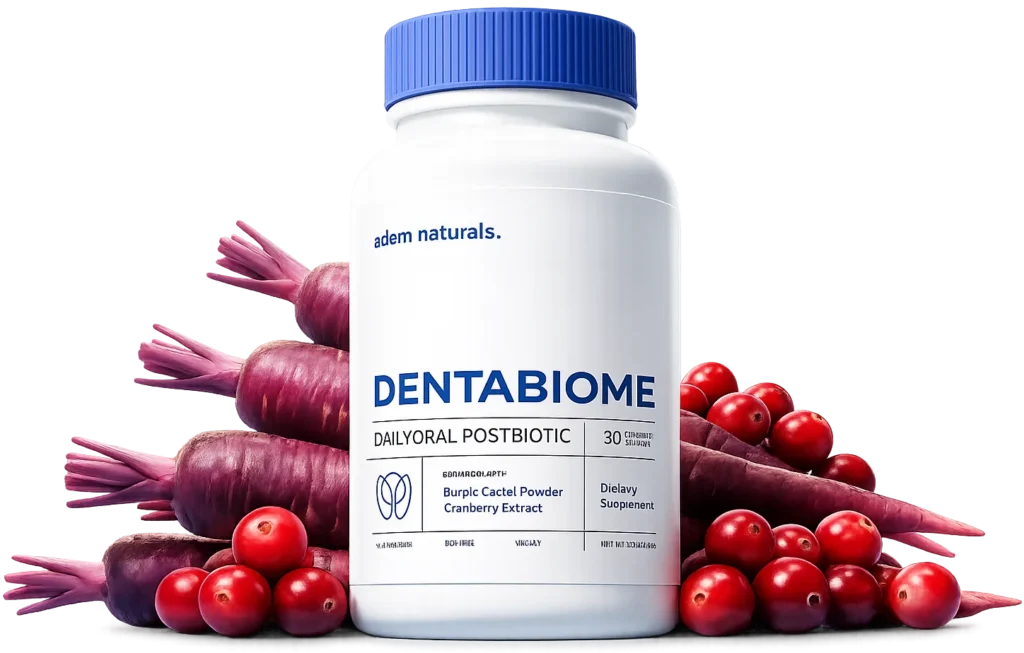
DentaBiome is a chewable, daily-use supplement organized around the concept of an oral postbiotic.
Per the company’s own product page, the formula blends postbiotic components, select bacterial strains, plant-derived ingredients, xylitol, and a few other oral-support compounds — all aimed at a more balanced oral microbiome, better breath, and healthier gums.
What stands out is the delivery method. This isn’t a paste, rinse, or floss — it’s a chewable tablet, taken once a day, that’s meant to mix with saliva as you chew before you swallow it.
None of that positions it as a substitute for standard dental care. The brand itself says as much, repeatedly: brushing, flossing, diet, hydration, and regular checkups still matter.
That caveat is worth holding onto.
A supplement like this can realistically function as an add-on. It shouldn’t be marketed — or understood — as a fix for cavities, gum disease, infections, or anything that needs a dentist’s attention.
The Gap DentaBiome Is Trying to Fill
The premise here is that oral health isn’t just about scrubbing plaque off enamel.
Your mouth hosts an entire ecosystem of microorganisms, shaped by diet, hygiene habits, age, and lifestyle. DentaBiome’s pitch leans into supporting that ecosystem rather than just cleaning it.
That’s where it gets interesting, because conventional oral-care tools already have well-defined jobs:
- Toothbrushes physically dislodge plaque and food debris.
- Toothpaste cleans and, in most cases, delivers fluoride.
- Floss reaches what a brush can’t, between teeth.
- Mouthwash adds extra cleansing or breath-freshening.
- Dentists diagnose and treat what’s already gone wrong.
DentaBiome slots in differently — as microbiome and nutritional support layered on top.
That’s not an unreasonable idea on its face. The real question is narrower: does this specific formula, at this specific dose, actually move the needle in a measurable way? That’s where things get murkier.
How the Formula Is Supposed to Work
DentaBiome brands its approach as working “from the inside out.”
Six components make up the core formula:
- Postbiotic ingredients
- Bacterial strains
- Xylitol
- BioFresh™ Clean Complex
- Purple carrot powder
- Cranberry extract
The reasoning is that each piece contributes a different, complementary angle of support.
Microbiome Balance
Three strains anchor the probiotic side: Lactiplantibacillus plantarum, L. salivarius, and L. rhamnosus.
This isn’t about wiping out bacteria wholesale — a healthy mouth is full of them. The goal, at least on paper, is nudging the microbial balance toward something more favorable.
The Postbiotic Angle
A proprietary postbiotic blend sits at the center of the product.
Postbiotics are generally defined as preparations made from non-living microorganisms or their byproducts that still confer a benefit — distinct from probiotics, which rely on live cultures.
DentaBiome pairs that postbiotic blend with live strains, rather than betting on one approach alone.
Fresh-Breath Ingredients
BioFresh™ Clean Complex and xylitol are the two ingredients the brand ties most directly to breath freshness and a “cleaner” mouth feel.
Worth flagging: this shouldn’t be read as a promise to resolve chronic bad breath, which often has causes that need a dentist to sort out.
Antioxidant Plant Extracts
Purple carrot powder and cranberry extract bring plant compounds with antioxidant properties into the mix.
But antioxidant activity measured in an ingredient is not the same as proof that the packaged product prevents or reverses dental problems.
Why a Chewable?
Chewing, rather than swallowing a capsule whole, lets the formula interact with saliva and oral tissue directly — which fits the product’s oral-focused premise.
That said, the delivery format itself doesn’t prove efficacy; it’s just a reasonable design choice.
A Primer on the Oral Microbiome
The oral microbiome refers to the full community of microorganisms that live in your mouth — on the tongue, in saliva, along the gumline, and on tooth surfaces.
The relationship between those organisms and your body isn’t simple, and “bacteria” isn’t automatically a bad word.
Modern microbiome research isn’t about sterilizing the mouth. It’s about understanding how these communities function together, and how shifts in that balance might connect to oral-health outcomes.
That’s the scientific basis products like DentaBiome are built on.
But this field is still young. A supplement that shifts a bacterial count on a lab test hasn’t automatically proven it improves anything a patient would notice or a dentist would measure.
So I’d break the question into three separate parts:
Is the oral microbiome a legitimate research area? Yes.
Do some probiotics influence oral-health outcomes? Yes — but results shift depending on strain, dose, delivery, and who’s being studied.
Does that mean DentaBiome specifically has been proven effective? No — not from anything I could verify.
Keeping those three questions separate matters more than it might seem.
Ingredient-by-Ingredient Breakdown
Here’s what the product page lists as the formula’s core components.
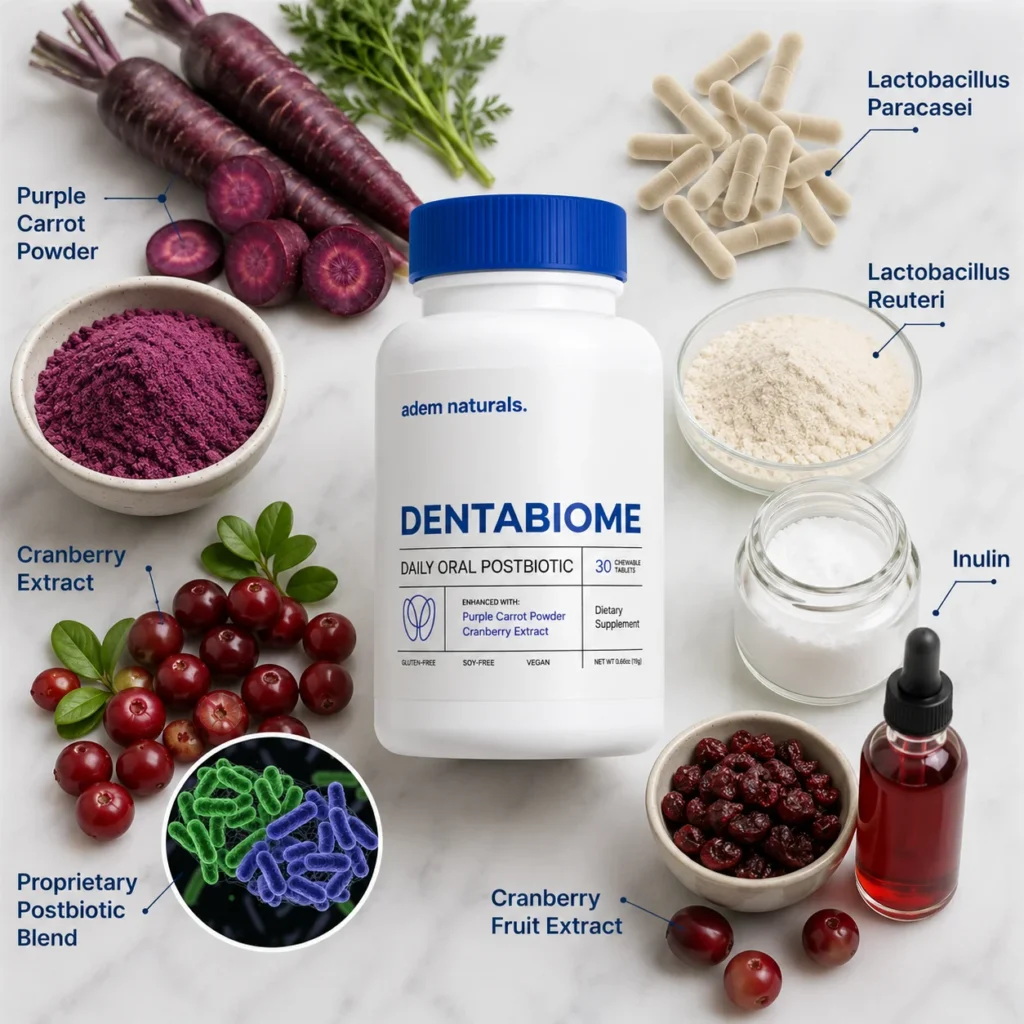
1. Proprietary Postbiotic Blend
This blend is arguably the product’s headline feature.
Postbiotics are an active area of research as a way to deliver microbial benefits without depending on live organisms surviving the trip through the mouth and gut.
The catch: because it’s proprietary, exact quantities and full composition aren’t disclosed, which makes it hard for anyone outside the company to weigh the evidence against the actual dose being used.
Take: an interesting category, but not one I can verify at the product level.
2. Dual-Strain L. plantarum Complex
Two strains of Lactiplantibacillus plantarum are named specifically.
L. plantarum shows up often in probiotic literature, oral health included.
The caveat that matters most: probiotic effects are strain-specific, not species-wide. Two products both containing “L. plantarum” can behave completely differently depending on the exact strain used.
Take: a species with real research behind it, but that doesn’t transfer automatically to this formulation.
3. L. salivarius
Lactobacillus salivarius is a species naturally found in the mouth and studied in probiotic contexts.
It fits DentaBiome’s overall microbiome thesis.
Same caveat applies — species-level data isn’t strain-, dose-, or product-level data.
Take: relevant, but shouldn’t be read as validation of the finished product.
4. L. rhamnosus
L. rhamnosus is one of the more heavily researched probiotic species overall, including in some oral-health studies.
But again, findings from a study strain don’t automatically carry over to whatever strain and quantity DentaBiome actually uses.
Take: solid research base at the species level; formulation-specific evidence is still missing.
5. BioFresh™ Clean Complex
Described only in general terms on the product page — a blend meant to support fresher breath and a cleaner mouth feel.
Because it’s proprietary, there’s no way to break down the individual ingredients or amounts.
Take: plausible as a formulation component, but not independently verifiable.
6. Xylitol
Xylitol is a well-known sugar alcohol already used in gum, toothpaste, and other oral products.
Unlike sugar, it isn’t easily fermented by the bacteria most associated with cavities.
The American Dental Association has noted that while several mechanisms have been proposed for how xylitol might reduce cavity risk, the overall evidence quality is not high and results are mixed.
Take: a legitimate, well-established ingredient — but not a guaranteed cavity-prevention tool.
7. Purple Carrot Powder
A plant-based ingredient rich in anthocyanins and other phytonutrients, included here mainly for its nutritional and antioxidant contribution.
The limitation is straightforward: antioxidant content in a food ingredient doesn’t by itself translate into a measurable dental benefit.
Take: a reasonable nutritional addition with limited direct evidence tied to oral outcomes.
8. Cranberry Extract
Cranberry’s polyphenols have been studied in connection with oral health in various contexts.
As with the other plant ingredients, lab or isolated-compound findings don’t guarantee the same effect at whatever dose is used in a finished supplement.
Take: a promising research area, but not proof at the product level.
Evidence Snapshot Table
| Ingredient | Purpose in Formula | Evidence Take |
|---|---|---|
| Proprietary Postbiotic Blend | Microbiome support | Emerging field; undisclosed dose limits assessment |
| L. plantarum complex | Probiotic support | Studied species; strain-specific results matter |
| L. salivarius | Microbiome support | Relevant species; no product-level data |
| L. rhamnosus | Probiotic support | Well-studied species; outcomes vary by strain/delivery |
| BioFresh™ Clean Complex | Breath/mouth-feel | Proprietary; composition not disclosed |
| Xylitol | Oral-care ingredient | Common ingredient; ADA calls evidence mixed |
| Purple Carrot Powder | Antioxidant/nutrition | Plausible role; little direct clinical evidence |
| Cranberry Extract | Plant polyphenols | Active research area; no product-specific proof |
DentaBiome Reviewed Against the Actual Studies
This is the part of the review that matters most.
Oral probiotics are a legitimately active research topic.
A 2024 systematic review and meta-analysis looked at probiotic-containing beverages and dental caries and found the effects were inconsistent overall — some analyses pointed to reduced caries increment, but the researchers stopped short of calling the evidence strong enough to establish a real impact on cavity development.
A 2025 systematic review of the clinical evidence on probiotics and caries found that certain strains were linked to lower levels of cavity-causing bacteria in many studies, but flagged major variability tied to strain, dosage, delivery, and study population — and called for more standardized, longer-term trials.
Periodontal (gum) research tells a similar story. Multiple systematic reviews and meta-analyses have found short-term improvements in some gum-health measures when probiotics were added to standard treatment, while other reviews point to inconsistency across studies and a need for better long-term data.
A 2026 umbrella meta-analysis found that probiotic supplementation may help with bleeding on probing and clinical attachment level during periodontitis treatment, though it didn’t find significant benefit across every outcome measured.
The fair summary:
This is a research area worth taking seriously — but it doesn’t support the idea that every oral probiotic or postbiotic product will perform the same way.
Which brings the conversation back to DentaBiome specifically.
I found nothing indicating a clinical trial was run on the actual finished DentaBiome formula. What’s available is ingredient- and category-level evidence — not evidence of the complete product.
Does DentaBiome Actually Work?
My honest take:
It may offer some genuine oral-wellness support, but there isn’t enough product-specific evidence to call the finished formula “clinically proven.”
Three reasons I’m not willing to go further than that:
1. No formula-specific trials
Research on L. rhamnosus, xylitol, or cranberry extract individually isn’t the same as a clinical trial of DentaBiome as a whole product.
2. Incomplete dosage disclosure
The public product page doesn’t spell out exact per-ingredient amounts for every proprietary component, which makes it hard to compare the formula to the doses used in actual clinical studies.
3. Oral health has many moving parts
Cavities, gum disease, plaque buildup, and chronic bad breath rarely have a single cause.
No chewable tablet should be treated as a substitute for a dentist’s diagnosis.
So if the question is:
“Will this fix my dental problems for sure?”
No — the evidence doesn’t support that claim.
If the question is:
“Is this a reasonable optional add-on for someone curious about oral microbiome support?”
Possibly — as long as expectations are realistic and regular dental care continues.
The Dosage Transparency Problem
This is a genuine weak point.
The public-facing page names several ingredients and proprietary blends but doesn’t list complete milligram amounts for each one.
That matters because dosage is part of what makes evidence meaningful.
If a clinical study uses a specific strain at a specific dose over eight weeks, knowing DentaBiome contains “the same species” tells you very little about whether it matches that strain, that quantity, that viability, or that formulation.
The takeaway:
Listing an ingredient is not the same as matching a clinically tested dose.
This isn’t automatically disqualifying — proprietary blends are common across the supplement industry — but it’s a real limitation for anyone trying to evaluate the product on evidence alone.
Recommended Use
The product page’s guidance is simple:
One chewable tablet per day, or as directed on the current label.
It’s designed to be chewed, not swallowed whole, so the formula interacts with saliva before you swallow it.
Building it into an existing daily routine (same time, same trigger habit) will likely produce more consistent use than taking it sporadically.
The brand also recommends keeping up with:
- Brushing twice a day
- Regular flossing
- Adequate hydration
- A balanced diet
- Limiting excess sugar
- Routine dental checkups
Don’t exceed the labeled serving in hopes of speeding up results — there’s no evidence that a higher dose accelerates anything, and no fixed timeline for when effects, if any, might appear.
Safety Considerations and Side Effects
One honest limitation up front: I couldn’t locate a published safety study on the finished DentaBiome formula, which means there’s no reliable, product-specific side-effect rate to cite.
Because of that, claiming “DentaBiome has no side effects” would be overstating what’s actually known.
It’s more useful to think about safety at the ingredient and individual level instead.
Probiotic strains
Generally well-tolerated in healthy adults, though individual responses vary. Anyone with a serious illness or compromised immune system should check with a healthcare provider before trying any probiotic product.
Xylitol
Can cause digestive discomfort in some people, especially at higher intakes.
Plant extracts and proprietary blends
Allergic or sensitivity reactions are possible with any multi-ingredient botanical formula.
The practical rule of thumb
If you notice an unexpected or significant reaction after starting the product, stop taking it and consult a healthcare professional.
The FDA also recommends talking to a doctor or pharmacist before starting any dietary supplement, since supplements can interact with medications or other supplements.
Who Should Pause Before Trying It
DentaBiome is marketed for adults.
Extra caution is warranted for:
- Children
- Pregnant or breastfeeding individuals
- People managing significant medical conditions
- Anyone on prescription medication
- Anyone allergic to a listed ingredient
- People currently under medical supervision
- Anyone with active dental pain, swelling, infection, or unexplained bleeding
If you already have a diagnosed dental issue, a supplement is not a substitute for treatment — see a dentist first.
FDA Status, Explained
No, DentaBiome is not FDA approved — and that’s normal for a dietary supplement, not a red flag on its own.
The FDA does not pre-approve dietary supplements for safety or effectiveness before they hit the market.
That means “FDA approved” simply isn’t the right benchmark to judge a product like this by. Better questions to ask instead:
- What’s actually in it?
- Is the labeling clear and complete?
- Does manufacturing meet applicable standards?
- Are the marketing claims reasonably supported?
- Is the company transparent about the product?
- Is there a fair return/refund policy?
- Does independent research back up the key ingredients?
The FDA places responsibility on supplement companies themselves to ensure products are safe and that claims made about them are truthful.
So if a page describes itself as “FDA-approved,” that phrasing deserves a second look.
DentaBiome should be understood as a dietary supplement — not a drug that’s gone through FDA approval.
DentaBiome Compared to Standard Oral Care
| Feature | DentaBiome | Standard Oral Care |
|---|---|---|
| Primary goal | Microbiome/nutritional support | Cleaning and hygiene |
| Format | Daily chewable | Brush, paste, floss, etc. |
| Mechanically removes plaque | No | Yes |
| Substitute for brushing | No | N/A |
| Substitute for flossing | No | N/A |
| Microbiome-targeted ingredients | Yes | Varies by product |
| Handles professional treatment | No | Dental visits still required |
| Best used as | Optional add-on | The foundation |
The takeaway here is simple:
DentaBiome and brushing aren’t interchangeable.
If it’s a choice between good toothpaste and consistent brushing versus a supplement, the fundamentals should come first every time.
DentaBiome makes the most sense as an extra layer for someone who’s already handling the basics.
DentaBiome Compared to Daily Habits
A supplement is only ever one piece of the puzzle.
If the actual goal is a healthier mouth, these habits still carry the most weight.
Brush twice daily
Non-negotiable foundation of oral hygiene.
Clean between teeth
Floss or an interdental brush, used consistently.
Watch sugar frequency
Frequent exposure to fermentable carbs feeds the bacteria linked to decay.
Stay hydrated
Saliva needs adequate hydration to function normally.
Keep up with dental visits
A dentist can catch problems no supplement is capable of diagnosing.
Don’t ignore persistent symptoms
Ongoing bad breath, bleeding gums, pain, or sensitivity call for a professional opinion — not another supplement stacked on top.
This is exactly why I wouldn’t frame DentaBiome as a shortcut around any of this.
Strengths and Weaknesses
Strengths
- A microbiome-centered concept — built around supporting the oral ecosystem, not just cleaning surfaces.
- Multiple ingredient categories — postbiotics, probiotic strains, xylitol, and plant compounds working together.
- Low-effort format — one tablet a day is easy to stick to.
- Honest positioning — the brand itself frames it as complementary, not a replacement for dental care.
- 60-day refund window — purchase protection, subject to the official terms.
Weaknesses
- No verified finished-product trial — ingredient research shouldn’t be mistaken for product-specific proof.
- Incomplete dosage disclosure — full per-ingredient amounts aren’t published for every proprietary component.
- Variable results likely — hygiene, diet, and existing conditions all affect outcomes.
- Pricier than basic oral care — this is a specialty add-on, not a toothpaste replacement.
- Not a treatment — active dental issues still require professional care.
Cost and Purchase Options
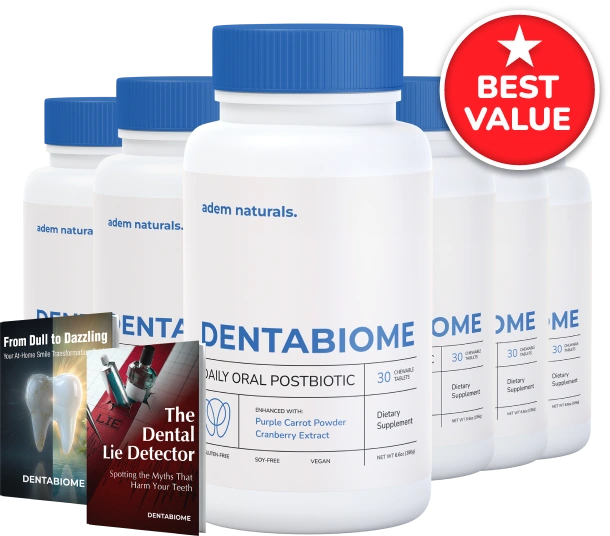
The official site currently advertises a promotional price of $49 per bottle, against a stated regular price of $99 per bottle.
Purchase options listed include:
- 1 bottle
- 3 bottles
- 6 bottles
Bundle contents and pricing can shift over time, so I wouldn’t rely on older screenshots or third-party listings for current numbers.
The 6-bottle option is described as including two digital bonuses and free U.S. shipping under the current promotion.
Where to buy it
According to the brand, DentaBiome is sold primarily through its own official checkout — not through major retailers or Amazon.
If you’re buying through an affiliate link, it’s worth double-checking the current offer, bundle contents, shipping terms, and refund policy directly on the official order page before paying.
Current single-bottle price: $49 Listed regular price: $99 per bottle
Since promotions change, confirm the final checkout price before completing an order.
The 60-Day Refund Window

DentaBiome’s official site states that eligible orders are covered by a 60-day money-back guarantee.
This is useful as buyer protection, but it isn’t scientific validation.
A refund policy answers one question:
“What happens if I’m not happy with what I bought?”
It does not answer:
“Has this actually been proven to work?”
Those are two entirely separate things, and it’s worth keeping them that way.
The current page states that refund requests are processed according to the company’s official policy and eligibility rules.
Before ordering, it’s worth saving a copy of the refund terms as they currently stand.
DentaBiome Reviewed for Legitimacy: Scam or Real Business?
Based on what’s publicly available, I would not call DentaBiome a scam.
The site includes:
- A named, identifiable product
- A stated ingredient list
- Clear usage directions
- Transparent pricing
- A money-back guarantee
- Contact details
- ClickBank checkout processing
- Health and FDA disclaimers
Those are all signs of a functioning, legitimate commercial operation.
That said, “not a scam” and “clinically proven” are two different bars, and only one of them is cleared here.
The more accurate conclusion:
DentaBiome looks like a genuine oral-wellness supplement, but the science behind the finished product shouldn’t be oversold.
That’s a more defensible position than either extreme —
“It definitely works”
or
“It’s definitely fake.”
Neither one is supported by what’s actually available to review.
How Much Weight Do Customer Reviews Carry?
The DentaBiome site features testimonials describing fresher breath, a cleaner mouth feel, and general satisfaction with the routine.
Those testimonials reflect individual experiences — nothing more.
They don’t establish clinical effectiveness, because they don’t control for:
- Other changes to oral-care routine
- Diet
- Concurrent dental treatment
- Placebo effect
- Natural day-to-day variation
- Reporting bias
- Different baseline oral health
So testimonials belong in the “anecdotal experience” bucket, not the “scientific evidence” bucket.
One more note: reviews on the site are labeled “Verified Purchase.” Without an independently confirmable verification process, I’d treat that label with some skepticism rather than as strong proof on its own.
Who It's Actually Built For
DentaBiome is probably the best fit for an adult who:
- Already brushes and flosses reliably
- Views supplements as optional extras, not essentials
- Is genuinely curious about oral microbiome support
- Prefers a low-effort chewable format
- Has realistic expectations going in
- Is comfortable with the price point
- Understands the evidence is stronger for individual ingredients than for the complete formula
This is not built for someone chasing an instant fix.
It’s better suited to someone thinking:
“My routine is already solid — I’m interested in adding an optional microbiome-focused supplement on top of it.”
That’s the realistic use case.
Who Shouldn't Self-Experiment
Skip the self-experimentation if you’re already dealing with symptoms that could point to an underlying problem, including:
- Ongoing tooth pain
- Noticeable gum bleeding
- Facial or gum swelling
- Suspected infection
- Loose adult teeth
- Severe sensitivity
- Persistent, unexplained bad breath
- A cavity that needs treatment
- Advanced gum disease
In any of these cases, a dentist needs to identify the cause and recommend treatment — a supplement can complement that process, but it shouldn’t delay it.
My Score
Here’s my rating based on everything currently available.
| Category | Score | Reasoning |
|---|---|---|
| Formula concept | 8/10 | Microbiome-focused premise is scientifically sound |
| Ingredient research | 7/10 | Several strains/species have real research behind them |
| Product-specific evidence | 4/10 | No finished-formula clinical trial identified |
| Transparency | 6/10 | Ingredients are named, but full amounts aren't disclosed |
| Ease of use | 9/10 | One daily chewable is about as simple as it gets |
| Value | 6/10 | $49/bottle is a real recurring cost vs. basic oral care |
| Overall | 6.5/10 | A reasonable add-on — not a proven treatment |
One-line verdict
DentaBiome is a solid concept with credible ingredient science behind it, but it’s best understood as an optional add-on rather than a proven dental-disease treatment.
Common Questions, Answered
1. Is DentaBiome legit?
When DentaBiome is reviewed against its own claims, it appears to be a genuine supplement sold through a real checkout system, with stated ingredients, usage directions, and a 60-day refund guarantee. That’s separate from whether the finished formula has been clinically proven — it hasn’t been, as far as I could verify.
2. Does it actually work?
It may offer some oral-wellness benefit, but product-specific evidence is thin. Research on individual probiotics doesn’t automatically prove the full DentaBiome formula performs the same way.
3. What’s actually in it?
A proprietary postbiotic blend, a dual-strain L. plantarum complex, L. salivarius, L. rhamnosus, BioFresh™ Clean Complex, xylitol, purple carrot powder, and cranberry extract.
4. Is it FDA approved?
No — the FDA doesn’t pre-approve dietary supplements for safety or effectiveness before they’re sold.
5. Does it contain real probiotics?
Yes — L. plantarum, L. salivarius, and L. rhamnosus, alongside postbiotic ingredients.
6. Is it better than toothpaste?
Not a fair comparison. Toothpaste and brushing handle fundamental cleaning; DentaBiome is positioned as an optional add-on. It shouldn’t replace brushing.
7. Can it replace flossing?
No — the brand itself frames it as complementary to standard hygiene, not a replacement.
8. Will it cure cavities?
There’s no evidence to support that. Supplements aren’t a substitute for dental treatment.
9. Will it help with bad breath?
It’s formulated with that goal in mind, but chronic bad breath often has causes that need professional evaluation.
10. How fast does it work?
There’s no guaranteed timeline — results depend on existing oral health, diet, habits, and consistency of use.
11. Is it safe?
No responsible reviewer can guarantee safety for every person. It’s intended for adults; anyone pregnant, breastfeeding, on medication, or managing a medical condition should check with a healthcare provider first.
12. Are there side effects?
There’s no verified, product-specific side-effect rate available. Individual ingredients carry their own general tolerance considerations, and responses vary person to person.
13. What does it cost?
The site currently lists $49 per bottle as a promotional price, against a stated $99 regular price — though promotions can change.
14. Is there a guarantee?
Yes — a 60-day money-back guarantee, subject to the official refund policy and eligibility terms.
15. Can I take it with my medications?
Don’t assume compatibility automatically. The FDA recommends checking with a doctor or pharmacist before starting any supplement, since interactions with medications are possible.
Sources
Used here for independent context, separate from the brand's own marketing claims.
- U.S. Food & Drug Administration (FDA) — Information for Consumers on Using Dietary Supplements
- American Dental Association (ADA) — Nutrition and Oral Health
- PubMed — Probiotics-containing beverages and dental caries: A systematic review and meta-analysis
- U.S. Food & Drug Administration (FDA) — Questions and Answers on Dietary Supplements
- PubMed — The role of probiotics in preventing dental caries: a systematic review of clinical evidence
- PubMed — Orally Administered Probiotics and Periodontal Pathogenic Bacteria: Systematic Review and Meta-Analysis
- PubMed — Probiotics in the Prevention and Treatment of Periodontal Diseases: A Systematic Review
- PubMed — Clinical Efficacy of Probiotics as an Adjunctive Therapy to Scaling and Root Planing
- PubMed — The Impacts of Probiotics Supplementation on the Treatment of Periodontitis: An Umbrella Meta-Analysis
- DentaBiome Official Product Information
Bottom Line: Is DentaBiome Worth Trying?
After going through the formula, the surrounding research on oral probiotics, the gaps in dosage transparency, and the absence of any verified clinical testing on the finished product, I’d place DentaBiome in the “reasonable add-on, not a miracle fix” category.
The strongest thing going for it is the underlying concept. The oral microbiome is a legitimate, active research area, and probiotics have shown some encouraging results in oral-health studies — especially when used alongside standard dental treatment, not instead of it.
The weakest link is the leap from:
“These ingredients have research behind them”
to:
“So DentaBiome is proven to deliver a specific result.”
That leap isn’t backed by the evidence available.
I also wouldn’t lean on this product as a replacement for the basics. Brushing, flossing, sensible eating habits, hydration, and regular dental checkups remain the foundation — nothing here changes that.
So who’s a reasonable candidate?
An adult with realistic expectations, who already has a solid oral-care routine and wants to experiment with additional microbiome-focused support, could reasonably give it a try.
Who shouldn’t rely on it?
Anyone dealing with active pain, swelling, infection, significant gum disease, or any condition that actually needs a diagnosis.
Final score: 6.5/10
DentaBiome earns a cautiously positive score — the concept is credible and the research area is real, but the evidence for the exact finished product isn’t strong enough to rate it any higher.
If you do decide to try it, treat the 60-day guarantee as purchase protection, not proof of efficacy — and confirm the current price, ingredient list, and refund terms directly on the official page before ordering.