
What does the Cholibrium Supplement Facts label list?
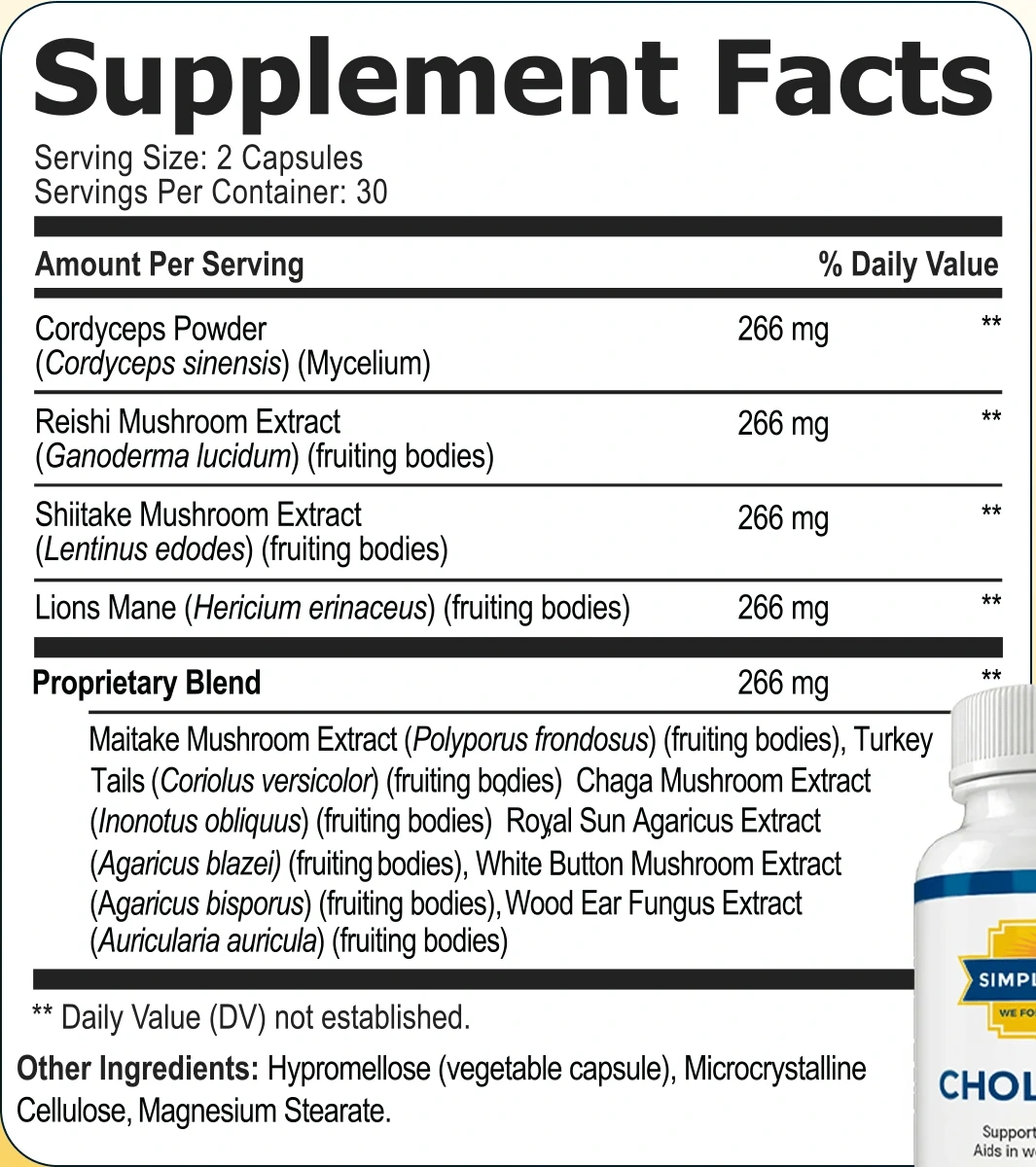
The supplied label names ten mushrooms: four entries at 266 mg each and six more sharing one 266 mg proprietary blend.
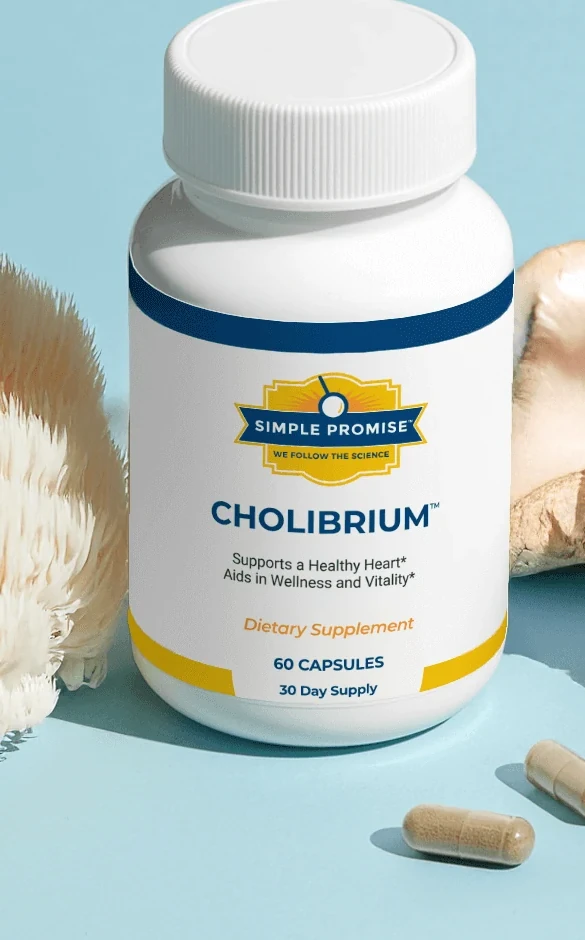
Serving size: two capsules. Servings per container: 30. The seller-published bottle identifies 60 capsules and a 30-day supply. These are label specifications, not a clinically validated duration of treatment. Amounts below apply to the two-capsule serving—not to each capsule.
| Listed entry | Scientific name | Labeled part or form | Amount |
|---|---|---|---|
| Cordyceps Powder | Cordyceps sinensis | Mycelium | 266 mg |
| Reishi Mushroom Extract | Ganoderma lucidum | Fruiting bodies | 266 mg |
| Shiitake Mushroom Extract | Lentinus edodes | Fruiting bodies | 266 mg |
| Lions Mane | Hericium erinaceus | Fruiting bodies; extract form not specified | 266 mg |
| Proprietary Blend | Six named members below | Fruiting bodies | 266 mg total |
The symbol beside each amount refers to “Daily Value (DV) not established.” It does not supply a target intake, a percentage of an effective dose or permission to take unlimited amounts. The four 266 mg entries are separately quantified; the blend is quantified only as a group.
| Name printed in the blend | Scientific name printed | Individual amount |
|---|---|---|
| Maitake Mushroom Extract | Polyporus frondosus | Not disclosed |
| Turkey Tails | Coriolus versicolor | Not disclosed |
| Chaga Mushroom Extract | Inonotus obliquus | Not disclosed |
| Royal Sun Agaricus Extract | Agaricus blazei | Not disclosed |
| White Button Mushroom Extract | Agaricus bisporus | Not disclosed |
| Wood Ear Fungus Extract | Auricularia auricula | Not disclosed |
The scientific names above preserve the supplied artwork, including Polyporus frondosus and Auricularia auricula. This is a transcription, not an independent species identification or silent taxonomic correction. The store description uses somewhat different naming and capsule wording; compare the actual bottle rather than assuming all versions are identical.
How should you interpret the 266 mg proprietary blend?
The six blend members share 266 mg per serving; the label does not disclose how much of each mushroom you receive.
FDA’s labeling guide describes a proprietary blend’s declared amount as the total weight of its included “other dietary ingredients,” with members listed in descending order of predominance by weight. That rule explains how to read a blend; it does not verify this product’s manufacturing, exact distribution or compliance. [1]
For this artwork, the reproducible calculation is 4 × 266 mg + 266 mg = 1,330 mg of listed mushroom entries per two-capsule serving. This total excludes unquantified other ingredients and capsule material. It is not the complete capsule mass, an assay result, a beta-glucan amount or a dry-mushroom equivalent.
- Do not assign 266 mg to every blend member. That would multiply the disclosed blend amount sixfold.
- Do not divide the blend equally. Equal portions are not stated, and numerical precision would disguise an invented allocation.
- Do not infer synergy from the total. Combining ingredients does not demonstrate that this combination performs better.
- Do not call it underdosed from mass alone. Such a judgment requires an appropriate preparation, outcome and evidence-based comparison.
The practical limitation is transparency: you cannot compare an individual chaga, maitake or other blend dose with research, nor precisely assess its exposure alongside another supplement. This is a substantive information gap, not proof of fraud or proof that no user could experience an effect. Our Supplement Label Guide explains the difference between a disclosed serving amount and an undisclosed component amount.
Do mycelium, fruiting bodies, powder and extract mean the same thing?
No. The artwork distinguishes a Cordyceps mycelium powder from several fruiting-body extracts, while leaving important preparation details unspecified.
Mycelium describes the fungus’s growing network; fruiting bodies describe its reproductive structures. These are different material descriptions, not automatic quality grades. The word “mycelium” alone does not reveal the growing medium, residual grain content, purity or chemical profile. Likewise, “fruiting bodies” alone does not prove superior clinical effectiveness.
The Cordyceps entry explicitly says powder. Reishi and shiitake explicitly say extract. Lion’s mane is listed by name and fruiting bodies without clearly specifying an extract. Within the blend, several entries say extract, but Turkey Tails does not. It would be inaccurate to rewrite the entire formula as ten standardized extracts.
As general preparation guidance, NIH ODS explains that an extract can concentrate selected constituents and that standardization involves measuring markers to help keep batches consistent. This guidance concerns botanical products; mushrooms are fungi, not plants. We use the preparation principle here—not the guidance as clinical evidence for these mushroom ingredients. [2]
No extraction ratio, extraction solvent, verified beta-glucan percentage or other active-marker specification was established from the inspected Cholibrium documents. Therefore, 266 mg of this reishi extract cannot simply be treated as interchangeable with 266 mg of a different extract or powder. Nor can we calculate an unstated “10:1” dry-material equivalent.
Useful seller questions are specific: Which entries are extracts? What material is used? What extraction and standardization specifications apply? Can those specifications be matched to a current lot? Without answers, the amount column describes labeled mass rather than a verified potency comparison.
What are the capsule and other ingredients?
The artwork lists hypromellose (vegetable capsule), microcrystalline cellulose and magnesium stearate; their individual amounts are not shown.
| Ingredient | What the inspected documents say | What remains unverified |
|---|---|---|
| Capsule material | Artwork: hypromellose (vegetable capsule). Store description: cellulose (vegetable capsule). | Exact current-bottle wording and finished-product certification. |
| Microcrystalline cellulose | Named in both the artwork and store description. | Amount and product-specific manufacturing function. |
| Magnesium stearate | Artwork names magnesium stearate; store description adds “vegetable.” | Amount and independently verified source for the received lot. |
These appear under “Other Ingredients,” separately from the mushroom entries. We have not verified their amounts or the precise manufacturing role of each in Cholibrium. They should not be counted as additional mushroom actives or credited with the seller’s heart-health claims.
The capsule wording discrepancy is worth clarifying, but the wording alone does not prove that the formulation changed. A description can use different levels of specificity. Ask for the label and documentation for the bottle being sold rather than substituting a more reassuring term ourselves.
If you avoid a particular ingredient or have a known reaction, use the complete current label in a professional review. A short other-ingredients list is not a universal safety clearance, and this document-based article cannot exclude manufacturing cross-contact or unlisted batch differences. [7]
Can ingredient studies establish what this formula will do?
Ingredient research can identify useful questions, but the inspected studies do not establish effects from this exact combination, preparation and dose.
The seller assigns the mushrooms roles in heart health, cholesterol support, vitality and immunity. Those are attributed marketing purposes. To evaluate them, the study must match the species, preparation, dose, population and measured outcome—not merely contain the same common mushroom name.
| Ingredient or group | Research context | Limit for the labeled formula |
|---|---|---|
| Reishi | Human trials and systematic reviews provide clinical evidence to examine. The 2025 review found very-low-certainty evidence across mixed preparations and outcomes; overall lipid and blood-pressure analyses were not significant. [3] [4] | The labeled 266 mg extract lacks verified standardization. These are not trials of Cholibrium or a validated dose-equivalence calculation. |
| Lion’s mane | One seller-linked lipid paper examined an experimental extract in high-fat-fed rats. [5] | Different preparation and animal model; it cannot confirm human cholesterol, focus or calm effects at this label’s dose. |
| Cordyceps | A cited fatigue experiment used C. militaris polysaccharides in mice. [6] | The label says C. sinensis mycelium powder. Species, preparation and outcome differ; swimming-related fatigue is not a human cholesterol test. |
| Shiitake and the six-member blend | The label identifies names and, mostly, material parts; individual blend amounts and marker levels remain undisclosed. | Ingredient identity, food use or mechanistic arguments cannot fill missing formulation-matched clinical evidence. No numerical study-dose match is established here. |
This comparison is deliberately limited. It is not a claim that all mushroom research is negative or that none of these ingredients has been studied for any use. The key finding is that the supplied amounts and descriptions do not bridge the gap between ingredient research and a dependable outcome for this bottle.
Our bounded exact-product searches did not identify a matching published finished-formula trial or registration. Searches can miss alternative names, unpublished work and unindexed studies; failure to locate a match is not proof that no study exists. The detailed Cholibrium effectiveness and evidence analysis owns that question. The Supplement Evidence Guide explains why preparation matching and study quality matter.
Are vegan, gluten-free and allergen-free claims verified?
The seller advertises vegan-friendly, gluten-free and allergen-free positioning, but independent finished-product certification was not verified in our inspection.
The inspected storefront says “Keto, Paleo & Vegan-Friendly,” “Allergen-Free” and “Gluten-Free.” The artwork’s vegetable-capsule description is consistent with a seller plant-based capsule claim, but it does not independently verify every ingredient, processing aid or possible manufacturing cross-contact.
Do not reinterpret “allergen-free” as a guarantee for someone with a mushroom allergy or an individual reaction to an excipient. Ask the seller for the current ingredient statement, relevant allergen controls and the certification or test results needed for your specific restriction. We did not obtain a finished-product vegan certification or a current-lot gluten test.
Similarly, promotional non-GMO or GMP wording does not itself establish a current certificate or batch assay. Quality-assurance claims and efficacy are different questions: even genuine quality testing does not guarantee that a supplement is safe for every person or clinically effective. [2] [7]
Reishi and chaga clinical-reference summaries contain ingredient-specific cautions, including interaction concerns and reports involving different exposures; these cannot supply Cholibrium-specific event rates. [8] [9] Our Cholibrium side-effects and safety analysis addresses these issues in detail. Bring the current label and your medicine-and-supplement list to a qualified professional instead of using dietary labels as a medical clearance.
Which seller-document discrepancies deserve a check?
The inspected documents differ on the mushroom-count slogan, capsule wording and some usage wording; the current bottle should resolve the purchase-specific facts.
| Issue | Observed difference | Practical next step |
|---|---|---|
| Mushroom count | A supplied promotional graphic says “9-in-1”; the Facts artwork names ten mushrooms and the storefront describes ten. | Use the received bottle’s complete list, not the slogan. |
| Capsule description | Artwork says hypromellose; store description says cellulose for the vegetable capsule. | Request current-lot label wording and clarification. |
| Serving versus promotional shorthand | Facts and supplied directions say two capsules; an affiliate-resource sentence says a single daily capsule. | Do not replace the two-capsule label serving with promotional shorthand. |
| Meal timing | Supplied directions say 20–30 minutes before a meal; some store wording says with a meal. | Check your bottle and ask the seller or healthcare provider; no evidence-based best timing is established here. |
These are document mismatches, not proof of a counterfeit or a confirmed formulation change. We have not purchased a bottle to inspect its seal, lot, expiry, full physical back label or current printed directions. The label artwork helps identify questions but cannot certify every shipment.
For label interpretation, two capsules are the denominator for the displayed amounts. That is separate from personalized dosing advice. Do not increase intake to resemble a research dose, combine additional mushrooms to “complete” the blend or invent a missed-dose schedule from this analysis.
What information should you request before comparing or using it?
Request a current label and lot-linked quality information; then compare identity, preparation, quantities and dietary restrictions without inventing missing specifications.
- Match the actual bottle. Confirm the ten names, four amounts, blend total, capsule wording and directions against what arrived.
- Clarify preparations. Ask which ingredients are powders or extracts, their parts, and any extraction ratios or marker specifications.
- Ask about the blend. If individual amounts are unavailable, keep them unknown rather than estimating equal portions.
- Request relevant lot documentation. Ask whether a certificate of analysis identifies the lot, test methods, results, laboratory and relevant contaminants. A generic logo is not the same record.
- Check your restrictions. Confirm the exact ingredient and allergen information needed for your own dietary or medical circumstances.
- Separate quality from benefit. A verified composition would improve identity confidence, not establish cholesterol lowering or clinical suitability.
No current-batch certificate of analysis, independently verified factory certificate or precise active-marker specification was obtained for this article. Lack of inspected documentation limits the assessment; it does not justify a claim that the product is contaminated. Store the seller’s response with the label so later formulation changes can be recognized.
Frequently asked questions about Cholibrium ingredients
These answers explain the inspected label; current-bottle confirmation and individualized professional advice remain separate steps.
Does Cholibrium contain ten mushrooms or nine?
The supplied Facts artwork names ten: four individually quantified mushrooms plus six blend members. A “9-in-1” graphic conflicts with that list; check the bottle actually supplied.
Is the 266 mg amount for each capsule?
No. The supplied artwork states a two-capsule serving. Four entries are 266 mg per serving, and the proprietary blend is 266 mg total per serving.
How much chaga or turkey tail is in Cholibrium?
Their individual amounts are not disclosed in the inspected artwork. Both are listed within the six-member 266 mg blend; an equal-share calculation would be an assumption.
Are all Cholibrium ingredients fruiting-body extracts?
No. Cordyceps is explicitly mycelium powder. Several ingredients say extract and fruiting bodies; lion’s mane and Turkey Tails do not clearly specify extract form in the artwork.
Does 1,330 mg mean the formula is clinically strong?
No. That number is the sum of the labeled mushroom entries. It does not specify marker content, extract equivalence, complete capsule mass or a proven effective dose.
Is the product definitely vegan or safe with allergies?
The seller calls it vegan-friendly and allergen-free, but independent finished-product certification and current-lot cross-contact controls were not verified. Someone with an allergy should not treat that wording as universal clearance.
Is a proprietary blend proof that Cholibrium does not work?
No. It creates a disclosure limit: individual ingredient exposures cannot be compared precisely. Demonstrating efficacy or ineffectiveness requires appropriate evidence, not a conclusion from the blend term alone.
How was this ingredient analysis prepared?
This is a document-based label analysis supported by independent guidance and selected studies, not hands-on testing or a clinically reviewed assessment.
We transcribed the user-supplied Supplement Facts artwork, compared it with the seller’s storefront description and supplied bottle/directions artwork, and checked general labeling guidance and preparation-specific research. The storefront was re-read on October 14, 2026. The 1,330 mg calculation uses only five declared amounts; no undisclosed constituent quantity was inferred.
AI assisted research, synthesis and writing. Biraj Health Care is the responsible editorial brand, not a medical credential. No independent human fact-check, clinical review, laboratory testing, purchase or personal-use experience is claimed. Source selection is limited to the inspected records; old artwork or a changed current lot can alter the applicable facts.
For broader product context, return to the main Cholibrium Review. Read our review methodology, sources policy and affiliate disclosure policy. The Biraj Health Care editorial profile explains the brand identity; contact FitnessLifeMag.com to request a correction. Material label or source changes should trigger a recheck of this page and the related review—not just a date change.
Sources and checked label documents
The independent references support the claims beside them; seller documents identify what is marketed and labeled rather than proving efficacy.
Commercial documents checked October 14, 2026: supplied Cholibrium Supplement Facts, bottle and Suggested Use artwork; Simple Promise’s Cholibrium storefront description and affiliate resource sheet. The tables distinguish artwork wording from storefront wording. We did not inspect a purchased current lot. Purchase actions use only the marked affiliate destination.
- FDA: Dietary Supplement Labeling Guide, Chapter IV — proprietary blends
- NIH ODS: Botanical Dietary Supplements Background Information — preparation and standardization principles
- Ganoderma lucidum supplementation: systematic review and meta-analysis, 2025
- Ganoderma lucidum for cardiovascular risk factors: Cochrane review, 2015
- Lion’s mane extract study in high-fat-fed rats, 2013
- Cordyceps militaris polysaccharides and fatigue in mice, 2016
- NCCIH: Using Dietary Supplements Wisely
- Memorial Sloan Kettering: Reishi Mushroom
- Memorial Sloan Kettering: Chaga Mushroom
What is the final label takeaway?
The label discloses ten mushroom names and some amounts, but not enough preparation or blend detail to establish a reliable research-dose match.
The most useful next step is obtaining the current bottle’s label and any relevant lot-linked specifications. Keep individual blend amounts, standardized marker levels and unverified dietary certifications explicitly unknown. Even a complete quality record would not substitute for clinical evidence of the finished product.
If cholesterol management is the goal, discuss the formula and your medicines with a qualified professional. Do not stop or replace prescribed treatment on the strength of mushroom names, a serving-total calculation or the seller’s heart-health positioning.