
The Memory Wave Review 2026: $39 Audio & 90-Day Terms
Affiliate disclosure: we may earn a commission if you buy through our links, at no extra cost to you. Disclosure policy.

Educational information; no product trial, personal listening test or medical review is claimed.
The Memory Wave review: what the offer actually is
The Memory Wave is an audio purchase with an uncertain memory payoff. Its appeal is a simple listening routine rather than a formula to swallow. The practical decision is whether that experience is worth the price to you after separating scientific possibility, demonstrated product benefit and the conditions attached to the transaction.
| Buyer question | Finding |
|---|---|
| What is it? | A commercial digital audio program. |
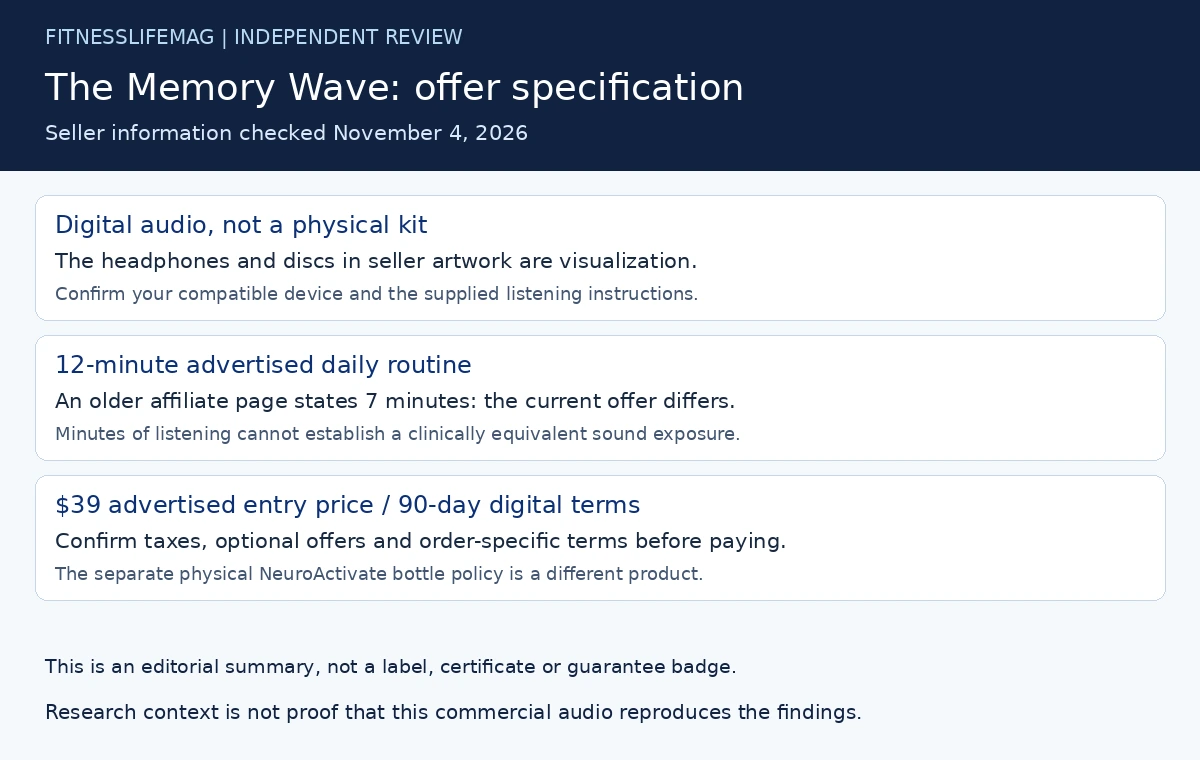
| Current routine | The live offer describes 12 minutes daily. |
| Physical shipment | Product images are visualization, not a promised headphone/CD kit. |
| Advertised mechanism | Gamma-related brain activity; exact waveform was not assessed. |
| Ingredients | No ingestible formula or Supplement Facts panel applies. |
| Product trial | No identifiable finished-recording trial located in our targeted public searches. |
| Best interpretation | Optional listening experience with uncertain cognitive benefit. |
| Safety | Volume and listening context matter; no measured product event rate established. |
| Advertised price | $39 front-end; address-dependent tax and optional purchases can differ. |
| Billing | The inspected cart shows a single $39 item; no recurring schedule displayed there. |
| Refund | Checkout states 90 days from purchase for this order. |
| Retailer | ClickBank; seller contact is linked from the current offer. |
Our current conclusion is cautious: the program may be attractive as a structured listening break, but it has not earned a recommendation as a memory treatment. Someone seeking help for progressive cognitive change has a different decision to make: assessment and practical support should come before an unverified audio purchase.
How the 2.6/10 editorial assessment was calculated
This audio assessment uses explicitly adapted criteria and earns 2.6 out of 10. The weights follow our published framework, while acoustic specifications replace ingredient doses. Bands describe documented support and transparency, not the likelihood that a listener will improve; the score is neither a customer average nor a medical validation.
| Adapted dimension | Band / 4 | Weighted points | Reason |
|---|---|---|---|
| Finished-recording human evidence | 0 | 0.000 / 3.0 | No matching trial identified in the documented search. |
| Audio research and plausibility | 2 | 1.250 / 2.5 | Relevant research exists, with mixed results and transfer limitations. |
| Acoustic specification transparency | 1 | 0.500 / 2.0 | The routine is described, but a reproducible acoustic protocol is not established. |
| Listening safety information | 1 | 0.375 / 1.5 | Hearing risks can be contextualized; product-specific tolerability data remain unresolved. |
| Checkout and digital refund clarity | 2 | 0.500 / 1.0 | Price and deadline are visible, with mismatched/template seller policy material. |
Calculation: 0 + 1.250 + 0.500 + 0.375 + 0.500 = 2.625, rounded once to 2.6/10. This category adaptation is specific to this review and is not a validated clinical scale. It does not convert a lack of located product research into proof that the recording cannot help anyone.
Practical strengths and limitations
The clearest strengths concern format and convenience rather than proven cognitive effects. Buying downloadable sound can be straightforward, but a convenient routine and a refund window do not answer whether memory improves. The balance depends on your goal, your budget and how much uncertainty you are prepared to accept.
Practical strengths
- No supplement to ingest.
- A defined short listening session.
- Digital access avoids reliance on a physical delivery.
- A dated price and checkout refund window can be inspected.
Material limitations
- No matching commercial-recording clinical trial located.
- Incomplete acoustic detail for reproducing research conditions.
- Inconsistent duration/policy material across seller resources.
- Visual packaging can be mistaken for a physical kit.
Do the advertised benefits follow from the research?
Research on sound stimulation supports investigation, not a promise about this recording. Memory and attention results vary across frequencies, tasks and populations. A perceived calmer break is also different from a durable improvement in daily recall, and neither establishes that a consumer audio file changes brain clearance or disease progression.
| Advertised idea | What evidence actually covers | Realistic interpretation |
|---|---|---|
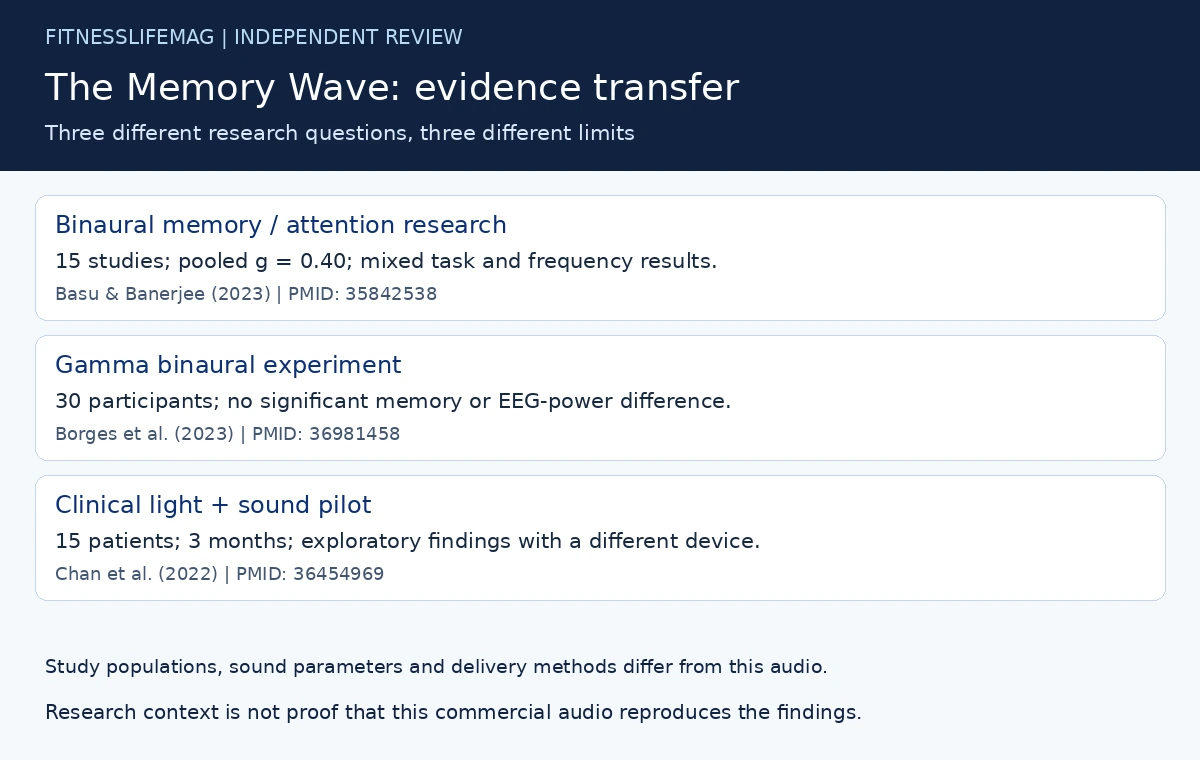
| Memory and focus | Mixed binaural research, including favorable pooled findings. Basu & Banerjee (2023) [PMID: 35842538] [1] | A plausible research question, without an established effect size for this product. |
| Gamma entrainment | A systematic review found inconsistent EEG results. Ingendoh et al. (2023) [PMID: 37205669] [2] | A sound label alone cannot confirm the listener’s brain response. |
| Brain cleaning | Multisensory amyloid-clearance research in mice. Murdock et al. (2024) [PMID: 38418876] [5] | Animal findings do not establish human clearance from a commercial recording. |
Positive and unfavorable findings both matter. A gamma binaural experiment in 30 people did not find significant memory-task or EEG-power changes (Borges et al. (2023) [PMID: 36981458] [3]). A small clinical pilot used light plus sound rather than this audio (Chan et al. (2022) [PMID: 36454969] [4]). Read the effectiveness review for the protocol differences and the Brain & Memory Guide for wider clinical context.
Audio components and specification transparency
There is no supplement ingredient list to audit for The Memory Wave. The relevant equivalent is the sound specification: delivery method, timing, channel separation, frequency structure and playback conditions. Without those details, matching an advertised gamma concept to a published experimental protocol would require assumptions that this review does not make.
| Component | Seller specification | Research comparison | Assessment |
|---|---|---|---|
| Core audio | Digital sound session. | Different studies use different sound or light-and-sound protocols. | Format is established; equivalence is not. |
| Session duration | 12 minutes in the current offer. | An older affiliate page says 7 minutes. | Use current supplied instructions; do not combine versions. |
| Gamma mechanism | Gamma activity is the advertised target. | Exact frequency, carrier, modulation and delivered level determine protocol relevance. | We did not analyze the purchased waveform. |
| Playback hardware | Not fully specified in the inspected short offer. | Binaural and other auditory methods have different delivery requirements. | Confirm headphones/speaker instructions after access. |
Bottles, active ingredients, excipients, milligram doses, blend ceilings and probiotic strains are inapplicable here. Our ingredient library covers ingestible products; it should not be used to give this audio a fictitious supplement formula.
Listening safety and reasons to seek assessment
The main controllable exposure is sound, so volume and context deserve attention. An audio program avoids ingestible-drug exposure, but that does not establish universal safety. Stop if listening causes discomfort, and do not let a wellness routine postpone assessment of new, worsening or function-limiting memory changes.
NIDCD explains that louder exposure becomes harmful over shorter periods (NIDCD (2025) [6]). Increasing volume to chase a stronger “brainwave” effect is not supported by the product evidence assessed here. Avoid listening during driving or other work that requires undivided attention.
- Use a comfortable, low volume; do not infer decibels from a phone percentage.
- If you have sound sensitivity, tinnitus, hearing loss or a seizure history, ask a relevant clinician about the specific sound and playback instructions.
- No product-specific adverse-event frequency was established; absence of ingestible ingredients is not a measured safety study.
The listening safety review distinguishes precaution from a documented contraindication. For health concerns, National Institute on Aging [7] discusses medicines, sleep, sensory health and other contributors; do not stop prescribed treatment to try an audio program.
What customer feedback can and cannot tell you
Public feedback does not provide a representative clinical result for The Memory Wave. A small third-party domain profile exists, but purchase identity, recording version and sampling are unresolved. Seller-selected experiences and promotional endorsements carry further selection concerns, so this review does not turn testimonials into a success rate or diagnosis.
The inspected Trustpilot profile is unclaimed and concerns a related support-domain name. Its small, self-selected collection cannot reliably establish typical memory improvement, complaint prevalence or refund recovery. We have not independently authenticated those purchases, and we are not reproducing customer testimonial text or a customer star score.
The complaints and buyer-options review focuses on verifiable policy friction and the limits of feedback attribution. For your own records, distinguish a disappointing listening experience from access failure, an unexpected charge or an unresolved refund; those issues need different evidence and next steps.
Price, billing and the digital refund window
The inspected checkout shows one digital item at $39 and a 90-day purchase-based return window. The blank US address state displayed zero tax, which cannot predict every buyer’s tax. No subscription schedule appeared in that inspected cart; separately accepted upgrades or a changed checkout require their own review.
| Item or calculation | Result | Boundary |
|---|---|---|
| Base price | $39 × 1 = $39. | Before address-dependent tax or optional purchases. |
| Thirty-day use illustration | $39 ÷ 30 = $1.30 per listening day. | An amortization example, not a recurring fee or time to benefit. |
| Thirty daily sessions | 12 × 30 = 360 minutes, or 6 hours. | A time commitment, not an effective clinical dose. |
| Digital return window | 90 days from purchase in the inspected checkout and digital terms. | Keep the receipt and order-specific instructions. |
| Net refund | Depends on the actual approved order refund and tax treatment. | No fixed deduction or guaranteed net amount was established. |
The separate NeuroActivate bottle-return text concerns physical goods and a 60-day period. It should not be applied to this audio. Generic template wording in the seller terms is a reason to retain your order evidence and ask for clarification when needed. No verified coupon was found on the current supplied offer; do not assume a code or countdown discount.
Before paying, save the item name, total, billing frequency, guarantee deadline and support route. Decline optional purchases you do not want. A refund promise reduces neither the uncertainty of the cognitive claims nor the time spent pursuing an unresolved order.
Seller identity, purchase route and legitimacy
The authorized affiliate route reached the supplied Memory Wave seller and then a ClickBank digital checkout. That verifies the observed transaction path, not the advertised science or every corporate claim. A familiar retailer, a working page and a refund statement answer different questions from whether an audio product improves memory.
- Start from the supplied offer path; avoid assuming a lookalike domain is the same seller.
- The current offer identifies ClickBank as retailer and provides a seller support email. The order receipt is the best reference for the item actually bought.
- The affiliate material names Binaural Technologies LLC, while some retrieved policy text retains generic identity fields. A complete legal-identity reconciliation was not established.
- NASA-related endorsement language was not independently authenticated and contributes no clinical credit to this assessment.
We do not infer fraud from inconsistent copy, and we do not issue a blanket legitimacy certificate from a working checkout. The useful distinction is between access to a product, clarity of terms and substantiation of benefits. Review all three before choosing.
How to approach the advertised listening routine
Follow the instructions supplied with the purchased recording rather than an older promotional duration. The current sales presentation describes a daily session, but this review did not access the paid file or verify its waveform. Device compatibility and any headphone requirement should be confirmed with support before relying on an assumption.
- Confirm that you are buying digital access, not the pictured accessories.
- Read the supplied playback instructions, including device, headphones and volume advice.
- Choose a safe seated setting and stop if the sound is unpleasant or distracting.
- If you choose to try it, define a small everyday goal and record whether it changes; repeated familiarity or expectation can influence perceived improvement.
Repeating sessions or turning sound up has not been shown here to increase benefit. A listening diary is a personal record, not a controlled trial, and it should never delay needed medical evaluation.
What to compare before paying for another audio program
Compare options by your intended outcome rather than by dramatic brainwave language. A free listening break can test whether you enjoy a routine, while persistent memory symptoms need clinical attention. Other commercial audio programs remain separate products; their existence does not establish that one proprietary sound is superior.
| Option | Decision it serves | Cost perspective | Evidence boundary |
|---|---|---|---|
| Quiet rest or already-owned familiar audio | Would a regular listening break feel useful? | No additional purchase cost if already accessible. | Not claimed to reproduce a gamma protocol. |
| The Brain Song | Compare another commercial audio presentation. | Read our separate review; verify current terms. | No assumed superiority or interchangeable waveform. |
| The Genius Switch | Compare another audio-led self-improvement offer. | Read our separate review; compare inclusions. | Different brand, claims and evidence need their own assessment. |
| Health assessment and practical supports | Understand new or disruptive memory changes. | Clinical cost varies; calendars and reminders may already be available. | Addresses the actual problem rather than proving an audio effect. |
For a deeper same-criteria buyer comparison, see complaints, terms and alternatives. A $0 incremental benchmark is a practical spending comparison, not a claim that free audio treats a disease.
Who might consider it, and who should skip it
Consider The Memory Wave only as an optional listening purchase with uncertain cognitive results. The strongest reason to skip it is a need for demonstrated treatment or a budget that makes an uncertain purchase burdensome. A modest daily routine cannot substitute for diagnosis, medication review or help with changing everyday function.
The price and digital format are easier to establish than the health payoff. The main unresolved questions are whether this exact recording produces the advertised brain response and whether that response improves meaningful daily outcomes. Better acoustic disclosure and well-controlled product trials would be more persuasive than another promotional neuroscience story.
If you are comfortable paying for an audio experience itself, read the current terms and keep the receipt. If you need reliable improvement in memory, this assessment does not establish that the program can deliver it.
Questions before deciding
Is The Memory Wave a supplement?
Is the routine seven or twelve minutes?
Does a gamma claim prove memory improvement?
Will I receive the pictured headphones?
Does the 90-day guarantee promise results?
Can it replace assessment of memory loss?
References
- Basu & Banerjee (2023) — Potential of binaural beats intervention for improving memory and attention (PMID: 35842538).
- Ingendoh et al. (2023) — Binaural beats to entrain the brain? A systematic review (PMID: 37205669).
- Borges et al. (2023) — Influence of Binaural Beats Stimulation of Gamma Frequency over Memory Performance and EEG Spectral Density (PMID: 36981458).
- Chan et al. (2022) — Gamma frequency sensory stimulation in mild probable Alzheimer’s dementia patients (PMID: 36454969).
- Murdock et al. (2024) — Multisensory gamma stimulation promotes glymphatic clearance of amyloid (PMID: 38418876).
- NIDCD (2025) — Noise-Induced Hearing Loss.
- National Institute on Aging — Cognitive Health and Older Adults.