
The Memory Wave Effectiveness Review: Gamma Evidence
Affiliate disclosure: we may earn a commission if you buy through our links, at no extra cost to you. Disclosure policy.

Educational information; no product trial, personal listening test or medical review is claimed.
This effectiveness review asks whether the advertised mechanism supports a useful memory benefit. The main Memory Wave review owns price, buying and overall value. Here the decision is narrower: how closely the recording matches research, what the studies measured, and what they leave uncertain for an individual listener.
| Claim | Relevant evidence | Match to this audio | Decision |
|---|---|---|---|
| Sharper recall | Mixed category-level research. | No finished-recording trial identified. | Do not expect a predictable gain. |
| Gamma entrainment | Inconsistent EEG literature. | Acoustic protocol and response not verified. | Mechanism needs direct testing. |
| Brain clearance | Animal multisensory work. | Species and delivery differ. | No human clearance conclusion. |
| Calmer thinking | May reflect the listening context. | No isolated commercial-product effect established. | Relaxation is distinct from memory treatment. |
A gamma concept is not a measured product response
The Memory Wave’s mechanism needs two separate demonstrations: a brain response and a useful outcome. Calling an audio gamma-oriented supplies neither measurement. An EEG response, if demonstrated under particular conditions, would still need a suitable comparison showing a meaningful change in the memory task or daily function that matters.
Ingendoh et al. (2023) [PMID: 37205669] [2] examined entrainment studies rather than this product. The mixed findings make an automatic “frequency in, benefit out” explanation unreliable. Binaural stimulation also differs from ordinary pulsed sound or combined light and sound; these methods should not be pooled as if they deliver an identical exposure.
- Signal: what is actually played, through which channels, at what level?
- Response: does that exact signal reliably affect the intended neural measure?
- Outcome: does the measured change help a relevant task beyond practice and expectation?
- Transfer: does a laboratory finding persist in daily life and the intended population?
What the studies do and do not establish
The strongest available comparison is between different research protocols, not between proven Memory Wave treatment outcomes. A favorable review of auditory research, a null gamma experiment and an exploratory light-and-sound pilot can coexist. Their different designs explain why none supplies a reliable clinical effect estimate for this commercial file.
| Research record | Design and population | Finding | Applicability |
|---|---|---|---|
| Basu & Banerjee (2023) [PMID: 35842538] [1] | 15 studies with 31 effect sizes. | Pooled g=0.40, with conflicting frequency/task findings. | Standardized task effects are not a percentage memory improvement or a product result. |
| Borges et al. (2023) [PMID: 36981458] [3] | 30 participants, gamma binaural and control conditions. | No significant memory-task or EEG-power difference. | A relevant unfavorable example; not proof that every sound intervention fails. |
| Chan et al. (2022) [PMID: 36454969] [4] | Single-blind randomized placebo-controlled pilot in 15 mild-AD patients. | Exploratory findings over 3 months with light and sound. | Small clinical pilot, different device and population; not validation of an audio download. |
| Murdock et al. (2024) [PMID: 38418876] [5] | Mouse-model multisensory gamma experiments. | Fluid-clearance and amyloid-related findings. | Animal mechanism, not demonstrated human benefit from this recording. |
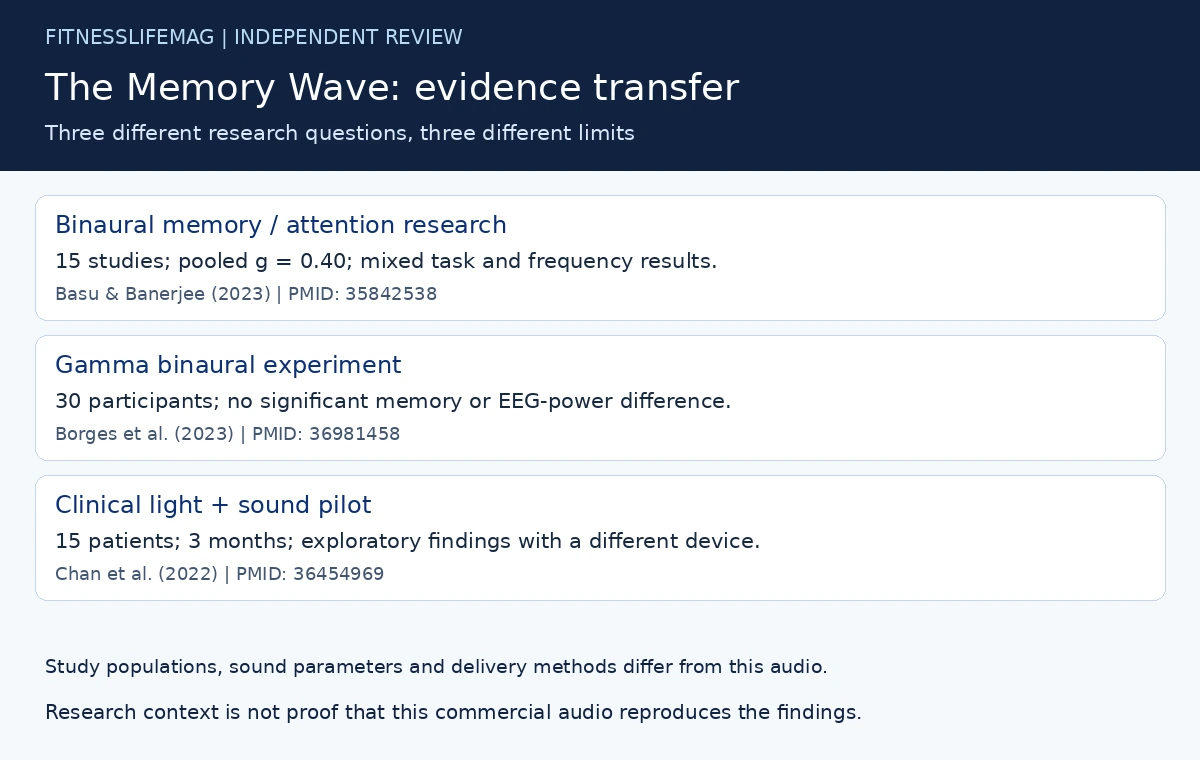
Our targeted exact-name public searches did not identify a trial of the finished commercial recording. The similarly named MemoWave sleep/EEG device registration belongs to a different sponsor and intervention and is not evidence for The Memory Wave. A product trial would need an identifiable recording version, a credible comparator and prespecified, useful outcomes.
There is no established product-specific benefit timeline
A daily listening schedule is not a validated timeline to better memory. The seller’s session duration tells you how the offer is presented, while a trial’s treatment duration tells you how that specific experiment was conducted. Neither can be converted into a guarantee that this recording works immediately or after several weeks.
- Immediate enjoyment, quiet or a change in mood is a subjective listening outcome.
- A better score on a repeated task can reflect practice rather than a durable cognitive change.
- A meaningful daily-life result requires a relevant goal, consistent measurement and a suitable comparison.
Do not extend a self-imposed trial indefinitely because a promised breakthrough remains just ahead. If the only reason to continue paying for audio is a result that has not appeared, reconsider the spending and the original goal. For transaction deadlines, use the main review’s buying section.
Why a personal impression can differ from a study result
Your listening context can alter what you notice without proving a unique recording effect. Distraction, expectations, repeated testing and the reason for the memory concern all influence interpretation. That makes an honest personal observation useful for deciding whether you enjoy a routine, but insufficient for diagnosing a cause or confirming treatment.
| Observation | Alternative explanation to consider | Useful response |
|---|---|---|
| I felt clearer after listening. | A quiet break, mood or expectation may contribute. | Separate relaxation from objective task change. |
| I remembered the practice list better. | The list or test may have become familiar. | Avoid treating repeated-test improvement as disease reversal. |
| I still struggle with daily tasks. | The underlying problem may require assessment. | Use the existing guide and seek appropriate care. |
For persistent concerns, National Institute on Aging [7] describes practical health factors. The Brain & Memory Guide provides broader education; the safety review covers listening exposure.
Questions before deciding
Is The Memory Wave clinically proven?
Does 40 Hz mean the audio is equivalent to GENUS?
Does the positive meta-analysis settle the question?
Could a null experiment miss a real effect?
What evidence would change this conclusion?
References
- Basu & Banerjee (2023) — Potential of binaural beats intervention for improving memory and attention (PMID: 35842538).
- Ingendoh et al. (2023) — Binaural beats to entrain the brain? A systematic review (PMID: 37205669).
- Borges et al. (2023) — Influence of Binaural Beats Stimulation of Gamma Frequency over Memory Performance and EEG Spectral Density (PMID: 36981458).
- Chan et al. (2022) — Gamma frequency sensory stimulation in mild probable Alzheimer’s dementia patients (PMID: 36454969).
- Murdock et al. (2024) — Multisensory gamma stimulation promotes glymphatic clearance of amyloid (PMID: 38418876).
- National Institute on Aging — Cognitive Health and Older Adults.