
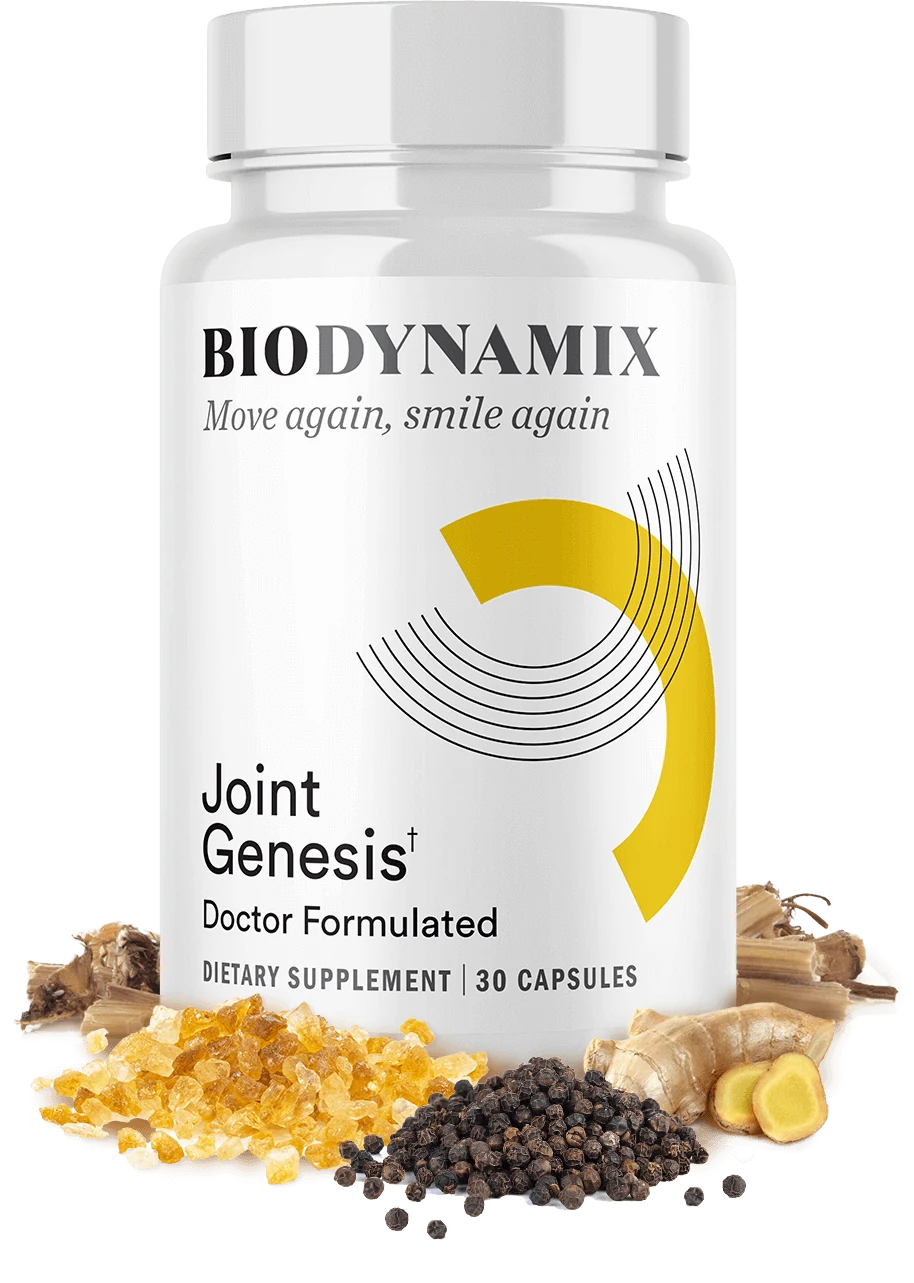
Does Joint Genesis work? The evidence reviewed here does not establish reliable benefits for the complete, currently labeled product. There is ingredient-level research worth examining, but it cannot be treated as a finished-formula result or a promise of pain relief.
This page examines how to interpret the studies, not the full buying decision. The main Joint Genesis review combines evidence with label, safety and transaction questions.
Affiliate disclosure: FitnessLifeMag may earn a commission through marked purchase links, at no additional cost to you. Compensation does not change our conclusions.
What would count as evidence that this product works?
A useful product-level study would identify the exact formula and serving, describe the participants and comparison group, measure outcomes that matter to users and report the findings transparently. It would distinguish changes over time from differences attributable to the product.
These are different evidence questions:
| Evidence level | What it can help establish | What it cannot establish by itself |
|---|---|---|
| Biological mechanism | A plausible reason to investigate an ingredient | That the capsule improves a person's symptoms |
| Ingredient study | Results for a specified preparation and exposure | Effects of every formula containing that name |
| Comparable blend | Findings for the tested combination | Equivalence to a different label or dose |
| Exact finished-product trial | Outcomes for that product in studied users | Guaranteed results for every buyer |
| Customer account | An individual's reported experience | Typical response or a controlled treatment effect |
We did not locate an independently verified exact-product human trial in the searches performed. That describes our search result, not proof that no unpublished, differently named or otherwise unlocated study exists.
Why the lubrication explanation is not enough
The seller emphasizes hyaluronan and joint fluid. A mechanism can guide research, but the steps from swallowing a capsule to changing a meaningful symptom still require evidence.
Ask what the cited experiment measured. Was it a laboratory marker, a joint-fluid measurement, muscle strength, pain, daily function or imaging? Those outcomes are not interchangeable. A change in a marker cannot automatically be rewritten as cartilage regrowth, pain elimination or restored mobility.
The same applies to the seller's numerical “10 times” claim. Before using it as a clinical conclusion, we would need the underlying report, setting, exposure and outcome. That chain was not verified here. We do not present it as a demonstrated human result of Joint Genesis.
What the HA and Mobilee studies add
The 2008 oral extract pilot enrolled 20 people and did not show a significant between-group result for its primary pain outcome. This limits what can be inferred from favorable secondary findings. Primary study.
The 2014 Sánchez report concerns a 90-day rooster-comb matrix intervention in yogurt and includes a blood-gene analysis subset. Its abstract reports favorable joint measures, but it does not test Joint Genesis. Without the complete analysis, we do not classify its overall primary result or treat biomarkers as cartilage-repair proof. Sánchez report.
A 2024 oral-HA review, indexed in 2025, reported a generally favorable picture across varied studies. Different preparations and outcomes still limit direct application to this formula, and our abstract-level inspection is not a full bias assessment. Review.
Together these sources justify qualified investigation, not a guaranteed product result. Full-text access was limited for some papers; we have not supplied a complete study-by-study certainty grading or represented it as complete.
What the broader HA overview cannot isolate
The publisher-indexed results for the 2024 review indicate that most included interventions combined HA with other substances. Consequently, a favorable overview cannot identify HA alone as the cause of every improvement or establish this particular combination’s effects. We accessed indexed passages, not a complete independent appraisal of all included trials. Publisher results.
For the 2013 yogurt study, improvements differed by muscle-test condition, and broader questionnaire outcomes were largely unchanged. This is a narrower finding than guaranteed relief of pain or restored daily mobility. Trial abstract.
How to read a favorable trial result
A study-to-claim comparison
| Report examined | Main relevance | Transfer problem | Permitted takeaway |
|---|---|---|---|
| 2008 oral HA-extract pilot | Small controlled knee study | Extract, not this finished capsule; primary pain result limited | An exploratory ingredient finding |
| Mobilee yogurt study | Defined matrix and functional measures | Delivery format and outcomes differ | Evaluate the measured outcome, not broad pain-free claims |
| Sánchez 2014 matrix report | Functional measures and exploratory biomarkers | Yogurt intervention; not the complete capsule | Promising ingredient context; no finished-product conclusion |
| Oral HA review | Broader overview of several preparations | Heterogeneous exposure and no exact-product trial | Qualified ingredient context |
The table is a comparability aid, not a complete systematic review or numerical certainty score. Source links and access limitations are given in the preceding section.
Start with the question the trial was designed to answer. A primary outcome usually deserves particular attention because it anchors that question. A secondary outcome or subgroup may provide a useful lead, but its interpretation depends on the analysis plan and context.
Then ask whether the improvement was between groups. People can improve during a study for many reasons. A before/after improvement in the supplement group alone does not establish superiority over the comparator.
Finally, consider clinical meaning. A statistical signal in one laboratory or performance measure may not translate into easier walking or a meaningful reduction in pain. A study may be interesting without supporting every advertising claim attached to it.
This framework is why our article does not assign a success percentage. Calculating “users helped” requires appropriate data, a defined threshold and transparent denominator; testimonials cannot supply those inputs.
Can supporting ingredients make the formula proven?
Combining ingredients does not combine their study results into a new clinical trial. Each preparation may have a different evidence base, and the finished combination can raise new questions about exposure and outcomes.
The inspected ginger is powder, the Boswellia has a particular total-acid specification, and the pine bark entry does not identify every research-extract detail. The ingredients page owns the complete form comparison. Here, the consequence is narrower: uncertain comparability prevents confidently assigning trial results to the bottle.
Neither “all ingredients have studies” nor “the doses look modest” is enough to settle effectiveness. The defensible conclusion depends on what was actually studied and how closely it matches the offered product.
What do the other ingredients contribute to the evidence?
The supporting ingredients add separate research questions, not an established combination effect. Ginger reviews, Boswellia guidance and pine-bark evidence must be read alongside preparation differences and uncertainty. A low-certainty finding is not a demonstrated synergy among five ingredients.
The ingredient preparation worksheet identifies which specifications can actually be compared. The safety review addresses a separate issue: a plausible benefit does not settle medicine compatibility or allergy suitability.
We also found no verified head-to-head trial in the reviewed sources showing this finished product superior to established care or another joint supplement. Comparative superiority therefore remains unestablished.
How long should results take?
We cannot provide a verified Joint Genesis response calendar. Ingredient-study durations, seller recommendations and selected customer timelines measure different things.
A longer study period does not prove that every user needs more bottles. Nor does a seller's recommendation to stock up establish increasing benefit with each month of use. Avoid interpreting a discounted large package as clinical evidence.
If you and your clinician decide to try a supplement, agree on what improvement would be meaningful and when the decision should be reviewed. Track a practical outcome such as an ordinary activity, along with concurrent care and symptoms. This is an individual decision record, not a personal experiment capable of proving product efficacy.
What can confuse an apparent response?
Changes in activity, exercise, prescribed treatment, other supplements, expectations and symptoms themselves can complicate interpretation. Record what else changed rather than attributing every good or bad day to one capsule.
A useful note includes the date, activity affected, symptom description, product serving and changes in other care. Avoid altering prescribed medicines to make a supplement easier to evaluate. Persistent or worsening symptoms deserve assessment, not an automatic extension of a trial because marketing says more time is needed.
The independent joint stiffness guide explains assessment and care options. That background matters because a product's intended audience is not a diagnosis of the reader.
Evidence questions
Is Joint Genesis clinically proven?
We did not verify an exact finished-product trial sufficient to support that broad wording. Ingredient research should be identified as ingredient research.
Does a positive subgroup prove the main trial succeeded?
Not automatically. Review the primary outcome, analysis plan, subgroup size and replication before turning the result into a general claim.
Does oral HA evidence prove a capsule repairs cartilage?
No such finished-product conclusion was established in our review. Route, preparation and measured outcome must be matched to the claim.
Do testimonials prove it works for most people?
No. Selected accounts do not provide a representative denominator or control for other explanations.
Method, limitations and conclusion
We searched exact product and ingredient/trial queries and checked primary research abstracts or indexed passages alongside the inspected product documents. Some full texts were inaccessible. Funding, analysis plans and risk of bias could not be fully assessed for those reports; no formal certainty grade is assigned. No personal-use or independent clinical review occurred.
Our conclusion is uncertainty at product level, with ingredient findings that warrant careful qualification. That is enough to reject guaranteed outcomes; it is not enough to declare that every user will receive no benefit.
Decision takeaway: judge product-level benefit as uncertain. Do not use an ingredient signal, a biomarker or a longer order package to substitute for an exact-product outcome study.
Policies: Editorial Methodology, Sources Policy, Affiliate Disclosure. Corrections.
Educational information only: Joint Genesis is a dietary supplement. This page is not a substitute for professional evaluation, diagnosis or treatment.
Affiliate disclaimer: FitnessLifeMag may earn commissions through marked purchase links. Evidence citations are not product endorsements.