
Does PrimeBiome Work? 500 Million CFU vs Human Trials
Editorial navigation. Commercial links appear separately.
Does PrimeBiome work for its advertised skin, digestive and weight outcomes? The answer depends on evidence for the complete formula, not merely a gut–skin explanation. The main PrimeBiome review covers the overall buying decision. This article grades the specific claims and checks whether human ingredient studies match the gummy’s strain, amount, preparation and intended result.
| Claim | Most relevant evidence type | Match to PrimeBiome | Assessment |
|---|---|---|---|
| Younger-looking skin | A controlled trial measuring skin appearance with the finished gummy. | No matching trial identified in retrieved exact-brand results. | A product-level effect is not established. |
| Digestive improvement | Human studies of named probiotic strains and defined populations. | The gummy gives a species and CFU count but no strain. | Indirect plausibility cannot predict individual response. |
| Regular bowel movements | A trial of a defined fiber amount in an appropriate group. | Inulin is hidden within a small nine-part blend. | The cited gram-scale study is not dose-matched. |
| Healthy weight | A relevant controlled study with measured weight outcomes. | The cited diuresis pilot studied a different dandelion preparation. | Urination is not evidence of sustained fat loss. |
This matrix separates what a study would need to show from what the available ingredient records actually establish. The exact-brand discovery searches did not identify a finished-formula RCT. PubMed exact-brand discovery query: PrimeBiome [1] ClinicalTrials.gov exact-brand discovery query: PrimeBiome [2]
A gut–skin mechanism is a research question, not an outcome
The seller links microbiome support to skin-cell turnover, digestion and youthful appearance. Even a plausible biological connection does not establish that one gummy changes a visible endpoint. A useful test would compare the finished formula with a suitable control, define the skin outcome in advance and measure the difference over an appropriate period.
Several steps separate the marketing story from that result: the specified organisms must be present and viable, exposure must resemble the studied preparation, a relevant biological change must occur, and that change must lead to a meaningful outcome. Evidence for one step cannot be silently promoted into proof of the entire chain. PrimeBiome (2026) [3] NCCIH [4]
| Evidence layer | Question it can address | Question left open |
|---|---|---|
| Laboratory mechanism | Can a substance affect a pathway under experimental conditions? | Will a person taking this gummy notice a benefit? |
| Ingredient trial | Did a specified preparation help a defined participant group? | Does a different blend with hidden amounts behave similarly? |
| Finished-product trial | Did this exact formula outperform its control for a stated outcome? | Will every individual respond or tolerate it? |
For skin concerns, the Beauty & Personal Care Guide helps distinguish temporary hydration, acne treatment and longer-term appearance goals. They require different endpoints. A general statement about “cell turnover” does not make them interchangeable.
What the human trials actually tested
Majeed et al. enrolled 36 people with diarrhea-predominant IBS and tested 2 billion CFU of B. coagulans MTCC 5856 daily alongside standard care for 90 days. PrimeBiome declares 500 million CFU without a strain ID. The dose ratio is 25%, and neither the organism specification nor the complete preparation is demonstrably matched.
The trial reported improvements in several IBS symptoms, but its small sample, specific diagnosis and industry affiliations matter when interpreting confidence and applicability. Thirty-one participants completed the study. It did not test PrimeBiome, a general healthy population’s cosmetic appearance, or a guarantee that another strain at a lower count will reproduce the findings. Majeed et al. (2016), PMID: 26922379 [5]
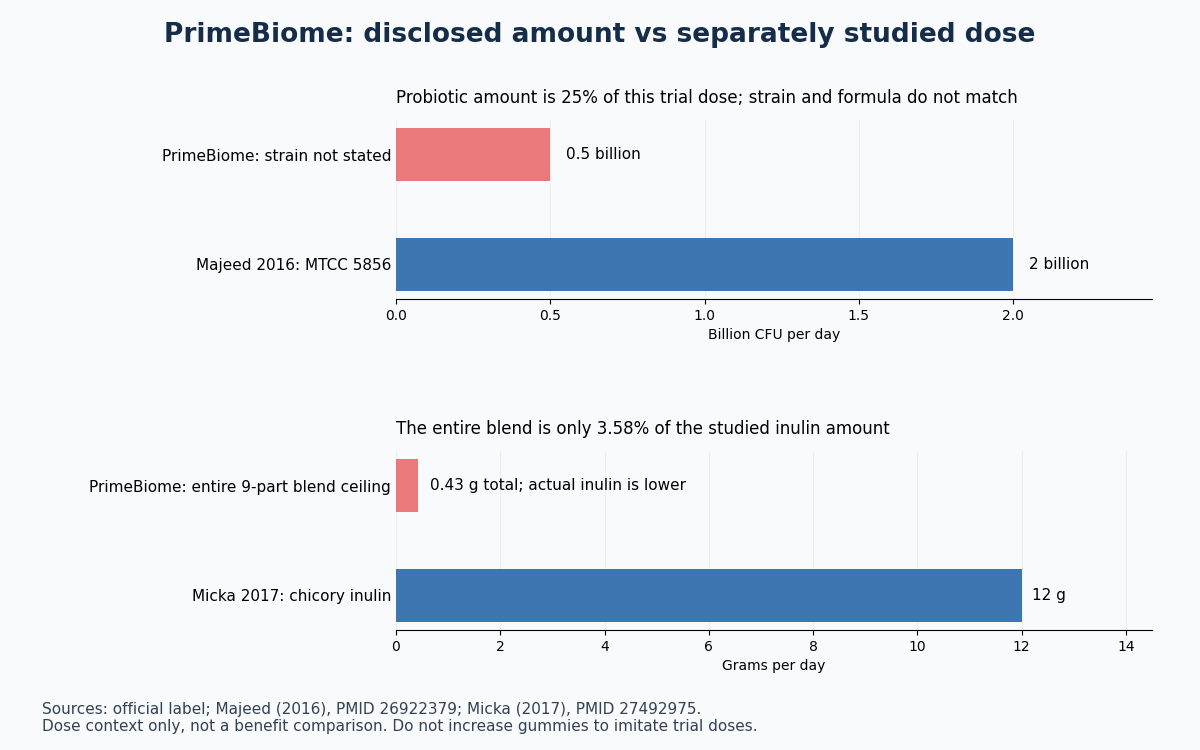
Micka et al. studied 44 volunteers with constipation using 12 g of chicory inulin each day for four-week periods in a crossover design. Stool frequency was the relevant endpoint. PrimeBiome’s whole blend weighs 0.43 g: even its upper-bound inulin allocation is less than 3.6% of that amount, and the actual allocation is smaller. Micka et al. (2017), PMID: 27492975 [6]
| Study | Preparation / population | Reported endpoint | Why transfer is limited |
|---|---|---|---|
| Majeed 2016 | Named MTCC 5856 strain; IBS-D; 90 days. | Questionnaire-based symptoms and related measures. | No demonstrated strain match or finished-gummy test. |
| Micka 2017 | 12 g/day chicory inulin; constipation; four-week periods. | Bowel frequency and consistency. | The blend cannot supply the studied inulin mass. |
| Clare 2009 | Leaf extract, 8 mL three times over one day; n=17. | Urinary frequency and excretion ratio. | An uncontrolled diuretic pilot is not a skin or fat-loss trial. |
Clare et al. (2009) provide an example of an endpoint mismatch: increased urination over one day does not establish lasting weight reduction. The trial also used liquid leaf extract, whereas the panel lists a hidden amount of dandelion leaf powder. Clare et al. (2009), PMID: 19678785 [7]
No verified PrimeBiome result timeline can be promised
A 30-serving bottle defines advertised supply, not the time required for a benefit. The ingredient studies used different periods, including four weeks and 90 days, but neither establishes a PrimeBiome response schedule. Without a relevant finished-formula trial, statements such as visible improvement in two weeks would add precision that the evidence does not support.
Before trying any optional product, define what you are actually observing: stool frequency, discomfort, a diagnosed skin condition or appearance under consistent lighting. Natural variation, changes in skin care, diet and concurrent treatment can influence those observations. A personal change can be worth discussing without proving that the gummy caused it.
- Choose a concrete outcome rather than a broad feeling of “detox” or rejuvenation.
- Record relevant changes to medicines, diet and skin care so they are not confused with the supplement.
- Do not regard worsening symptoms as evidence that a product is beginning to work.
- Seek assessment for persistent or concerning symptoms instead of repeatedly extending a self-directed experiment.
The safety guide addresses when to pause or seek care. The complaints article covers buying friction separately, so evidence timing does not get confused with transaction terms.
Why response cannot be predicted from CFU alone
A count of 500 million CFU does not describe the full intervention. Strain identity, viable-count timing, delivery format, background treatment and the participant’s condition all affect how a study should be interpreted. The nine hidden botanical amounts add another uncertainty. A higher count would not, by itself, establish a relevant skin benefit or individual suitability.
It is also possible for people to differ in tolerance or expectations even when taking a well-characterized preparation. That variability does not mean every outcome is equally plausible. The more specific the claim, the more directly the study should match it; an IBS questionnaire cannot be relabelled as a wrinkle endpoint. NCCIH [4]
The ingredient audit explains the disclosure gaps that constrain this analysis. Use the Ingredients hub to read about preparations, and keep the broader category perspective through Beauty & Personal Care Reviews. None of these pages treats ingredient overlap as product validation.
Five questions about PrimeBiome effectiveness claims
These questions focus on what the studies can establish. They distinguish the 2 billion CFU trial, the 12 g fiber trial and the much less informative brand-specific record. The useful conclusion is about applicability: promising findings for another preparation do not supply an unknown PrimeBiome success rate or a predictable personal response.
Does taking it for 90 days reproduce the IBS trial?
No. Matching the duration alone does not match the studied strain, dose, formulation, diagnosis or concurrent care. The trial tested MTCC 5856 at 2 billion CFU daily alongside standard care. PrimeBiome’s panel does not establish an equivalent intervention.
Can gut changes prove that wrinkles improved?
No. A change in a microbiome measure is a different outcome from a meaningful visible skin change. A skin claim needs an appropriate assessment, a comparison group and a relevant preparation. One cannot assume that any detectable microbial change produces the desired cosmetic result.
Is 25% of the probiotic dose the same as 25% of the benefit?
No. The 25% figure compares declared organism counts only. It is not a linear effect estimate, and the unidentified strain prevents equivalence. A quarter of another study’s CFU amount does not allow calculation of a quarter of its symptom change.
Can increased urination establish fat loss?
No. Urinary frequency and short-term fluid changes are not measurements of sustained fat loss. The dandelion pilot used another preparation and examined a one-day urinary endpoint. It does not establish a weight-loss result for the nine-component gummy blend.
Would an uncontrolled before-and-after photo settle the question?
No. Lighting, pose, concurrent products and natural variation can alter appearance. A photograph may document an observation, but without appropriate comparison and standardized assessment it cannot isolate the effect of PrimeBiome or establish how commonly the result occurs.
Affiliate link. Compare the offer with the study limitations rather than assuming an ingredient match.
Explore the PrimeBiome audit series
The five articles separate the overall purchase from four deeper questions. Use the main review for package value and the overall score, then choose the label, clinical evidence, safety or complaints page for its specific analysis. All figures use the same dated source record, while each article owns a distinct decision.
Sources and references
- PubMed exact-brand discovery query: PrimeBiome. Reviewed October 28, 2026. No matching finished-formula trial identified in retrieved records.
- ClinicalTrials.gov exact-brand discovery query: PrimeBiome. Reviewed October 28, 2026. No matching finished-formula record identified in retrieved results.
- PrimeBiome (2026). Official text presentation, package offers and FAQ.
- NCCIH. Probiotics: Usefulness and Safety. Safety and strain-specific interpretation guidance. Accessed October 28, 2026.
- Majeed M, Nagabhushanam K, Natarajan S, et al. (2016). Bacillus coagulans MTCC 5856 supplementation in diarrhea-predominant IBS: a double blind randomized placebo controlled pilot study. Nutrition Journal. 15:21. doi:10.1186/s12937-016-0140-6. PMID: 26922379.
- Micka A, Siepelmeyer A, Holz A, Theis S, Ehrhardt S. (2017). Effect of consumption of chicory inulin on bowel function in healthy subjects with constipation: a randomized, double-blind, placebo-controlled trial. International Journal of Food Sciences and Nutrition. 68(1):82–89. doi:10.1080/09637486.2016.1212819. PMID: 27492975.
- Clare BA, Conroy RS, Spelman K. (2009). The diuretic effect in human subjects of an extract of Taraxacum officinale folium over a single day. Journal of Alternative and Complementary Medicine. 15(8):929–934. doi:10.1089/acm.2008.0152. PMID: 19678785.