
PrimeBiome Ingredients: 430 mg Blend & 500 Million CFU
Editorial navigation. Commercial links appear separately.
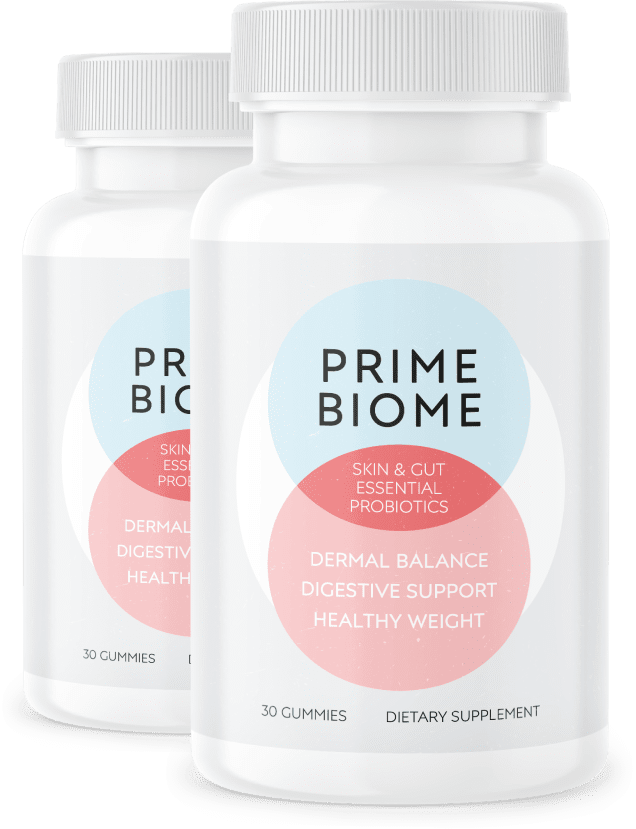
PrimeBiome ingredients combine a probiotic with a nine-part proprietary blend. This page examines the published label, amount disclosure and excipients, rather than package value or buying instructions. Start with the main PrimeBiome review for the overall judgment, then use the matrix below to separate declared facts from assumptions about ingredient doses and quality.
| Label component | Declared amount | Form / position | Missing detail | Practical interpretation |
|---|---|---|---|---|
| B. coagulans | 500 million CFU | Listed separately from the blend. | Strain ID and guarantee timing are not stated. | A species name cannot establish equivalence with a strain-specific trial. |
| Chicory root inulin | Part of 430 mg | First of nine blend components. | Its individual mass is hidden. | The entire blend provides a useful ceiling, not an actual inulin amount. |
| Babchi powder | Part of 430 mg | Second blend component. | Botanical standardization and psoralen content are absent. | Ask about identity and exposure before assuming a skin-care analogy. |
| Fennel seed powder | Part of 430 mg | Third blend component. | No individual dose is shown. | A culinary name does not establish a clinical exposure. |
| Fenugreek powder | Part of 430 mg | Fourth blend component. | No active-compound specification is shown. | Ask a pharmacist about relevant medicine and allergy considerations. |
| Ginger root extract | Part of 430 mg | Fifth blend component. | Extract ratio and gingerol content are not stated. | Marketing origin language cannot supply a missing standardization. |
| Lemon balm leaf extract | Part of 430 mg | Sixth blend component. | Extraction method and dose are not disclosed. | Other lemon-balm preparations are not automatically comparable. |
| Lion’s mane powder | Part of 430 mg | Seventh blend component. | The panel does not specify fruiting body, mycelium or beta-glucans. | Avoid importing a different mushroom preparation’s findings. |
| Slippery elm bark powder | Part of 430 mg | Eighth blend component. | Its dose is hidden within the total. | The name alone cannot define a useful regimen. |
| Dandelion leaf powder | Part of 430 mg | Ninth blend component. | Individual quantity is undisclosed. | Leaf powder differs from the liquid extract in the cited pilot. |
| Gummy excipients | Amounts not individually stated | Listed outside active Supplement Facts. | Flavor and vegetable-oil sources are not fully specified. | Read the exact current panel against your dietary needs. |
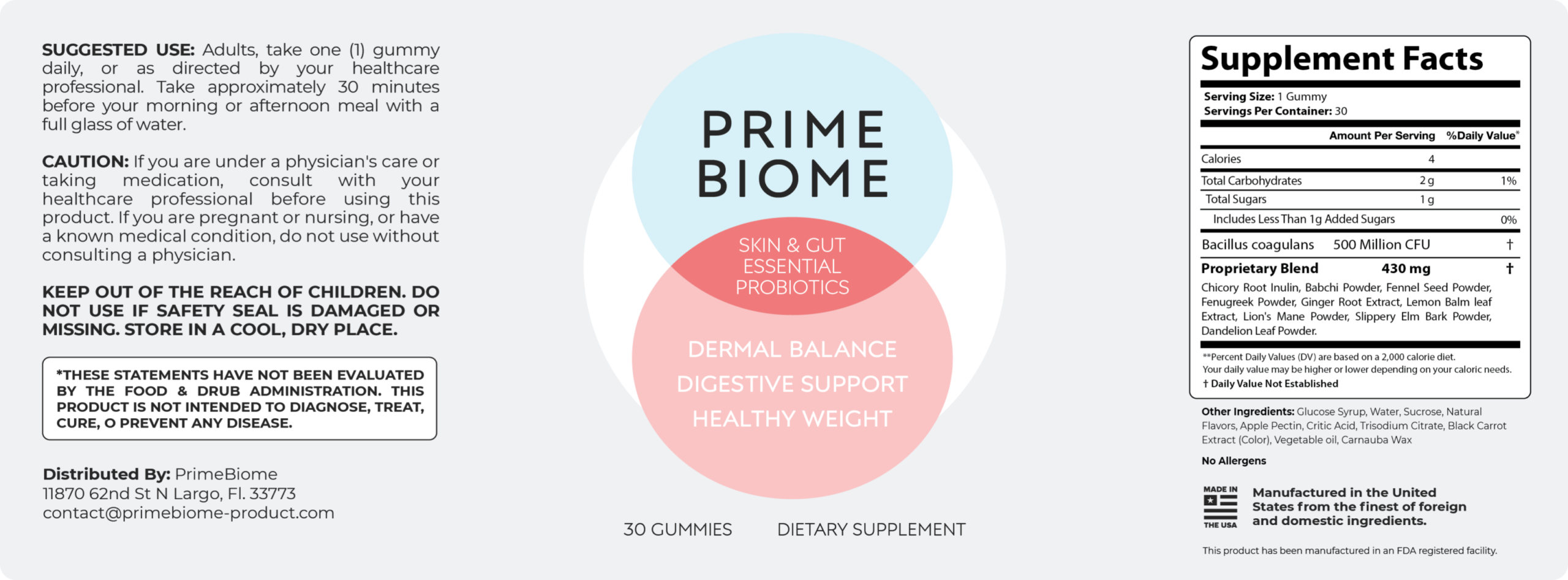
The matrix transcribes the official artwork, including its order. The full label below also supplies warnings and nutrition information that are easy to miss in the ten marketing highlights. PrimeBiome (2026) [1]
How to interpret the 430 mg proprietary blend
The nine-component blend totals 430 mg per gummy, so an equal-share calculation gives 47.78 mg per component. That arithmetic describes a hypothetical distribution, not the recipe. Each actual amount remains unknown, and no single ingredient can use the full blend allocation while leaving positive amounts for the other eight ingredients.
This distinction makes the inulin comparison unusually clear. A study using 12,000 mg daily cannot be matched by a gummy whose entire botanical and prebiotic blend weighs 430 mg. Dividing 430 by 12,000 gives 3.58%; the actual inulin percentage is smaller because the rest of the blend must also fit. Micka et al. (2017), PMID: 27492975 [2]
The result is a mass constraint, not a measured shortfall for every ingredient. It does not tell us which botanical is most abundant beyond the disclosed listing, whether any ingredient is active at a smaller amount, or how the complete mixture behaves. It simply prevents an implausible claim that the gummy supplies the studied 12 g of inulin.
- Use 430 mg as the combined allocation, not as the dose of each botanical.
- Do not convert CFU to milligrams: viable organism count and mass are different measurements.
- Do not interpret 47.78 mg as nine equal label servings.
- Do not take extra gummies to close a calculated gap; all other ingredients would rise too.
Ingredient evidence needs matching preparations
The clearest human comparisons involve B. coagulans and chicory inulin, but neither matches the published gummy specification. Majeed’s trial used MTCC 5856 at 2 billion CFU daily, while the label lists 500 million CFU without a strain. Inulin was studied at gram-scale intake, above this product’s entire blend mass.
| Ingredient | Seller label dose | Studied human dose | Audit verdict |
|---|---|---|---|
| Bacillus coagulans | 500 million CFU; strain unspecified. | Majeed et al. (2016): 2 billion CFU/day of MTCC 5856, 90 days, n=36. PMID: 26922379 [3] | One-quarter of that count, with no demonstrated strain equivalence. |
| Chicory root inulin | Individual amount hidden within 430 mg. | Micka et al. (2017): 12 g/day for four weeks per period, n=44. PMID: 27492975 [2] | Even the whole blend is below 3.6% of this studied amount. |
| Dandelion leaf powder | Individual amount undisclosed. | Clare et al. (2009): 8 mL leaf extract three times in one day, n=17. PMID: 19678785 [4] | A liquid diuresis pilot cannot validate gummy weight or skin claims. |
| Remaining seven blend ingredients | No individual mg or standardization shown. | No dose-matched finished-gummy trial identified. PrimeBiome (2026) [1] | Do not infer effective doses from the ingredient names. |
A named species is a broad starting point. The letters and numbers after it identify the studied strain; they are not optional marketing decoration. Without that identifier, a reader cannot establish whether the organism is the same as the one tested. A larger count alone would not repair an identity mismatch. NCCIH [5]
The botanicals raise additional preparation questions. Babchi powder is not purified topical bakuchiol. A leaf extract is not automatically interchangeable with leaf powder, and a mushroom powder is not necessarily the standardized extract used elsewhere. The relevant question is not simply whether an ingredient has ever appeared in a paper, but whether the preparation and endpoint apply here.
For study design and outcomes, continue to the effectiveness analysis. This label audit establishes what can be compared, rather than repeating every claim about what the combination may do.
Other ingredients, sugars and dietary screening
The panel lists glucose syrup, water, sucrose, natural flavors, apple pectin, citric acid, trisodium citrate, black carrot extract, vegetable oil and carnauba wax. Nutrition values are 4 calories, 2 g carbohydrate and 1 g total sugar per gummy. Less than 1 g added sugars does not mean a sugar-free product.
| Declaration | What it establishes | What it does not establish |
|---|---|---|
| Apple pectin | A stated gummy ingredient. | Complete vegan certification or full supply-chain documentation. |
| Natural flavors | A flavor category appears on the panel. | The identity of every flavor component. |
| Vegetable oil | An oil is included outside the active blend. | Its specific plant source. |
| No Allergens wording | The seller makes an allergen statement. | An individualized guarantee against botanical allergy. |
| Less than 1 g added sugars | The declared amount is below 1 g. | Zero added sugar or suitability for every glucose-management plan. |
If an allergy, strict dietary restriction or sensitivity affects your choice, ask about the ambiguous ingredients directly. Do not use the “No Allergens” wording to override a known reaction to a listed botanical. Keep the ingredient list available when discussing symptoms or compatibility with a professional. PrimeBiome (2026) [1] NCCIH (2025) [6]
Questions worth taking to a clinician or the supplier
A useful discussion starts with the exact panel and your intended outcome, not the promise of ten beneficial ingredients. Ask for the strain, viable-count guarantee timing, individual blend quantities and babchi specification. Those details would make the comparison more informative; a general facility badge cannot substitute for missing identity and exposure information.
- Which exact B. coagulans strain is used, and is the declared CFU count guaranteed through expiry or only at manufacture?
- What are the individual quantities and standardized constituents of the nine blend components?
- What botanical identity and psoralen testing support the babchi ingredient?
- Is a current independent finished-product testing report available, covering identity and relevant contaminants?
- Do my medicines or conditions make any ingredient inappropriate, even if its amount is not disclosed?
An independent quality report can address whether a batch matches specified contents, while a clinical trial addresses outcomes in participants. These are complementary forms of evidence. Neither an FDA facility statement nor a study of an isolated ingredient answers both questions. FDA (2026) [7] USP [8]
For symptoms, precautions and medicine questions, use the dedicated safety article. For the wider context, browse the Beauty & Personal Care Guide and Ingredients hub.
Five questions about the PrimeBiome ingredient label
These answers focus on interpreting the panel rather than predicting results. The 500 million CFU declaration, 430 mg total and one-gummy serving are useful facts, but leave important gaps. Distinguish a value actually printed on the label from an average, a marketing adjective or a study amount borrowed from another preparation.
Is Bacillus coagulans a strain name?
No. It is the species name as printed on this panel. A strain identifier adds a more specific designation, such as MTCC 5856 in the cited study. The label does not show that identifier, so the study organism cannot be assumed to match.
Does 430 mg apply to each ingredient?
No. It is the total for all nine components in the proprietary blend. Assigning 430 mg to each would imply a combined amount of 3,870 mg, which contradicts the declared total. The actual individual quantities cannot be read from that single value.
Can the equal-share average estimate my actual babchi intake?
No. The 47.78 mg calculation assumes nine equal portions solely to explain the total. The manufacturer does not state that the recipe uses equal parts. Use neither that average nor the full 430 mg as the actual babchi dose when assessing exposure.
Does the panel verify organic certification for every botanical?
No. The sales presentation uses organic language for selected highlights, while the panel names powders and extracts without a full set of certification details. That difference should be documented rather than filled in by assumption. Ask for the applicable certification when it matters to your choice.
Is a powder automatically equivalent to an extract?
No. Preparation changes which constituents are concentrated and how the material is specified. A powder weight cannot be converted into an extract dose without validated composition information. Compare the actual botanical part, extraction method and standardization before treating study findings as relevant.
Affiliate link. The independent label analysis above remains separate from the seller’s claims.
Explore the PrimeBiome audit series
The five articles separate the overall purchase from four deeper questions. Use the main review for package value and the overall score, then choose the label, clinical evidence, safety or complaints page for its specific analysis. All figures use the same dated source record, while each article owns a distinct decision.
Sources and references
- PrimeBiome (2026). Manufacturer label artwork, serving directions, Supplement Facts and distributor details.
- Micka A, Siepelmeyer A, Holz A, Theis S, Ehrhardt S. (2017). Effect of consumption of chicory inulin on bowel function in healthy subjects with constipation: a randomized, double-blind, placebo-controlled trial. International Journal of Food Sciences and Nutrition. 68(1):82–89. doi:10.1080/09637486.2016.1212819. PMID: 27492975.
- Majeed M, Nagabhushanam K, Natarajan S, et al. (2016). Bacillus coagulans MTCC 5856 supplementation in diarrhea-predominant IBS: a double blind randomized placebo controlled pilot study. Nutrition Journal. 15:21. doi:10.1186/s12937-016-0140-6. PMID: 26922379.
- Clare BA, Conroy RS, Spelman K. (2009). The diuretic effect in human subjects of an extract of Taraxacum officinale folium over a single day. Journal of Alternative and Complementary Medicine. 15(8):929–934. doi:10.1089/acm.2008.0152. PMID: 19678785.
- NCCIH. Probiotics: Usefulness and Safety. Safety and strain-specific interpretation guidance. Accessed October 28, 2026.
- NCCIH (2025). Fenugreek: Usefulness and Safety. Updated February 2025.
- FDA (2026). Questions and Answers on Dietary Supplements. Regulatory framework and limits of premarket approval.
- USP. Dietary Supplement Verification Program. Finished-product verification requirements. Accessed October 28, 2026.