
Prostavive Ingredients: Active & Other-Ingredient Map
For the full product assessment and buying terms, read our complete Prostavive review. This page focuses on the actual formula and label.
The label is best read as individually quantified nutrients and botanicals, one combined produce blend, and separate flavoring ingredients.
| Group | Active / other | Printed information | Why it matters | Next check |
|---|---|---|---|---|
| Nutrient panel | Active | D3, B6, magnesium, zinc, sodium | Adds to your existing supplement intake. | Compare total daily intake. |
| Botanical/fungal list | Active | Fenugreek, artichoke, ashwagandha, cordyceps, maca, nettle, tongkat ali, ginseng | Different plant parts and preparations serve different research questions. | Read each amount and extract specification. |
| Boron | Active | 5 mg as boron citrate | A trace element, not a prostate treatment. | Check other products containing boron. |
| Produce blend | Active blend | 200 mg for six named components | The total is disclosed, but individual component doses are not. | Avoid treating it as six separately dosed servings. |
| Flavor and processing ingredients | Other ingredients | Natural flavors, citric acid, sea salt, stevia leaf extract | Relevant to taste preferences and individual sensitivities. | Ask about the specific flavor source if allergic. |
Active Ingredients: Forms, Amounts & Research Relevance
Nettle root is the most directly relevant urinary-research example in the inspected evidence, while the rest of the panel needs outcome-specific interpretation.
The label’s 200 mg nettle root extract can be compared descriptively with the 450 mg/day root extract in the 2020 randomized trial. They are different preparations at different amounts; a larger or smaller printed milligram number alone cannot predict the effect of this complete powder. [1]
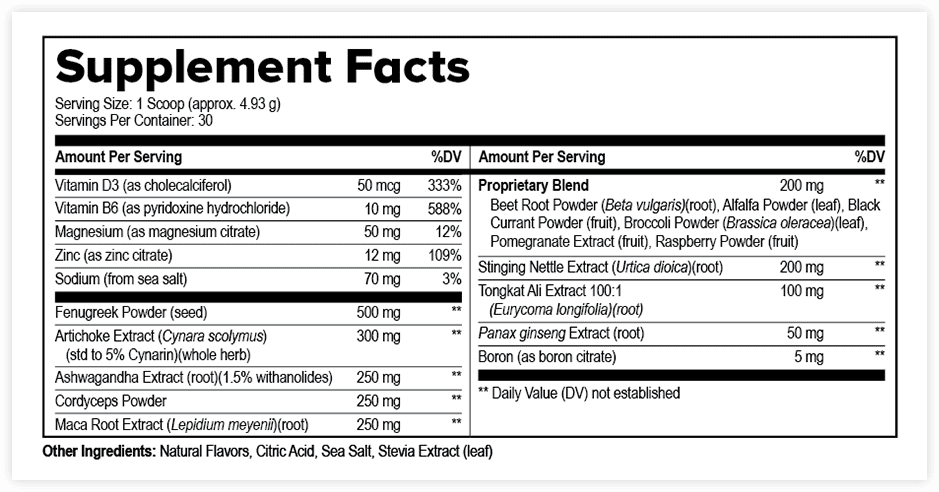
Complete Supplement Facts & Label Transcription
Serving size: 1 scoop (approximately 4.93 g). Servings per container: 30. Amounts and percentages below reproduce the inspected artwork, including its printed vitamin D percentage.
| Ingredient / printed form | Amount per serving | Printed %DV |
|---|---|---|
| Vitamin D3 (as cholecalciferol) | 50 mcg | 333% |
| Vitamin B6 (as pyridoxine hydrochloride) | 10 mg | 588% |
| Magnesium (as magnesium citrate) | 50 mg | 12% |
| Zinc (as zinc citrate) | 12 mg | 109% |
| Sodium (from sea salt) | 70 mg | 3% |
| Fenugreek powder (seed) | 500 mg | ** |
| Artichoke extract (Cynara scolymus), whole herb; standardized to 5% cynarin | 300 mg | ** |
| Ashwagandha extract (root), 1.5% withanolides | 250 mg | ** |
| Cordyceps powder | 250 mg | ** |
| Maca root extract (Lepidium meyenii), root | 250 mg | ** |
| Proprietary blend: beet root powder (Beta vulgaris), alfalfa powder (leaf), black currant powder (fruit), broccoli powder (Brassica oleracea, leaf), pomegranate extract (fruit), raspberry powder (fruit) | 200 mg total | ** |
| Stinging nettle extract (Urtica dioica), root | 200 mg | ** |
| Tongkat ali extract 100:1 (Eurycoma longifolia), root | 100 mg | ** |
| Panax ginseng extract (root) | 50 mg | ** |
| Boron (as boron citrate) | 5 mg | ** |
** Daily Value not established. Other ingredients: Natural Flavors, Citric Acid, Sea Salt, Stevia Extract (leaf). The label prints 333% for vitamin D3; this is a transcription of the artwork rather than a recalculation of current US Daily Values.
Which extract details are actually printed?
Artichoke is standardized to 5% cynarin, ashwagandha to 1.5% withanolides, and tongkat ali is described as 100:1. These describe different properties: standardization specifies a constituent proportion, while an extraction ratio describes starting-material concentration. Neither is a clinical outcome or a license to compare unlike botanicals by one number.
The 250 mg ashwagandha entry is relevant to the broader wellness positioning because some preparations have sleep and stress research. It also makes the condition and interaction checks in the safety analysis particularly relevant. [2]
D3, B6, magnesium and zinc are familiar nutrients with physiological roles, but their presence does not establish treatment of enlarged prostate or nocturia. Boron is not classified as an essential nutrient for humans by NIH ODS. Nutritional identity and disease efficacy are separate questions. [6] [7] [8] [9] [10]
For the claim-by-claim interpretation, use our Prostavive effectiveness analysis rather than assuming every ingredient contributes the same urinary benefit.
Other Ingredients, Allergens & Dietary Preferences
The other-ingredient line lists natural flavors, citric acid, sea salt and stevia leaf extract.
This is a flavored powder rather than a capsule, so the inspected panel has no capsule-shell entry. Natural flavors is a category description rather than an exact botanical or allergen-source breakdown. People with a specific sensitivity should obtain the flavor-source information from the seller before use.
The seller’s contact FAQ describes the formula as free of gluten, dairy, soy, wheat, barley and animal products. That supports an attributed dietary description; it does not establish independent certification or remove the possibility of allergy to a listed herb such as fenugreek. [4]
| Label question | Reader implication |
|---|---|
| Does the blend replace the individual active amounts? | No. The six-component 200 mg produce blend is one entry alongside separately listed botanicals and nutrients. |
| Is the powder a full vegetable serving? | The label describes a small supplement blend, not a substitute for dietary vegetables or a complete nutritional product. |
| Does natural flavor mean allergen-free? | No. Ask the seller about the particular flavoring sources when a sensitivity matters. |
Useful Questions for Your Pharmacist or Clinician
Bring the complete panel, not only the eight marketing highlights.
- Do the ashwagandha, ginseng and fenugreek fit my medicines and conditions?
- How much B6, vitamin D, zinc and magnesium am I already taking?
- Does my urinary symptom pattern need assessment before adding a supplement?
- Which changes or adverse effects should prompt stopping and review?
For product-wide supply, directions and buying terms, return to the main Prostavive review.
Ingredient Takeaway
The useful strength is a readable, mostly quantified formula that you can discuss alongside your current routine.
Choose it for a suitable powder preference and an informed formula decision, rather than inferring disease treatment from a long ingredient list. The practical next step is to compare this panel with the other supplements and medicines you already use.
Review Prostavive’s Current OfferIngredient Questions
Does the inspected label list saw palmetto?
Saw palmetto is not named on the inspected Prostavive powder panel. The formula instead includes nettle root and other botanicals plus nutrients. A saw-palmetto capsule list from another website may describe a different product or an inaccurate summary; compare it with this actual label.
Is cordyceps included even though it is not a headline highlight?
Yes. The inspected Supplement Facts panel lists cordyceps powder at 250 mg per scoop. That is why this guide uses the full panel rather than only the marketing highlights. The entry does not specify a species or establish a urinary outcome for the complete formula.
Does 100:1 tongkat ali mean 100 mg is equivalent to a clinical extract?
The label’s ratio describes an extract characteristic, not a validated clinical equivalence. A trial also depends on manufacturing method, standardization, studied population and outcome. Do not convert the ratio into a predicted testosterone change or a prostate benefit.
Are the six produce-blend components each 200 mg?
No. The panel gives one 200 mg total for beet root, alfalfa, black currant, broccoli, pomegranate and raspberry ingredients. It does not assign 200 mg to each or reveal their proportions. An equal division would also be an invented ingredient distribution.
Why reproduce the label’s vitamin D percentage exactly?
The purpose of the transcription is to show what the inspected artwork actually prints. It lists 50 mcg and 333%. Those are label-transcription details, not our recalculation or endorsement of the percentage. Compare the current jar panel and ask the seller about a discrepancy.
Explore Our Prostavive Analysis
Author, Method & References
- Karami et al. (2020). Nettle root extract randomized trial in 60 men; PubMed abstract.
- NCCIH. Ashwagandha: usefulness and safety.
- NCCIH. Fenugreek: usefulness and safety.
- NIH ODS. Vitamin B6 health professional fact sheet.
- NIH ODS. Vitamin D health professional fact sheet.
- NIH ODS. Zinc health professional fact sheet.
- NIH ODS. Magnesium health professional fact sheet.
- NIH ODS. Boron health professional fact sheet.
Affiliate disclosure: FitnessLifeMag may earn a commission from purchases through the commercial links on this page, at no extra cost to you. Scientific and editorial reference links are separate.
Educational information, not personal medical advice. Prostavive is a dietary supplement, not a treatment for BPH, prostate cancer or urinary retention. Discuss symptoms and supplement decisions with your clinician.