
Kerassentials Ingredients: 17 Listed, Just 1 Percentage
Educational information, not medical advice. Some links earn a commission at no extra cost to you. Read the affiliate disclosure.
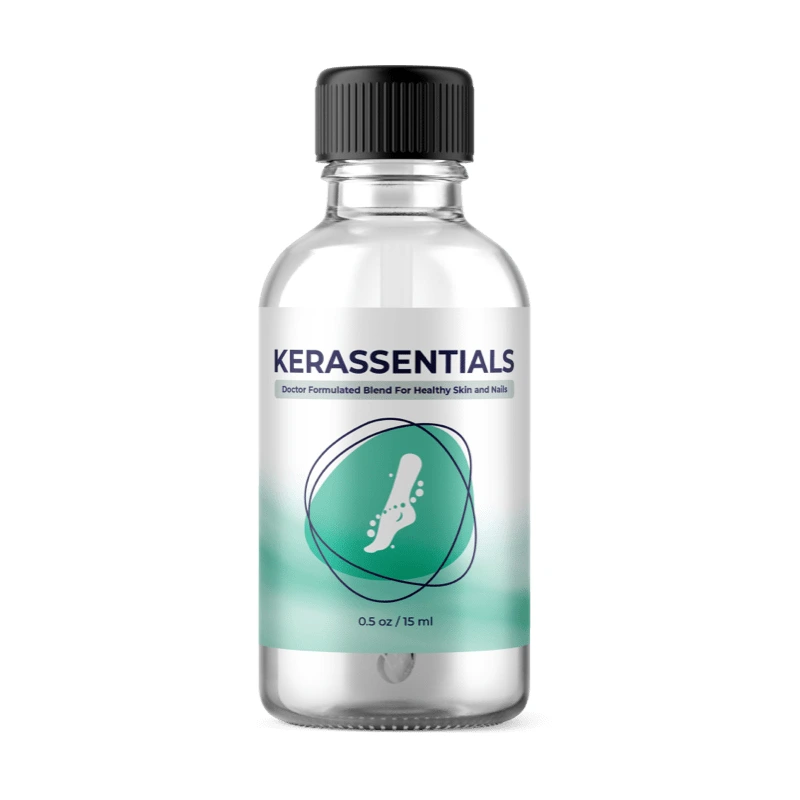
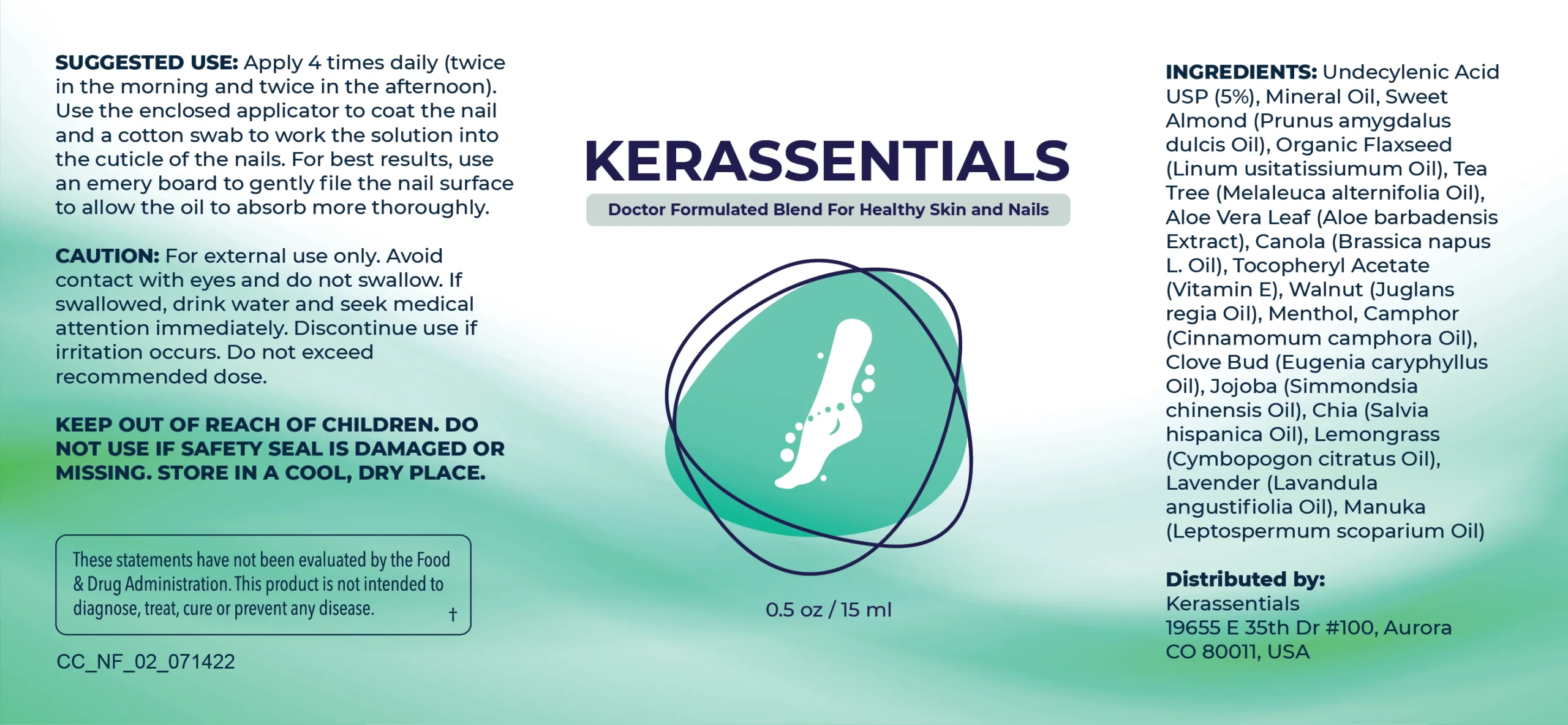
Kerassentials is an external-use nail and skin oil with 17 listed ingredients. This article examines what its official artwork discloses, how that differs from selected sales-page highlights, and which questions remain about exposure. For the overall buying decision, use the main Kerassentials review; the concentration audit begins below. Official label [1]
| Label entry / group | Disclosed quantity | How it appears | Useful question | Interpretation |
|---|---|---|---|---|
| 1. Undecylenic acid USP | The label states 5%. | It is listed first, but not in a separate Drug Facts active panel. | Does the current bottle match the published artwork? | A percentage is disclosed; finished-product clinical equivalence is not. |
| 2. Mineral oil; 7. Canola oil | Individual percentages are not stated. | These oils appear in the same ingredient list as the botanical components. | What fraction of the finished mixture is carrier? | The label does not support an equal-share calculation. |
| 3. Sweet almond; 9. Walnut | Individual percentages are not stated. | Both named nut-derived oils are disclosed. | Does a personal allergy history change suitability? | The label is useful for a professional allergy discussion, not a risk percentage. |
| 4. Organic flaxseed; 13. Jojoba; 14. Chia | Individual percentages are not stated. | These three oils appear on the full artwork. | Are exact specifications available for this production lot? | A plant name does not establish an effective nail-treatment concentration. |
| 5. Tea tree; 15. Lemongrass; 16. Lavender; 17. Manuka | Individual percentages are not stated. | These essential oils are named without marker standardization. | What are their final concentrations and stability specifications? | Their presence does not reproduce a different tested preparation. |
| 6. Aloe vera leaf; 8. Tocopheryl acetate | Individual percentages are not stated. | Aloe extract and vitamin E appear in the full mixture. | Which form and concentration are supplied in the current bottle? | Skin-support descriptions do not substitute for formula-matched research. |
| 10. Menthol; 11. Camphor; 12. Clove bud | Individual percentages are not stated. | All three are in the label list rather than the eight highlighted sales-page components. | Could adding another topical product increase irritation? | Review the entire mixture, not only the ingredients emphasized in marketing. |
The matrix transcribes common ingredient names and original order numbers from the manufacturer artwork. Functional groupings are editorial navigation, not manufacturer-declared active/inactive classifications. Official label [1]
What can—and cannot—be calculated from the label
Only undecylenic acid has a stated concentration: 5%. The 15 ml bottle size describes container volume, not an oral serving or a known mass applied per day. Because the other proportions are undisclosed, neither an equal-share average nor a percentage tea-tree shortfall can be calculated from the published label.
A familiar supplement-review shortcut would be to divide a total blend weight by an ingredient count. That operation has no basis here. No total active blend weight is given, ingredients need not have equal shares, and oil density and application amount are not specified. “Seventeen ingredients” is a list count, not a concentration equation. Official label [1]
Nor does 5% tell us how much undecylenic acid reaches the nail bed. Exposure depends on formulation, application and delivery through the nail. Clinical guidance treats nail penetration as an important distinction between a skin antifungal and a nail treatment; an ingredient percentage does not resolve it. AAD (2025) [2]
How the disclosed oils compare with human research
The most relevant human research concerns different preparations rather than the Kerassentials mixture. Buck’s 117-person trial used 100% tea-tree oil; Syed’s 60-person study used 5% tea tree with 2% butenafine. Those percentages describe the trial interventions, not a target dose proven necessary or sufficient for this commercial oil.
Buck et al. compared tea-tree oil with 1% clotrimazole solution for six months. Culture cure and visible improvement were separate outcomes. The trial is relevant to tea tree as a research topic, but its neat-oil intervention is not the same as a 17-ingredient product with no tea-tree percentage on the artwork. Buck et al. (1994), PMID: 8195735 [3]
Syed et al. tested a drug–oil combination. The presence of butenafine prevents attributing the combination’s benefit to tea tree alone, and Kerassentials does not list that drug. Calling the trial a test of this bottle would erase a medically important difference. Syed et al. (1999), PMID: 10357864 [4]
- A separate open study enrolled 20 patients using vitamin E plus lime, oregano and tea-tree oils. Kerassentials lists vitamin E and tea tree but does not list lime or oregano. The uncontrolled design and different formulation limit transfer of its findings. Read the clinical-evidence article for outcomes and study limitations. Alessandrini et al. (2020), PMID: 32021856 [5]
Carriers, label completeness and allergen questions
The official list includes mineral oil, sweet-almond oil, walnut oil, menthol and camphor alongside the highlighted botanical oils. It does not split the mixture into a formal active and inactive list. For allergy or irritation screening, the practical approach is to review every named component and the current bottle’s warnings.
The sales page’s shorter ingredient presentation is not a replacement for the full artwork. “Natural” does not mean free of potential irritants, and “no chemicals” is not a meaningful scientific description of an oil mixture. The complete list is a better starting point than either slogan. Seller presentation [6] Official label [1]
The label identifies undecylenic acid as USP. That wording is attached to an ingredient and should not be rewritten as USP verification of the completed formula. The reviewed artwork is also not a lot-specific Certificate of Analysis. It supplies label information, not independently measured purity or stability. Official label [1]
- If you have a nut allergy, bring the sweet-almond and walnut entries to the clinician who manages it rather than assuming that all oil processing is identical. For sensitive or inflamed skin, tea-tree irritation guidance is relevant, but it does not establish the reaction rate of this multi-ingredient bottle. Official label [1] NCCIH (2025) [7]
What to ask your clinician or pharmacist about the label
Take the actual 15 ml bottle or a readable label photograph to the discussion. The useful questions concern the nail diagnosis, the complete ingredient list, concentration disclosure and other products applied to the same area. An ingredient name alone is not enough to judge a mixture’s likely benefit or personal suitability.
Ask whether the nail change is likely fungal and whether testing would change treatment. Then ask which components matter for your allergy history, whether the surrounding skin is healthy enough for a new product, and whether using several topicals together would make a reaction harder to interpret. AAD (2025) [2] NCCIH (2025) [7]
For general label-reading context, explore the Ingredients hub and Research Guides. The methodology explains why label disclosure and demonstrated clinical benefit are assessed separately.
Questions about Kerassentials ingredients
The most common label-reading mistakes involve treating highlighted components as the full formula, moving a percentage from one ingredient to another, or confusing ingredient specifications with finished-product certification. Keep the 17-entry list, the single 5% declaration and the external-use route distinct when discussing the bottle with a professional.
Why are there eight highlighted components but seventeen label ingredients?
The sales presentation selects eight ingredients to describe, while the manufacturer artwork lists 17 total components, including carriers and additional oils. These counts describe different source sections. For a complete exposure discussion, use the full bottle label rather than assuming the highlighted list is exhaustive. Seller presentation [6] Official label [1]
Does 5% undecylenic acid mean 5% tea-tree oil?
No. The 5% figure is attached specifically to undecylenic acid. Tea-tree oil appears later in the list without a percentage. Transferring that figure between ingredients would create a false dose match with the tea-tree combination study and misrepresent what the manufacturer actually discloses. Official label [1] Syed et al. (1999), PMID: 10357864 [4]
Is there a Supplement Facts panel for this oil?
The reviewed artwork is a topical ingredient, directions and caution label, not a Supplement Facts panel for an ingestible dietary supplement. That distinction reflects the external-use route. Oral serving sizes, Daily Values, capsule shells and probiotic strain fields are not the right framework for reading this bottle. Official label [1]
Can ingredient order reveal each oil’s exact percentage?
No. This artwork does not provide enough quantitative information to reconstruct the mixture. It identifies 5% undecylenic acid but not the individual shares of the remaining oils. Do not assign equal portions, infer a precise tea-tree percentage or turn the list order into a daily exposure calculation. Official label [1]
Does the USP wording certify the entire Kerassentials bottle?
The label prints USP with undecylenic acid, not as an independently verified certification of the finished bottle. Ingredient wording and a finished-product quality program are different claims. This review did not identify a lot-specific independent test report in the manufacturer records it examined. Official label [1]
Explore the complete Kerassentials audit series
Use the series to separate the buying decision from its supporting questions. The main review holds package prices and the overall evaluation. Four focused articles examine the topical label, clinical relevance, skin safety and documented purchase friction, without treating seller claims as established treatment results.
Browse the broader product review library. That site category is navigation only; Kerassentials is reviewed here as a topical oil, not an ingestible dietary supplement.
References & seller records
Each numbered source supports the claim placed beside its citation. Manufacturer records document the offer, not independent proof of efficacy. Clinical sources concern their named preparations and populations; their results cannot be transferred to Kerassentials merely because an ingredient name overlaps with the product label.
- Manufacturer ingredient label and references
- American Academy of Dermatology (2025). Nail fungus: Diagnosis and treatment. Updated June 26, 2025.
- Buck DS, Nidorf DM, Addino JG (1994). Comparison of two topical preparations for the treatment of onychomycosis: Melaleuca alternifolia (tea tree) oil and clotrimazole. J Fam Pract. 38(6):601–605. PMID: 8195735.
- Syed TA, Qureshi ZA, Ali SM, Ahmad S, Ahmad SA (1999). Treatment of toenail onychomycosis with 2% butenafine and 5% Melaleuca alternifolia (tea tree) oil in cream. Trop Med Int Health. 4(4):284–287. PMID: 10357864.
- Alessandrini A, Starace M, Bruni F, Piraccini BM (2020). An Open Study to Evaluate Effectiveness and Tolerability of a Nail Oil Composed of Vitamin E and Essential Oils in Mild to Moderate Distal Subungual Onychomycosis. Skin Appendage Disord. 6(1):14–18. PMID: 32021856.
- Manufacturer sales presentation
- NCCIH (2025). Tea Tree Oil: Usefulness and Safety. Updated April 2025.