
Kerassentials Review 2026: 5% Label & 60-Day Refund Audit
Educational information, not medical advice. Some links earn a commission at no extra cost to you. Read the affiliate disclosure.
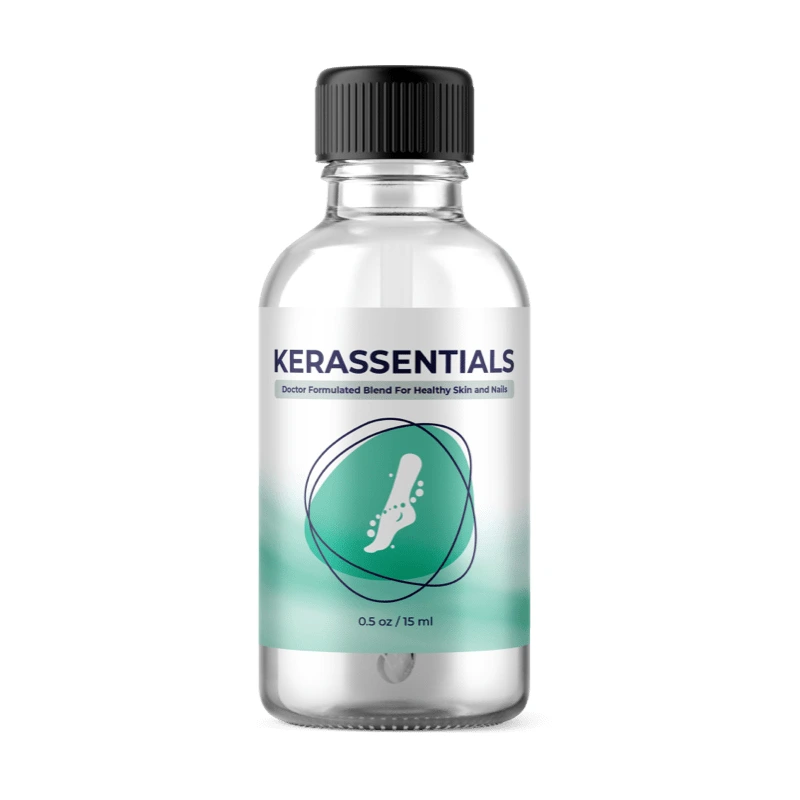
Affiliate link. $49–$79 per bottle at the checked offer; refund starting dates differ across records.
Kerassentials review: the quick audit
Kerassentials is a 15 ml topical oil, not a capsule or oral supplement. Its label lists 17 ingredients and identifies undecylenic acid at 5%. The inspected offer costs $49–$79 per bottle before shipping. The main concern is the gap between fungal-treatment marketing and formula-matched clinical evidence.
| Audit attribute | Verified finding |
|---|---|
| Product format | The bottle is an external-use nail and skin oil containing 15 ml. Official label [1] |
| Formula list | The official artwork lists 17 ingredients, including carrier oils; these are not 17 clinically proven actives. Official label [1] |
| Concentration disclosure | Undecylenic acid is listed at 5%; tea-tree and other oil concentrations are not stated. Official label [1] |
| Clinical match | Exact-brand PubMed and ClinicalTrials.gov searches returned no matching records on October 28, 2026. PubMed brand search [2] ClinicalTrials.gov brand search [3] |
| Directions | The artwork instructs four daily applications, not ingestion. Official label [1] |
| Advertised supply | The offer assigns 30 days per bottle; real consumption will depend on use. Seller presentation [4] |
| Inspected prices | Two bottles cost $158; three cost $207; six cost $294 before shipping and location-specific tax. Two-bottle checkout [5] Three-bottle checkout [6] Six-bottle checkout [7] |
| US shipping | The two-bottle cart adds $9.99; the larger carts displayed free shipping. Two-bottle checkout [5] Three-bottle checkout [6] |
| Billing model | The seller FAQ describes a one-time purchase without recurring shipments. Seller FAQ [8] |
| Refund deadline | Seller policy says 60 days from delivery; checkout says 60 days from purchase. Refund policy [9] Two-bottle checkout [5] |
| Return obligation | The policy requires all bottles and the packing slip back at the customer’s shipping expense. Refund policy [9] |
| Retailer | ClickBank identifies itself as retailer, which does not establish medical endorsement. Seller presentation [4] |
Our five-dimension topical evidence score: 2.9/10
The editorial score is 2.9/10 for documented support and disclosure, not measured nail improvement. This is an explicit topical adaptation of the requested five-dimension framework: concentrations and formulation replace oral dose and strain criteria. Each band runs from 0 to 4, with the final result rounded once.
The site’s published methodology requires category-appropriate criteria for topicals rather than automatic supplement scoring. Here, a zero trial band means no exact-brand trial was identified within the documented search, not proof that the product cannot work. A low transparency band likewise assesses disclosure, not laboratory purity.
| Dimension | Weight | Band / 4 | Weighted points / 10 and rationale |
|---|---|---|---|
| Finished-formula human evidence | 30% | 0 | 0.000. No exact-brand trial record was found in the two searched databases. PubMed brand search [2] ClinicalTrials.gov brand search [3] |
| Ingredient relevance | 25% | 1 | 0.625. Small tea-tree studies concern different preparations, and their transfer to this blend is limited. Buck et al. (1994), PMID: 8195735 [10] Syed et al. (1999), PMID: 10357864 [11] |
| Topical label/concentration disclosure | 20% | 2 | 1.000. A full ingredient list and 5% acid are disclosed, but most concentrations are not. Official label [1] |
| Safety information | 15% | 2 | 0.750. External-use and irritation warnings exist; product-specific adverse-event rates are not established. Official label [1] NCCIH (2025) [12] |
| Buying conditions | 10% | 2 | 0.500. Bundle totals are checkable, but deadline and shipping statements conflict. Refund policy [9] Shipping policy [13] |
| Total | 100% | — | 2.875/10 before rounding, displayed as 2.9/10. |
What stands out—and what needs caution
The useful disclosures are practical rather than clinical: a readable ingredient label, one stated concentration and checkable bundle totals. The limitations concern missing formula-matched research, uncertain oil concentrations and inconsistent buying terms. Neither column establishes that the oil will clear an infection or be suitable for every reader.
What stands out
- Readable official label artwork is available.
- Undecylenic acid is specifically listed at 5%.
- The 15 ml container size is stated.
- The seller describes one-time billing rather than auto-ship.
- Public return instructions identify a physical address.
What to watch
- No exact-brand clinical trial was identified.
- Most ingredient percentages are undisclosed.
- Tea-tree trial results do not establish this blend’s performance.
- Purchase-date and delivery-date refund clocks differ.
- The basic cart adds shipping despite a general free-US-shipping policy.
Does Kerassentials really work for nail fungus?
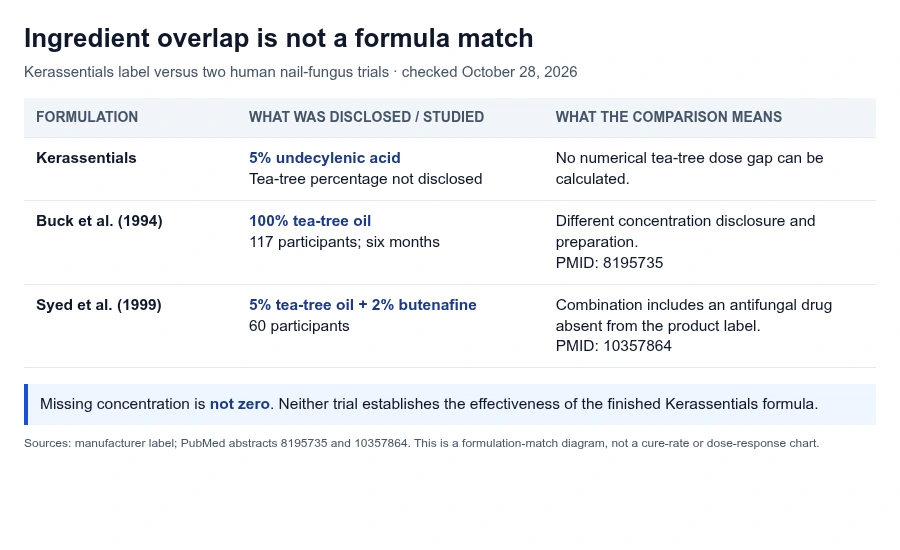
Ingredient studies do not establish the effectiveness of the finished Kerassentials oil. A 117-person trial used 100% tea-tree oil, while another 60-person study combined 5% tea-tree oil with 2% butenafine. Neither preparation matches the disclosed label, and no product-specific success rate can be calculated from those results.
Buck et al. reported culture cure in 18% of the tea-tree group versus 11% with clotrimazole after six months. Partial or full clinical resolution was a different outcome, reported in 60% versus 61%. Combining those endpoints would make the evidence look stronger than it was. Buck et al. (1994), PMID: 8195735 [10]
The combination study cannot isolate tea tree from butenafine, an antifungal drug not listed in Kerassentials. NCCIH describes the amount and quality of tea-tree nail-infection research as insufficient for a conclusion. Syed et al. (1999), PMID: 10357864 [11] NCCIH (2025) [12]
For the study-by-study explanation, read Does Kerassentials work?. The broader Research Guides explain how treatment questions differ from ingredient plausibility.
Kerassentials ingredients and topical-label audit
The official topical label lists 17 ingredients, but only one concentration: undecylenic acid 5%. Tea-tree oil, lavender and the other oils have no published percentages on that artwork. This is an ingredient label, not Supplement Facts; oral milligram calculations and proprietary-blend averages would not describe this product accurately.
The sales presentation highlights eight components, while the label also names mineral oil, canola, walnut, menthol, camphor, clove, jojoba, chia and manuka. Use the complete label rather than the marketing highlights when discussing allergy or exposure. Seller presentation [4] Official label [1]
| Ingredient / preparation | Seller label concentration | Studied human preparation | Audit verdict |
|---|---|---|---|
| Tea-tree oil | The percentage is not disclosed. | Buck (1994): 100% tea-tree oil twice daily for six months, n=117. Buck et al. (1994), PMID: 8195735 [10] | A concentration shortfall cannot be calculated from an unknown. |
| Tea tree plus butenafine | Tea tree is unquantified; butenafine is not listed. | Syed (1999): 5% tea tree plus 2% butenafine, n=60. Syed et al. (1999), PMID: 10357864 [11] | A different drug combination is not validation of this oil. |
| Undecylenic acid | The label states 5%. Official label [1] | No matched Kerassentials trial was found in the exact-brand searches. PubMed brand search [2] ClinicalTrials.gov brand search [3] | A disclosed percentage alone does not prove nail penetration or cure. |
| Vitamin E and essential oils | Tocopheryl acetate is listed without a percentage. | Alessandrini (2020): vitamin E with lime, oregano and tea tree, n=20, open study. Alessandrini et al. (2020), PMID: 32021856 [14] | The formula and study design differ from this product. |
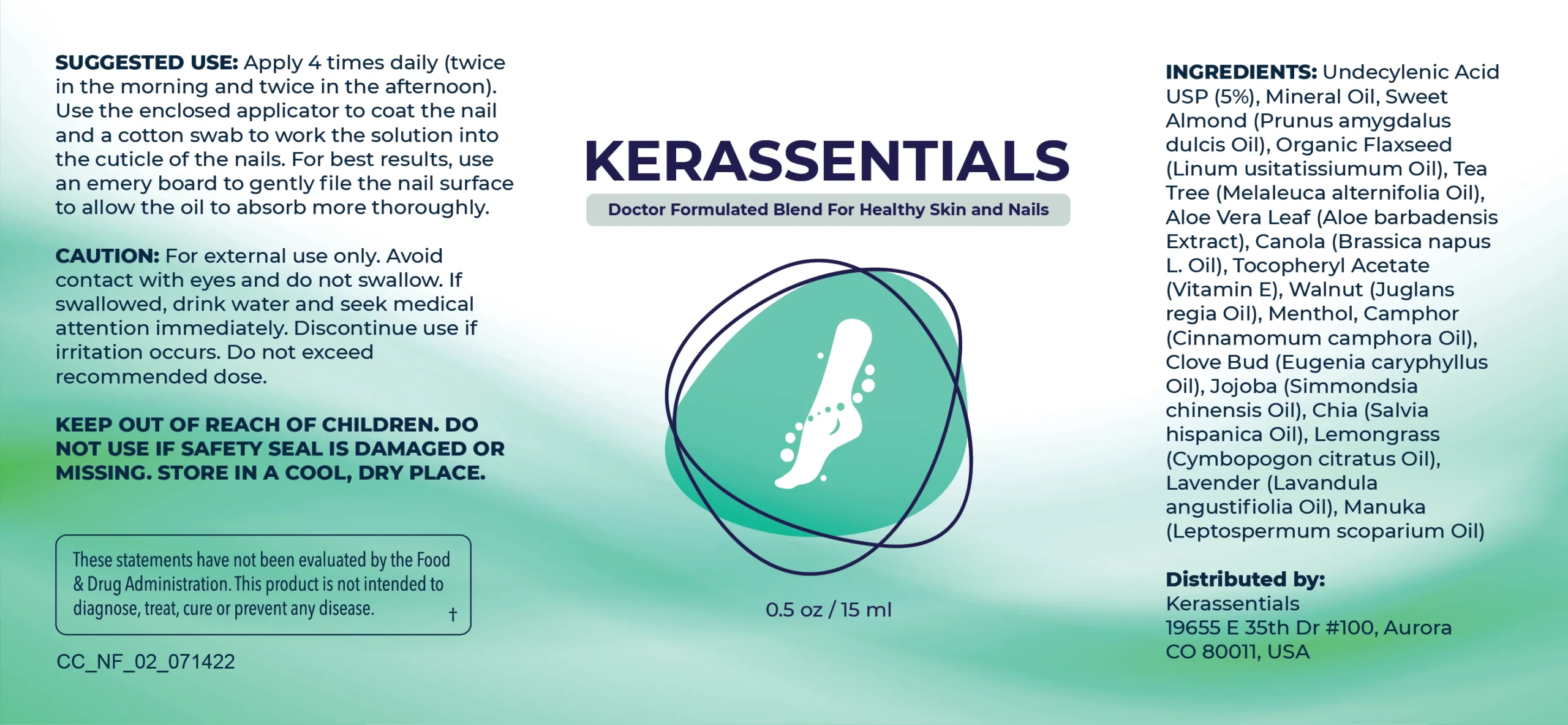
The “USP” wording modifies the undecylenic-acid ingredient; it is not a verified certification of the finished bottle. See the complete ingredient audit and the site’s Ingredients hub for label-reading context. Official label [1]
Kerassentials side effects and safety warnings
The relevant concerns are skin irritation, allergy, accidental swallowing and delayed assessment of a diseased nail. The label specifies external use and stopping if irritation occurs. Seventeen ingredients do not establish seventeen safe exposures: most percentages are unknown, and no product-specific adverse-event rate was identified in this review.
Tea-tree products can cause redness or irritation, particularly when old or exposed to heat, light or air. NCCIH warns that swallowing tea-tree oil can cause serious neurological symptoms. Keep this blend away from children and do not interpret the seller’s “natural” language as a safety guarantee. NCCIH (2025) [12]
Readers with nut allergy should discuss the sweet-almond and walnut oils with an appropriate professional. Pain, an open wound, spreading redness or a high-risk foot condition warrants clinical advice rather than more oil or aggressive filing. See the dedicated safety and interaction guide. Official label [1] AAD (2025) [15]
Kerassentials reviews and complaints: what is documented?
The strongest documented purchase concerns come from the seller’s own records, not an invented complaint count. Its presentation features selected testimonials, but those do not establish representative results. This audit identified a refund-clock mismatch, a shipping-price mismatch and advice to try three months despite a 60-day return window.
The complaints and alternatives article separates policy friction from unverified customer anecdotes. That distinction matters: contradictory wording can create a buying risk without proving that every order has a problem.
Kerassentials price, shipping and net-refund audit
The inspected US checkout totals were $167.99 for two bottles, $207 for three and $294 for six, before location-specific tax. The basic package includes $9.99 shipping. Per-day figures below use the seller’s advertised 30-day bottle supply, not measured application volume or a clinically established treatment duration.
| Bundle | Product arithmetic | Displayed shipping / pre-tax total | Cost per advertised supply day |
|---|---|---|---|
| 2 bottles | $79 × 2 = $158 | $9.99 shipping; $167.99 total. Two-bottle checkout [5] | $167.99 ÷ 60 advertised days = $2.80/day. |
| 3 bottles | $69 × 3 = $207 | $0.00 shipping; $207.00 total. Three-bottle checkout [6] | $207.00 ÷ 90 advertised days = $2.30/day. |
| 6 bottles | $49 × 6 = $294 | $0.00 shipping; $294.00 total. Six-bottle checkout [7] | $294.00 ÷ 180 advertised days = $1.63/day. |
The refund policy starts its 60-day clock on delivery, requires every bottle and the packing slip, and leaves return postage to the buyer. Checkout instead describes 60 days from purchase. Until clarified in writing, plan around the earlier date rather than assuming a later deadline. Refund policy [9] Two-bottle checkout [5]
Net-recovery example: if the $158 product amount is refunded, the $9.99 outward charge is retained, and return postage costs an illustrative $8–$12, recovery after postage is $146–$150. Total spending not recovered is $17.99–$21.99. These are scenarios, not carrier quotes; the policy does not explicitly settle outward-fee reimbursement. Refund policy [9]
Where to buy: verify the offer rather than the logo
The seller identifies its own page as the authorized purchase route and ClickBank as retailer. Similar branding on another website does not authenticate a bottle. This review did not verify individual Amazon or Walmart listings, so it does not label every marketplace item genuine or counterfeit based on appearance alone.
How to use Kerassentials: external application only
The official label says to apply the oil four times daily, twice in the morning and twice in the afternoon. It describes coating the nail and working solution around the cuticle. This is the seller’s direction, not a clinically established Kerassentials dosing schedule, and the oil must not be swallowed.
Follow the current bottle’s warnings, store it cool and dry, and keep it away from children. Do not use filing advice to override clinical foot-care precautions. Official label [1] AAD (2025) [15]
Kerassentials versus diagnosis-led alternatives
The meaningful comparison is with a treatment selected for a confirmed diagnosis, not a generic oral supplement. Prescription nail products and oral antifungals have different indications, burdens and risks. No matched pharmacy price or USP-verified finished topical benchmark was established here, so a cheaper clinical cost-per-day claim would be speculative.
| Criterion | Kerassentials oil | Prescription nail topical | Generic oral terbinafine |
|---|---|---|---|
| Defined preparation | Seventeen ingredients; most concentrations undisclosed. Official label [1] | Options include efinaconazole 10% or prescribed ciclopirox lacquer. AAD (2025) [15] | A prescription drug used for confirmed fungal nail disease. AAD (2025) [15] |
| Treatment context | No formula-matched human trial identified in the search. PubMed brand search [2] | A clinician selects therapy for appropriate nail involvement. AAD (2025) [15] | Requires consideration of liver function and medicines. NIH LiverTox [16] |
| Burden / safety | Seller directs four applications daily; irritation is possible. Official label [1] NCCIH (2025) [12] | Some regimens require daily use for 48 weeks. AAD (2025) [15] | Toenail treatment commonly lasts 12 weeks; nail appearance grows out later. AAD (2025) [15] |
| Price comparison | Checked bundles are shown above. | Obtain a current pharmacy/coverage quote. | Obtain a current prescription and pharmacy quote; no oral-supplement comparison applies. |
Final verdict: is Kerassentials worth buying in 2026?
Kerassentials offers a disclosed 5% undecylenic-acid concentration and a readable topical label, but those features do not establish fungal nail clearance. At $49–$79 per bottle before shipping, it is difficult to justify choosing the oil instead of obtaining a diagnosis and discussing evidence-based options for persistent nail changes.
Someone considering it for cosmetic nail conditioning should still review allergy concerns and return conditions first. A person seeking treatment for pain, extensive nail disease or a high-risk foot should prioritize appropriate care. No bundle size guarantees success, and improvement in appearance should not be treated as proof of eradication. AAD (2025) [15]
Frequently asked questions about Kerassentials
These answers address the overall buying decision rather than repeat the specialist articles. Start with the product’s external-use route, separate regulatory language from clinical evidence, and examine the return obligation. The 15 ml bottle, 60-day guarantee and lower bundle price answer different questions; none independently proves a treatment benefit.
Is Kerassentials an oral dietary supplement?
No. The official 15 ml bottle artwork describes an external-use topical oil. It is applied to nails and surrounding skin and must not be swallowed. A website calling it a supplement does not override the route and warnings printed on the label. Official label [1]
Is the finished product FDA approved?
This review did not establish FDA approval of the finished Kerassentials product. The seller’s facility language and the label’s “USP” ingredient wording are not evidence of an approved fungal-nail indication. The product artwork also carries a statement that it is not intended to treat disease. Official label [1] Seller FAQ [8]
Does the six-bottle package prove better results?
No. The seller offers six bottles at a lower unit price, but purchasing more oil is not clinical evidence. The offer assigns 180 days of supply to that bundle; this review did not measure bottle consumption or find a formula-matched trial showing a bundle-dependent benefit. Seller presentation [4]
Can a return guarantee show that the oil works?
No. A guarantee is a transaction term, not a study outcome. Here the seller’s delivery-based 60-day window differs from checkout’s purchase-based window, and physical returns are required. Review those obligations independently of any expectation that a nail will become clear. Refund policy [9] Two-bottle checkout [5]
Why does this review have a 2.9/10 score?
It is a transparent editorial calculation about evidence and documentation, using a topical adaptation explained in the scorecard. It is not a cure rate, a consumer-review average or a laboratory grade. The ingredient studies and label disclosures receive different credit from an exact finished-formula clinical trial.
What should I do before spending money on nail oil?
Get persistent or concerning nail changes assessed, particularly if you have a medical condition affecting foot care. Injury and nail psoriasis can resemble fungus. A clinician may examine or sample the nail and discuss whether observation, prescription treatment or another approach fits the actual diagnosis. AAD (2025) [15]
Explore the complete Kerassentials audit series
Use the series to separate the buying decision from its supporting questions. The main review holds package prices and the overall evaluation. Four focused articles examine the topical label, clinical relevance, skin safety and documented purchase friction, without treating seller claims as established treatment results.
Browse the broader product review library. That site category is navigation only; Kerassentials is reviewed here as a topical oil, not an ingestible dietary supplement.
References & seller records
Each numbered source supports the claim placed beside its citation. Manufacturer records document the offer, not independent proof of efficacy. Clinical sources concern their named preparations and populations; their results cannot be transferred to Kerassentials merely because an ingredient name overlaps with the product label.
- Manufacturer ingredient label and references
- PubMed exact-brand search: Kerassentials; zero indexed records on check date.
- ClinicalTrials.gov exact-brand search API: Kerassentials; totalCount 0 on check date.
- Manufacturer sales presentation
- ClickBank two-bottle checkout, item 305
- ClickBank three-bottle checkout, item 202
- ClickBank six-bottle checkout, item 203
- Manufacturer directions, billing and support FAQ
- Manufacturer refund policy
- Buck DS, Nidorf DM, Addino JG (1994). Comparison of two topical preparations for the treatment of onychomycosis: Melaleuca alternifolia (tea tree) oil and clotrimazole. J Fam Pract. 38(6):601–605. PMID: 8195735.
- Syed TA, Qureshi ZA, Ali SM, Ahmad S, Ahmad SA (1999). Treatment of toenail onychomycosis with 2% butenafine and 5% Melaleuca alternifolia (tea tree) oil in cream. Trop Med Int Health. 4(4):284–287. PMID: 10357864.
- NCCIH (2025). Tea Tree Oil: Usefulness and Safety. Updated April 2025.
- Manufacturer shipping policy
- Alessandrini A, Starace M, Bruni F, Piraccini BM (2020). An Open Study to Evaluate Effectiveness and Tolerability of a Nail Oil Composed of Vitamin E and Essential Oils in Mild to Moderate Distal Subungual Onychomycosis. Skin Appendage Disord. 6(1):14–18. PMID: 32021856.
- American Academy of Dermatology (2025). Nail fungus: Diagnosis and treatment. Updated June 26, 2025.
- NIH LiverTox. Terbinafine: clinical overview and hepatotoxicity.