
Does Kerassentials Work? 2 Trials and the Formula Gap
Educational information, not medical advice. Some links earn a commission at no extra cost to you. Read the affiliate disclosure.
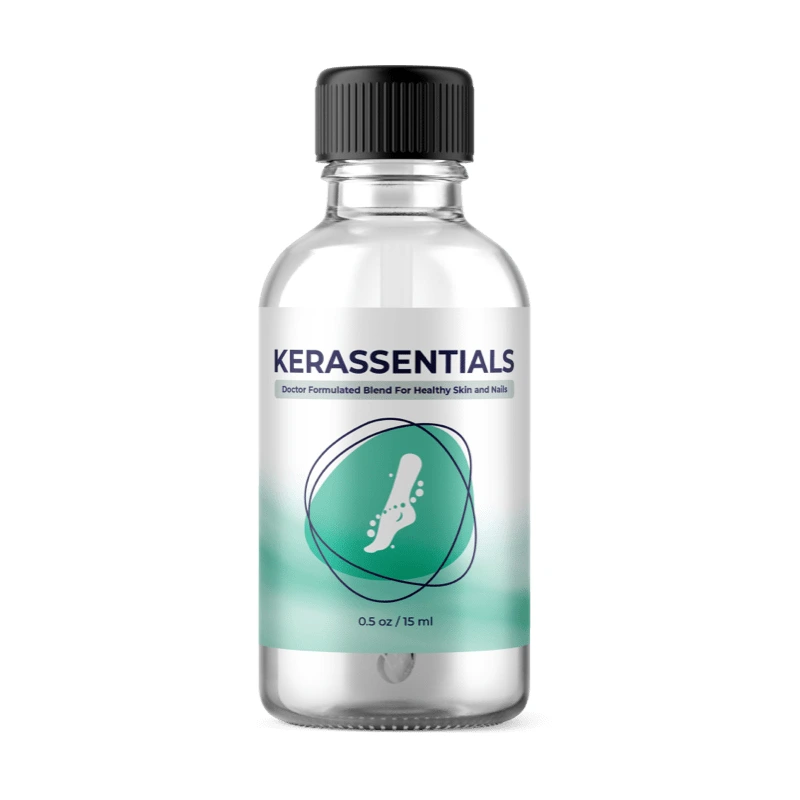
Kerassentials is marketed as a topical nail and skin oil. This article asks whether the research actually tests that formula and those claims, rather than whether individual oils show laboratory activity. For the full offer and overall recommendation, return to the main Kerassentials review; the claim-by-claim evidence assessment follows. Seller presentation [1]
| Claim being assessed | Relevant evidence | Evidence match | Practical conclusion |
|---|---|---|---|
| The finished formula clears fungal nails. | Exact-brand PubMed and ClinicalTrials.gov searches returned no records on the check date. PubMed brand search [2] ClinicalTrials.gov brand search [3] | The searches identify a brand-name record gap, not every possible differently indexed formulation. | No product-specific cure probability can be assigned. |
| Tea tree in the bottle proves effectiveness. | Buck (1994) used 100% tea-tree oil in 117 participants. Buck et al. (1994), PMID: 8195735 [4] | Kerassentials does not disclose its tea-tree concentration. Official label [5] | Shared ingredient names do not establish exposure or formulation equivalence. |
| A combination study validates the oils. | Syed (1999) studied 5% tea tree plus 2% butenafine in 60 participants. Syed et al. (1999), PMID: 10357864 [6] | The commercial label does not list butenafine. Official label [5] | A drug–oil result cannot be attributed to this blend. |
| Vitamin E nail oil evidence validates this bottle. | Alessandrini (2020) studied a four-component oil in 20 people without a randomized control group. Alessandrini et al. (2020), PMID: 32021856 [7] | That oil included lime and oregano, unlike the listed Kerassentials formula. | The study is preliminary and formula-specific. |
| An early appearance change proves infection clearance. | Clinical appearance and fungal culture are separate trial outcomes. Buck et al. (1994), PMID: 8195735 [4] | Shine, smoothness or reduced discomfort is not the same endpoint as mycological cure. | Discuss persistent changes and objective follow-up rather than relying on a photograph alone. |
Why a plausible mechanism is not a demonstrated result
Laboratory antifungal activity can justify a research question, but it does not establish that this oil reaches organisms inside a nail at an effective exposure. Nail delivery and a confirmed diagnosis matter. The 5% acid declaration is useful label information; it is not a measured Kerassentials nail-penetration result.
The seller frames difficult treatment in terms of fungal resistance and presents the oil as a way around it. Resistance is a real scientific issue, but it is not the only explanation for a persistent abnormal nail. An incorrect diagnosis, a hard-to-penetrate nail or incomplete treatment can change the clinical picture. Seller presentation [1] AAD (2025) [8]
The American Academy of Dermatology distinguishes medication designed for nails from over-the-counter skin terbinafine cream, which does not treat nail infection. That example illustrates why route, vehicle and destination matter; it is not a claim that all topicals behave the same way. AAD (2025) [8]
What the human trials actually show
Two small randomized studies are relevant to tea-tree research but do not test Kerassentials. Buck’s trial separated culture cure from appearance improvement after six months. Syed’s study evaluated a tea-tree and butenafine combination. Their participants, preparations and outcome definitions must stay attached to their results rather than becoming a brand success rate.
In Buck et al. (1994), 117 participants received 100% tea-tree oil or 1% clotrimazole solution twice daily for six months, alongside periodic assessment. The abstract reports culture cure of 18% versus 11%, and partial or full clinical resolution of 60% versus 61%. Similar appearance results are not proof of robust infection clearance or proof of equivalence to today’s nail-specific prescriptions. Buck et al. (1994), PMID: 8195735 [4]
Syed et al. (1999) enrolled 60 outpatients and reported benefit for a preparation containing both 5% tea tree and 2% butenafine. Because that intervention includes a drug absent from the Kerassentials label, it cannot demonstrate that the oil blend has the same effect. Syed et al. (1999), PMID: 10357864 [6] Official label [5]
- The open vitamin E–essential-oil study is also frequently relevant to this sales narrative. It enrolled 20 people, with 14 completing follow-up, and used a different four-component formulation. Without randomization or a control group, improvement cannot be cleanly separated from other explanations. Its formulation included lime and oregano, neither listed in this product. Alessandrini et al. (2020), PMID: 32021856 [7]
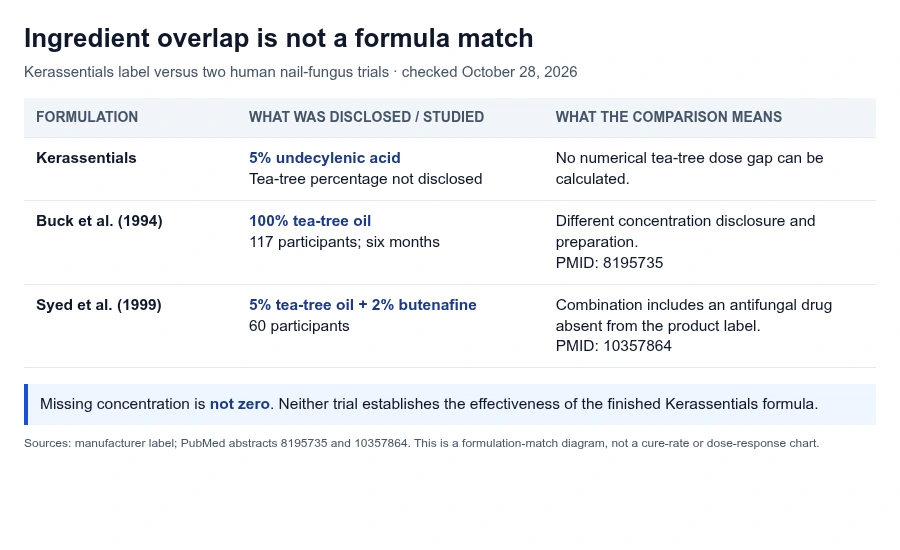
NCCIH concludes that the amount and quality of research for tea-tree nail infections are insufficient for a conclusion. A systematic review of complementary nail therapies likewise calls for larger, better-controlled trials before endorsement. That is a more balanced summary than promoting a small study’s most favorable number. NCCIH (2025) [9] Nickles et al. (2022), PMID: 35983465 [10]
What week 2, week 4 and week 8–12 can tell you
There is no validated Kerassentials response timeline in the brand-name records searched. The seller’s page suggests early improvement, while its FAQ mentions roughly 9–12 weeks. Nail growth is slow, and visible replacement can take much longer than symptom changes. These are different observations, not guaranteed milestones for this oil.
At week 2, a difference in shine, surface feel or surrounding skin comfort would not prove fungal eradication. It also would not establish that an underlying diagnosis was correct. Do not interpret an early cosmetic change as permission to stop a prescribed antifungal. Seller presentation [1] AAD (2025) [8]
At week 4, worsening pain, spreading inflammation or a new skin reaction matters more than meeting a marketing photograph. Clinical advice is appropriate when symptoms are concerning; repeated application is not a substitute for understanding why a nail is abnormal. AAD (2025) [8] NCCIH (2025) [9]
- At weeks 8–12, compare any observations with the plan agreed with your clinician, not a promise that a nail must now look normal. AAD notes that even after effective oral treatment, visible changes can persist while a toenail grows out over a year or longer. That timeline is about nail growth, not a tested schedule for Kerassentials. AAD (2025) [8]
Why individual results cannot be predicted from testimonials
The diagnosis, extent of nail involvement, nail thickness, prescribed treatment and adherence all affect interpretation. A selected testimonial usually does not supply those details, a comparator or a fungal test. Without a matching product trial, it is not possible to identify a subgroup reliably likely to benefit from this oil.
A person with nail trauma is not asking the same biological question as someone with confirmed fungal infection. Someone with several thickened nails may need a different treatment plan from someone with limited involvement. Medical conditions and medicines also influence which established options are suitable. AAD (2025) [8]
The ingredient audit explains the concentration gaps, while the safety article covers reactions and high-risk situations. Consult the Research Guides, Ingredients hub and editorial methodology for broader evidence-reading principles.
Questions about Kerassentials effectiveness
The central evidence questions concern formula matching, outcome definitions and realistic interpretation of change. A 117-person ingredient trial or a 60-person combination study can inform a discussion, but neither supplies a Kerassentials success rate. Keep research participants, intervention concentrations and clinical endpoints attached to the study that actually measured them.
Has a trial of the exact Kerassentials brand been identified?
No matching record was found in exact-brand PubMed and ClinicalTrials.gov searches on October 28, 2026. This is a documented search result, not proof that no differently indexed formulation study could exist. Ingredient trials remain separate from a randomized study of the commercial formula. PubMed brand search [2] ClinicalTrials.gov brand search [3]
Is the 60% tea-tree trial figure a fungal cure rate?
Not in the sense often implied by marketing. Buck’s abstract reports 60% partial or full clinical resolution in the tea-tree group, but culture cure was 18%. These outcomes answer different questions, and neither percentage is a measured result for the finished Kerassentials mixture. Buck et al. (1994), PMID: 8195735 [4]
Can the butenafine combination result be credited to tea tree alone?
No. Syed’s study tested an intervention containing 2% butenafine alongside 5% tea-tree oil. A combination result does not isolate each component’s contribution. Since Kerassentials does not list butenafine, transferring the study’s outcome to that bottle would also change the tested formulation. Syed et al. (1999), PMID: 10357864 [6] Official label [5]
Would a shinier nail show that the fungus has gone?
No. Surface appearance and mycological clearance are distinct outcomes. A nail can look different without demonstrating a negative fungal test, and residual damage can remain after successful treatment. Ask the treating clinician which observation or test is appropriate for the diagnosis and follow-up plan. Buck et al. (1994), PMID: 8195735 [4] AAD (2025) [8]
Would a larger ingredient count make the oil more effective?
An ingredient count alone does not establish a stronger treatment effect. The relevant questions are which preparation was tested, at what exposure, in which patients and against what outcome. Kerassentials lists 17 ingredients, but most concentrations are undisclosed and those ingredients have not been shown to add together into a proven formula. Official label [5] NCCIH (2025) [9]
Explore the complete Kerassentials audit series
Use the series to separate the buying decision from its supporting questions. The main review holds package prices and the overall evaluation. Four focused articles examine the topical label, clinical relevance, skin safety and documented purchase friction, without treating seller claims as established treatment results.
Browse the broader product review library. That site category is navigation only; Kerassentials is reviewed here as a topical oil, not an ingestible dietary supplement.
References & seller records
Each numbered source supports the claim placed beside its citation. Manufacturer records document the offer, not independent proof of efficacy. Clinical sources concern their named preparations and populations; their results cannot be transferred to Kerassentials merely because an ingredient name overlaps with the product label.
- Manufacturer sales presentation
- PubMed exact-brand search: Kerassentials; zero indexed records on check date.
- ClinicalTrials.gov exact-brand search API: Kerassentials; totalCount 0 on check date.
- Buck DS, Nidorf DM, Addino JG (1994). Comparison of two topical preparations for the treatment of onychomycosis: Melaleuca alternifolia (tea tree) oil and clotrimazole. J Fam Pract. 38(6):601–605. PMID: 8195735.
- Manufacturer ingredient label and references
- Syed TA, Qureshi ZA, Ali SM, Ahmad S, Ahmad SA (1999). Treatment of toenail onychomycosis with 2% butenafine and 5% Melaleuca alternifolia (tea tree) oil in cream. Trop Med Int Health. 4(4):284–287. PMID: 10357864.
- Alessandrini A, Starace M, Bruni F, Piraccini BM (2020). An Open Study to Evaluate Effectiveness and Tolerability of a Nail Oil Composed of Vitamin E and Essential Oils in Mild to Moderate Distal Subungual Onychomycosis. Skin Appendage Disord. 6(1):14–18. PMID: 32021856.
- American Academy of Dermatology (2025). Nail fungus: Diagnosis and treatment. Updated June 26, 2025.
- NCCIH (2025). Tea Tree Oil: Usefulness and Safety. Updated April 2025.
- Nickles MA, Lio PA, Mervak JE (2022). Complementary and Alternative Therapies for Onychomycosis: A Systematic Review of the Clinical Evidence. Skin Appendage Disord. 8(4):269–279. PMID: 35983465.