
Does Advanced Amino Formula Work? 5 g vs Human Trials
Affiliate disclosure: FitnessLifeMag may earn a commission from purchase links at no extra cost to you. How this works.
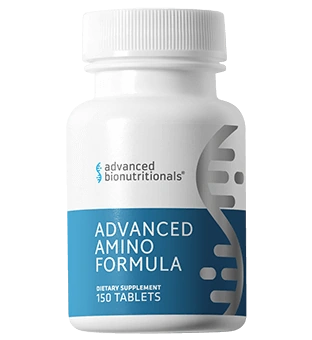
This effectiveness assessment separates amino-acid physiology, human mixture studies and the finished tablets. The Advanced Amino Formula review handles the overall purchase decision. Here the central question is whether the inspected evidence supports the specific muscle, recovery and wider wellness outcomes advertised for this five-gram blend, rather than amino acids in general.
| Advertised outcome | Relevant evidence | Formula match | Reasonable expectation |
|---|---|---|---|
| Build muscle / strength | Human EAA trials show mixed mass and strength findings. | The trials are not on these tablets. | Benefits are plausible in some nutrition/training contexts, not guaranteed. |
| Recovery / endurance / energy | Amino acids contribute to protein metabolism; training influences function. | No matching finished-product outcome trial was identified. | Do not promise faster recovery or treatment of severe fatigue. |
| Weight, skin/hair and mood/concentration | The inspected trials did not establish this broad combination of outcomes. | Ingredient identity cannot bridge all these claims. | Treat them as advertised rather than established product benefits. |
| Injury prevention / food sensitivities | These are clinically consequential claims requiring relevant outcomes. | The located mixture studies do not validate them for this product. | Do not replace prevention, diagnosis or appropriate care with the supplement. |
A biological mechanism is only the beginning
Amino acids are protein building blocks, and essential amino acids must come from the diet. That makes the category nutritionally relevant, but the path from ingesting a blend to gaining useful muscle is not automatic. Dose, composition, dietary adequacy, training and the actual outcome measured all affect how much an inference can carry.
MedlinePlus: amino acids [1] supports the nutritional role. It does not validate a proprietary utilization percentage, a claimed replacement for meals or a guarantee of new muscle from Advanced Amino Formula. The relevant finished-product question still needs direct outcome evidence.
The seller contrasts the product with whey using a fixed percentage supposedly converted to sugar. NIH ODS: protein evidence [2] describes whey as a complete protein source and emphasizes the wider nutrition context. A universal waste percentage is not a sound basis for declaring all whey inferior to these tablets.
- Absorption means material entered the body; it is not the same as new muscle tissue.
- An acute synthesis response is not a measured long-term strength gain.
- A larger blend mass or more ingredients does not guarantee a better outcome.
What the human studies actually found
The inspected human evidence supports a qualified category discussion rather than a product-level effectiveness verdict. One small trial reported increased lean mass without improved strength, while a longer exercise trial found no lean-mass improvement. Neither tested Advanced Amino Formula, and the tablet panel does not disclose the quantities needed to establish a formulation match.
| Human study | What was tested | Finding and limit |
|---|---|---|
| Dillon et al. (2009) | Fourteen older women received placebo or 15 g/day EAAs for 3 months. | Lean mass increased in the supplemented group; strength did not. Small sample; abstract-level assessment. Dillon (2009), PMID: 19208731 [3] |
| Markofski et al. (2019) | Fifty older adults were randomized to EAA/placebo with or without aerobic training for 24 weeks. | No lean-mass improvement; strength improved in the combined EAA/exercise group. The mixture included histidine and differed from this product. Markofski (2019), PMID: 29750251 [4] |
Dillon’s study was assessed through its PubMed abstract. Its small sample and limited accessible outcome detail constrain confidence. Markofski’s full methods/results showed a specifically composed EAA mixture, a selected healthy older population and supervised exercise; those conditions should remain attached to its findings.
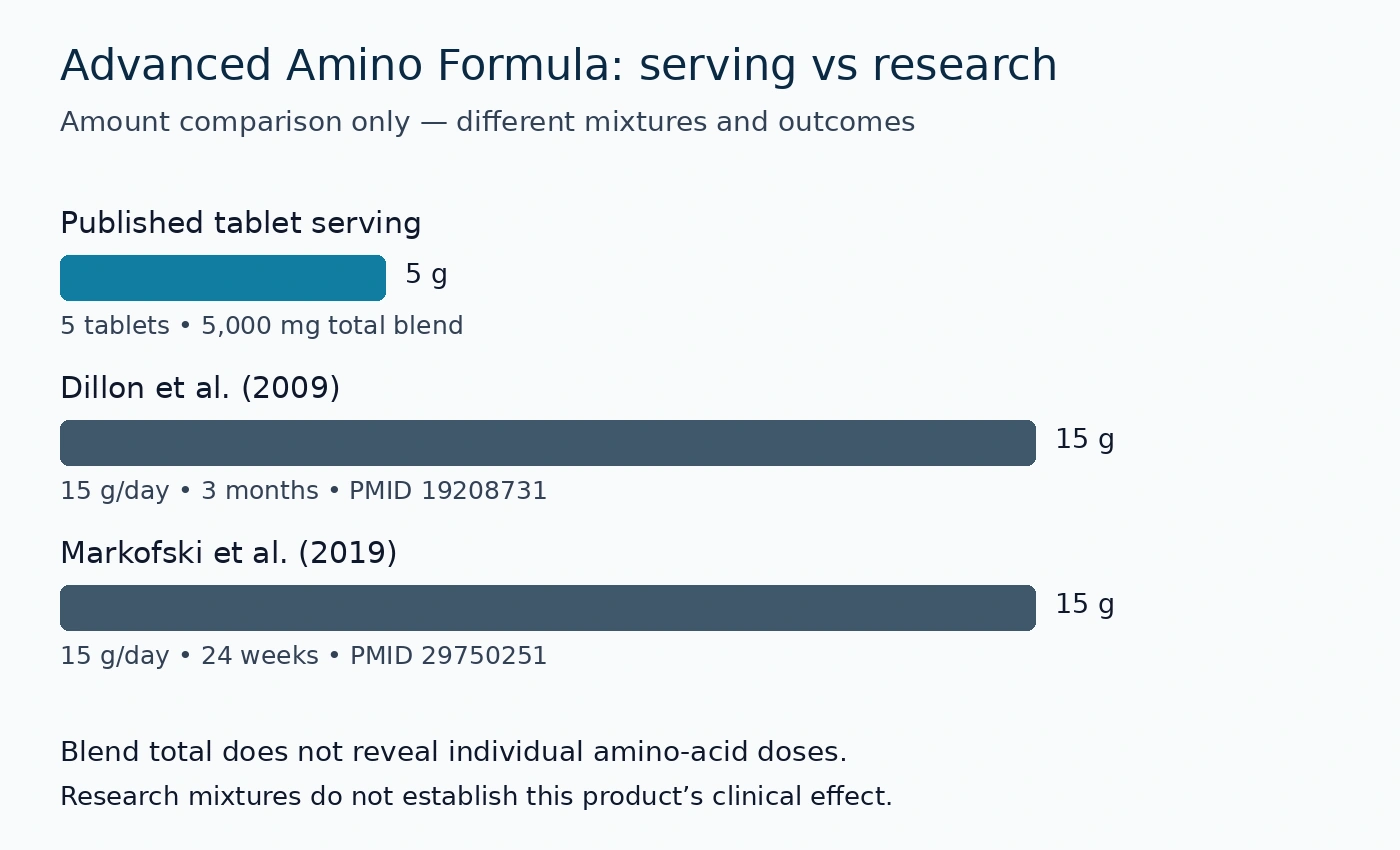
The 2 November 2026 targeted product-name and trial searches found no qualifying randomized study on the finished commercial formula. That finding describes the inspected search, not proof that no study can exist. The ingredient page explains why blend arithmetic cannot resolve the formulation gap.
How long would a meaningful result take?
There is no verified finished-product timeline for muscle gains from Advanced Amino Formula in the evidence inspected. The cited studies assessed different mixtures over months, not a guaranteed tablet response within days. A report of feeling more energetic does not establish that muscle mass, strength or recovery has changed because of this product.
Dillon followed participants for 3 months; Markofski used 24 weeks. Those durations describe research protocols, not a recommended waiting period or a promise that the same result appears at the end. Waiting longer can also extend a purchase beyond its return deadline.
- Choose an outcome you can describe, such as a consistent training measure or a nutrition goal.
- Keep major changes in exercise, food and other supplements in view when interpreting a perceived improvement.
- Do not keep taking a suspected adverse-reaction product just to complete a trial period.
What could change an individual response?
Dietary intake and training provide essential context for judging an amino-acid supplement’s possible added value. Someone with an intake gap is making a different decision from an adult already eating adequate protein and training consistently. Age alone does not establish a deficiency, and persistent weakness or fatigue can have causes that tablets do not address.
| Situation | Why it changes the decision | Useful next step |
|---|---|---|
| Adequate dietary protein | More amino acids may not solve an existing limitation. | Review the goal and training routine before adding a product. |
| Restricted diet or poor intake | There may be a practical nutrition gap. | Assess intake and suitable complete nutrition with a dietitian. |
| New unexplained weakness or weight loss | A supplement choice does not establish the cause. | Seek clinical assessment rather than assuming normal aging. |
| Difficulty swallowing tablets | Five daily tablets may reduce practical adherence. | Discuss a suitable format without assuming related products have identical formulas. |
The existing Dietary Supplements Guide provides the broader assessment framework. Safety questions belong to the interaction and precaution page.
Effectiveness questions
The useful distinction is between a plausible nutritional role and a demonstrated benefit from the exact commercial formulation. These answers address common evidence-transfer errors without dismissing the amino-acid category. Individual suitability still depends on diet, medicines, medical context and the goal; a positive customer story does not remove those requirements.
Does increased muscle protein synthesis prove more muscle later?
Not by itself. Acute protein synthesis is a metabolic measurement, whereas longer-term muscle mass and strength are separate outcomes. The Markofski study illustrates that distinction: acute responses occurred, but lean mass did not significantly improve over its longer intervention.
Can the study results be added together to prove this blend?
No. Findings from different populations, mixtures and outcomes cannot be summed into a product-level success claim. The ingredients overlap with legitimate research, but the exact tablet formula, quantities and intended clinical outcomes need their own relevant assessment rather than an assembled list of benefits.
Will taking more tablets reproduce the 15 g research dose?
Do not increase the published serving to imitate a study. A different mixture’s total weight does not establish an equivalent, appropriate or safe tablet exposure. The product’s hidden individual quantities and your medical context make that conversion an unreliable basis for personal dosing.
Are BCAA-only products equivalent to this formula?
No. BCAA-only products supply leucine, isoleucine and valine, whereas this panel lists eight amino acids. That difference describes composition, not comparative clinical effectiveness. The broader diet and the actual amounts matter, and this formula still does not list histidine.
Does the evidence support using it for severe fatigue?
The inspected evidence does not establish Advanced Amino Formula as a treatment for severe fatigue. Amino-acid nutrition and a serious symptom are different questions. Persistent or unexplained fatigue should be assessed rather than interpreted as proof that a particular supplement is needed.
A realistic conclusion is conditional: amino-acid nutrition matters, while the clinical effect of this particular hidden-quantity tablet blend remains unestablished by the located research. Use the full review to assess the purchase trade-offs.
Complete Advanced Amino Formula series
References
Medical education notice: This article provides general information, not diagnosis, treatment or personal dosing advice. Discuss medicines, medical conditions and supplement decisions with an appropriately qualified professional.
Affiliate notice: Eligible purchase links may earn FitnessLifeMag a commission at no extra cost to you. Scientific citations and internal editorial links are not purchase links.