
Advanced Amino Formula Ingredients: 8 Aminos, 1 Blend
Affiliate disclosure: FitnessLifeMag may earn a commission from purchase links at no extra cost to you. How this works.
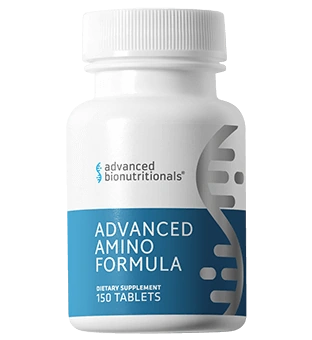
This ingredient assessment examines the tablet label, the shared blend and the information needed for a meaningful dose comparison. For the overall buying decision, use the Advanced Amino Formula review. The key distinction is between knowing which amino acids are present and knowing how much of each you actually receive.
| Label component | Role | Disclosed quantity | Useful comparison | What remains uncertain |
|---|---|---|---|---|
| L-leucine, L-valine, L-isoleucine | These are the three BCAAs. | Each amount is hidden within the 5,000 mg total. | A BCAA-only product is a different formulation. | The exact BCAA ratio and leucine exposure cannot be read from this panel. |
| L-lysine HCl, L-phenylalanine, L-threonine | These add essential amino acids beyond BCAAs. | The label names them in the blend. | The lysine salt form is specified. | The quantity of each component is not stated. |
| L-methionine, L-tryptophan | These complete the eight listed blend entries. | Only the total blend is quantified. | Their nutritional presence does not establish a sleep or energy effect. | Individual exposure and trial equivalence remain unresolved. |
| Histidine | It is an essential amino acid. | It is not listed here. | A complete diet can supply it separately. | The seller’s nonessential explanation conflicts with standard classification. |
| Vegetable stearic acid, silica, cellulose coating | These are the listed other ingredients. | The panel does not quantify them. | They are distinct from the active blend. | Individual allergy suitability needs the delivered label and relevant advice. |
What 5,000 mg does—and does not—reveal
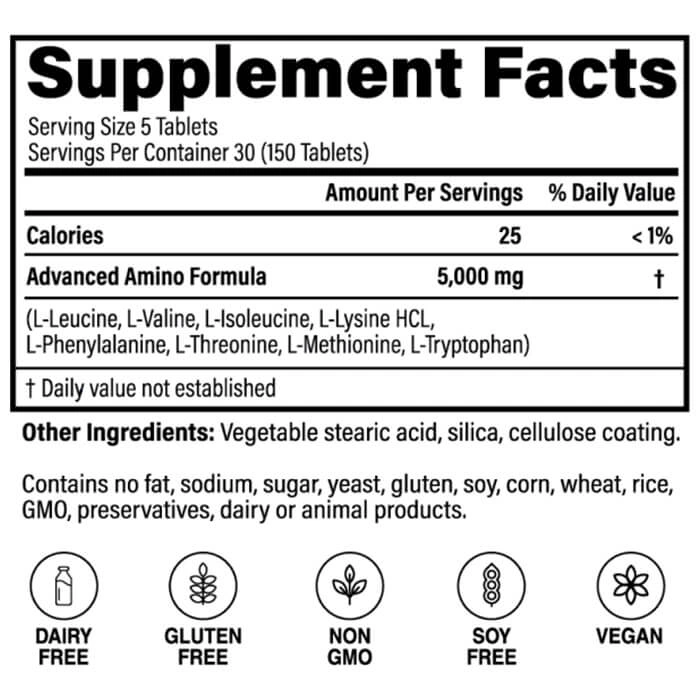
A five-tablet serving provides a disclosed blend total, not eight disclosed individual doses. Dividing 5,000 mg by eight gives a mathematical average of 625 mg, but the formula need not distribute its ingredients equally. That arithmetic cannot identify the leucine dose, establish a clinical match or prove the blend is underdosed.
| Calculation | Valid interpretation | Invalid inference |
|---|---|---|
| 5,000 ÷ 8 = 625 mg | This is the average if total mass is spread across eight entries. | It does not say that each ingredient actually contains 625 mg. |
| Each component ≤ 5,000 mg | The total is a conservative mathematical ceiling for any single component. | It is not that component’s actual quantity or a safe intake limit. |
| 150 ÷ 5 = 30 servings | This explains the stated serving count. | It does not establish thirty days of guaranteed benefit. |
The product contains lysine hydrochloride rather than simply identifying free lysine. With its amount hidden, neither lysine-equivalent exposure nor the other component amounts can be reconstructed from the shared total. A list order is not a quantitative assay.
Matching the ingredients with human research
The relevant clinical comparisons concern mixtures, not eight separate proven benefits added together. A total blend weight does not reproduce the proportions, study population or clinical outcomes of a research preparation. Advanced Amino Formula therefore cannot inherit a muscle-strength claim merely because a study used some of the same amino-acid names.
Dillon et al. used 15 g/day EAAs in a small older-women trial, with lean-mass but not strength improvement. Dillon (2009), PMID: 19208731 [1]. Markofski’s 15 g/day mixture included nine EAAs, including histidine; its longer trial did not increase lean mass. Markofski (2019), PMID: 29750251 [2].
These differences are reasons to limit evidence transfer, not instructions to increase the tablet serving. The effectiveness page owns the full outcomes analysis; this page’s question is whether the disclosed panel permits a reliable formulation match.
| Label feature | Evidence implication |
|---|---|
| Leucine is named first. | Its actual amount is still unknown, so a leucine threshold cannot be confirmed. |
| Eight active entries are named. | More than three BCAAs does not mean all nine essential amino acids are included. |
| The blend is 5 g. | A 15 g research mixture is three times the total mass but not necessarily three times the physiological effect. |
Why the histidine distinction matters
Histidine is classified as an essential amino acid, even though this supplement does not list it. The seller’s explanation that it is nonessential conflicts with standard nutrition references. This does not mean every supplement must contain histidine; it means the tablets should not be presented as supplying the full set of nine essential amino acids.
MedlinePlus: amino-acid classification [3] lists histidine with the other eight essential amino acids. A rise in circulating histidine after ingestion, even if measured, would not by itself demonstrate that the body can meet its ongoing requirement without dietary histidine.
- Evaluate the complete diet when deciding whether an eight-amino-acid supplement has a useful role.
- Do not infer deficiency from the ingredient omission alone.
- Do not turn the omission into proof that the other amino acids cannot have any physiological effect.
Other ingredients and allergy questions
The inspected tablet panel lists vegetable stearic acid, silica and cellulose coating outside the active blend. It also carries vegan and several exclusion statements. These are seller label declarations, not an independent cross-contact or batch-purity assessment; someone with a serious allergy should verify the delivered label and manufacturing information before use.
The pictured panel declares no dairy, soy, gluten and several other listed substances. The formula should not be casually described as containing “only amino acids,” because the same panel lists tableting/coating ingredients. Presence of an excipient is not itself evidence of harm, and the panel does not establish a sensitivity diagnosis.
- Check the tablet version rather than borrowing the flavored powder’s ingredient list.
- Ask the seller about a specific allergy and cross-contact controls if that changes your decision.
- Compare the seal, lot and expiry with the actual bottle rather than relying only on website artwork.
Questions to bring to a clinician or dietitian
The most useful label question is whether this specific mixture solves a nutritional problem in your situation. Bring the five-tablet serving, hidden component quantities and existing supplement list to the discussion. A clinician or dietitian can help connect food intake, symptoms, medical restrictions and the outcome you want to assess.
- Does my usual diet leave a protein or amino-acid intake gap, or is my goal mainly an advertised performance effect?
- Does phenylalanine affect my PKU or other specialist nutrition plan?
- Does tryptophan change the review of my medicines or overlapping products?
- Would a transparent powder or suitable protein food better fit my swallowing, dietary and monitoring needs?
Start with the existing supplement guide and ingredient library; consult the product safety page for more specific precautions.
Ingredient questions
The label can answer identity and total-serving questions while leaving important component-dose questions open. These ingredient answers explain those boundaries without assigning invented milligrams or turning mathematical bounds into clinical conclusions. For price, return eligibility and the wider buying verdict, follow the review owner instead of treating this label analysis as a purchase recommendation.
Is the 5,000 mg amount for one tablet?
No. The pictured panel defines one serving as five tablets and assigns 5,000 mg to that serving. Dividing the blend total by five gives an average 1,000 mg blend per tablet, not 1,000 mg of each amino acid or a verified individual tablet assay.
Does the label disclose a leucine-to-isoleucine-to-valine ratio?
The inspected panel names those amino acids but does not supply their individual amounts. Their order cannot be converted into an exact ratio. Ask for quantitative formulation information if a disclosed BCAA ratio is essential to your comparison with another product or study.
Is histidine another name for one of the listed ingredients?
No. Histidine is a separate essential amino acid, and it does not appear in the eight-entry active blend shown here. That observation concerns the supplement panel; it does not establish whether a person’s overall food intake provides adequate histidine.
Is the label a certificate of analysis?
No. The pictured Supplement Facts panel describes the intended formulation and serving. A certificate of analysis would report testing for a particular material or batch under stated methods. Do not interpret readable label artwork or a general GMP statement as that batch-specific evidence.
Can I use the powder label to assess these tablets?
Use the tablet panel for this reviewed product. Flavored powders can contain different serving weights, sweeteners and other ingredients even when related branding appears. Match format, serving and formula version before carrying any dose, allergy or nutrition statement across products.
For ingredient transparency, the deciding issue is individual quantities: the total and names are useful, but they do not fully characterize exposure. Return to the complete review for the wider decision.
Complete Advanced Amino Formula series
References
Medical education notice: This article provides general information, not diagnosis, treatment or personal dosing advice. Discuss medicines, medical conditions and supplement decisions with an appropriately qualified professional.
Affiliate notice: Eligible purchase links may earn FitnessLifeMag a commission at no extra cost to you. Scientific citations and internal editorial links are not purchase links.