
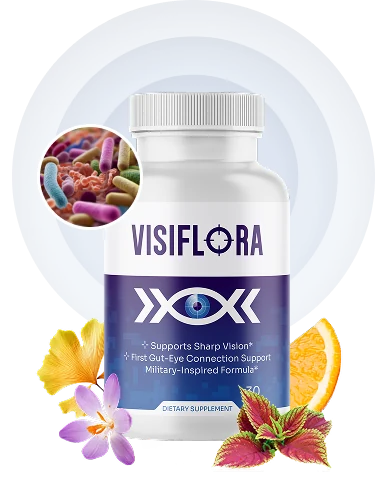
What is VisiFlora intended to do?
VisiFlora is an oral dietary supplement marketed for eye nutrition and comfort, with an additional emphasis on the gut–eye connection.
Its seller groups vitamins, minerals, carotenoids and botanicals into a vision-support formula. This places it in the nutritional-supplement category, rather than prescription eye treatment, corrective eyewear or a diagnostic test. A capsule cannot tell you why reading has become difficult or whether your current prescription is correct.
The important buying question is narrower than whether nutrition matters to the eyes: does this particular preparation, at its actual daily amounts, improve an outcome relevant to you? A list of familiar nutrients does not answer that question. This review therefore separates the product description, ingredient science and commercial terms.
The seller presentation and policy documents were checked on October 17, 2026. We inspected online material and product artwork, not a purchased bottle or a laboratory-tested sample. The available front image is not a readable Supplement Facts panel.
What ingredients does VisiFlora disclose?
The seller names carotenoids, vitamins, minerals and plant extracts, but the inspected presentation does not provide a complete dose-by-dose label.
| Seller grouping | Named components | What remains unclear |
|---|---|---|
| Carotenoids | Astaxanthin, lutein, zeaxanthin and lycopene | Amounts, preparation and standardization |
| Vitamins and minerals | Vitamins A (described as beta carotene), C and E; copper, selenium, chromium and zinc | Most amounts and chemical forms; zinc alone is displayed as 11 mg in seller copy |
| Botanical/polyphenol ingredients | Grape seed extract, rutin, quercetin, ginkgo, coleus, eyebright, bilberry and saffron | Extract strength, dose, identity testing and allergens |
| Additional nutrients | Taurine and alpha lipoic acid | Amounts and full daily-serving basis |
The sales page advertises 22 nutrients; counting its individually named entries produces 21 under the grouping used here. That discrepancy is a question for the current label, not grounds to invent an extra ingredient. Likewise, an undisclosed amount is not automatically a proprietary blend: no verified blend-total declaration was available.
Our VisiFlora ingredients analysis distinguishes the named list from actual Supplement Facts and explains which missing details prevent a meaningful study-dose comparison. Use the existing supplement label guide if serving sizes and extract descriptions are unfamiliar.
Does VisiFlora have convincing evidence that it works?
We did not identify a published clinical trial of the finished VisiFlora formula; ingredient studies cannot establish its results or success rate.
This is an evidence gap, rather than proof that no user could notice a change. A defensible efficacy claim needs the tested formulation, comparator, relevant population and measured outcome. Neither a scientific-looking ingredient illustration nor a seller testimonial supplies those elements.
Some listed nutrients belong to eye-health research, but the context matters. NEI’s AREDS/AREDS2 guidance concerns specified formulations and particular stages of age-related macular degeneration (AMD), not a general promise of clearer vision. VisiFlora’s incompletely disclosed doses prevent establishing equivalence.
Saffron research also deserves accurate scale: a 100-person AMD crossover trial reported a small average visual-acuity improvement with 20 mg daily; it did not test VisiFlora. Read the saffron trial.
For the detailed claim-to-evidence assessment, including mixed ingredient findings, see Does VisiFlora Work?. Its role is to assess the advertised outcomes separately, rather than turn every antioxidant mechanism into a clinical benefit.
Does the gut–eye connection prove the product’s claims?
Gut–eye research is a legitimate field, but a proposed biological pathway does not demonstrate that this capsule improves everyday eyesight.
A 2024 randomized study included 30 people with neovascular AMD and examined a different micronutrient preparation alongside anti-VEGF treatment. Its small size and concurrent medical care prevent treating it as proof of an over-the-counter replacement. Read the gut–retina trial.
For a consumer, the missing link is product-specific: whether VisiFlora changes the proposed pathway, whether that change causes a useful visual outcome, and whether any benefit outweighs risks and cost. Current seller material does not establish that chain. The presence of “gut” in a product description also does not establish a probiotic formulation; the named list does not identify probiotic strains or colony counts.
Can it remove floaters or replace an eye examination?
VisiFlora is not an established treatment for floaters, sudden visual change or eye disease; symptoms should guide assessment rather than supplement selection.
NEI explains that floaters commonly arise from changes in the vitreous inside the eye. A sudden increase, flashes or a curtain-like shadow can signal a retinal emergency and needs immediate eye or emergency care. NEI’s floater guidance.
Night-driving difficulty, recurring blur and persistent discomfort also deserve a cause-based evaluation. Do not assume a supplement timeline is an appropriate waiting period. For screen-related dry-eye symptoms, established options can include breaks and eye-care-directed treatment; a new capsule is not a substitute for finding the cause. NEI’s dry-eye guidance.
What side effects and interactions matter?
Product-specific adverse-effect rates are unavailable, and the listed botanicals and nutrients warrant medication, smoking-history and life-stage checks before use.
Ginkgo has recognized interaction concerns, including bleeding risk with anticoagulants. The seller also names beta carotene, making smoking history a relevant discussion; the unknown product amount prevents quantifying a VisiFlora-specific risk. Pregnancy, breastfeeding, treatment for an eye condition and use in children require particular care rather than a blanket “natural means safe” assumption. NCCIH ginkgo safety; NEI formulation precautions.
Bring the full current label and your complete medicine/supplement list to a pharmacist or clinician. If the seller cannot supply that label, the professional cannot fully assess overlap and interactions. Read VisiFlora side effects and safety for the focused risk checklist; our supplement interactions guide explains why simply separating doses does not resolve every interaction.
How does the seller say to take VisiFlora?
The inspected seller FAQ directs one capsule daily with a meal and water; confirm that instruction against the bottle you receive.
We have not verified a physical label’s serving size, storage requirements or capsule count. Do not infer bottle duration from a package name or a small front-label image. Ask for a legible label before purchase if the daily amount, excipients or swallowing format affects your decision.
No reliable product-specific missed-dose instruction was located. Do not invent a catch-up schedule or increase the amount to pursue quicker vision changes. If your prescriber recommends a particular eye formulation, ask before replacing it or combining it with this broader blend. Record any new symptoms and discuss continued use rather than interpreting every fluctuation as a treatment effect.
Are customer reviews and complaints reliable?
The available material does not establish a representative, verified customer sample, so no trustworthy satisfaction percentage or complaint rate can be calculated.
Search results include review-style affiliate pages, syndicated promotional material and social posts. A page describing personal testing is not independently verified merely because its headline says “honest.” The seller also says identifying information in testimonials has been changed; we do not reproduce those accounts as verified outcomes.
Separate product response from delivery, billing and customer service. To assess an individual report, check whether the reviewer identifies the actual seller and formula, dates the purchase, distinguishes a refund request from a completed refund, and discloses incentives. A marketplace review of a similarly named product may concern a different manufacturer entirely.
No absence-of-complaints claim is warranted from a limited search. We found neither a sufficient denominator for complaint frequency nor evidence to assign a star rating. This article is a document-based analysis, not a customer survey.
What does VisiFlora cost?
The checked seller offer lists two bottles for $158, three for $177 and six for $294, before any applicable extra charges.
| Package | Product total (USD) | Per bottle | US shipping shown |
|---|---|---|---|
| 2 bottles | $158 | $79 | Extra shipping |
| 3 bottles | $177 | $59 | Free US shipping advertised |
| 6 bottles | $294 | $49 | Free US shipping advertised |
Prices were checked October 17, 2026 and can change. Checkout, destination, taxes and optional extras determine the amount actually paid. The seller calls the offer a one-time purchase without automatic shipment, but inspect the payment screen before accepting that condition as your order’s contract.
A larger pack lowers the bottle price while increasing the amount committed before you know whether the product fits your needs. The smallest listed pack is two bottles, so a reader seeking a single-bottle trial should not confuse $49 with the entry price.
Our VisiFlora price and refund analysis recalculates the seller’s savings, considers shipping and explains return-cost exposure. A cost per serving is not reliable until bottle count and daily serving are confirmed.
How does the 60-day refund work?
The seller policy starts the window at delivery, requires returned items and excludes shipping costs; the badge is not a guarantee of results.

Checked October 17, 2026: the policy says to return all purchased items and pay return postage. Its wording allows dispatch near the end of the window, but retain proof and confirm instructions before posting. Opened/empty-bottle eligibility is not sufficiently clear in the reviewed wording; obtain a written answer rather than assuming it.
The practical issue is the amount recoverable after any shipping deductions and return expense. Save the delivery date, order identifier, current policy and correspondence. Contact the support route on your receipt promptly if there is a problem; do not wait until the deadline to locate the instructions.
Where can you buy it, and is the seller legitimate?
The supplied offer identifies ClickBank as retailer, but a checkout service and published policies do not independently verify formula quality or clinical effectiveness.
The brand presentation is reachable and shows commercial terms. We did not establish the legal manufacturer, manufacturing facility, batch-level test results or an independently verifiable certificate from the inspected sources. That prevents a strong manufacturing-quality endorsement; it does not by itself prove wrongdoing.
Similar VisiFlora names appear on marketplaces. Authorization and formulation equivalence were not established, so this review does not route purchases to those listings or borrow their ratings. Confirm the actual product name, seller identity, current label, package quantity and return terms on the offer reached through the marked link.
Dietary supplements do not receive FDA premarket approval as medicines do. A manufacturing or registration statement is not FDA approval of an eyesight claim. FDA’s supplement explanation. A limited name search did not identify a product-specific FDA result, which is not a safety clearance.
What alternatives should you compare?
The useful alternative depends on the problem: a transparent nutritional formula, indicated AMD supplementation or an eye-care plan may answer different needs.
| Your actual decision | Meaningful comparison | Why it matters |
|---|---|---|
| Diagnosed AMD | Clinician-selected AREDS2 formulation, if appropriate | Evidence is tied to diagnosis, stage and formulation, not the word “eye” on a bottle |
| Need for clearer ingredient information | Products with legible amounts, forms and independent batch documentation | Compare the same daily serving; ingredient count alone is not quality |
| Persistent screen discomfort | Eye examination, prescription review and dry-eye management | A cause-specific approach may address something nutritional blending cannot |
| A possible nutrient deficiency | Assessment and targeted nutritional replacement | A broad blend may add cost and overlap without establishing the missing nutrient |
We have not verified current competing-brand prices or tested substitutes, so there is no defensible “best cheaper product” ranking here. Start with the needed outcome and total daily regimen. The Dietary Supplements Guide helps distinguish a demonstrated nutritional need from an untested enhancement claim.
What are its advantages and limitations?
VisiFlora offers a simple seller-described routine and package choices, but dose transparency and finished-product evidence are the main unresolved limitations.
| Potential advantage | Important limitation |
|---|---|
| One capsule daily according to seller directions | Physical-label directions and a full ingredient-by-amount panel were not verified |
| Named familiar eye-nutrition ingredients | Presence alone does not match a clinical preparation or establish benefit |
| Published packages and refund policy | Lowest bottle price requires six bottles; returns have costs and conditions |
| Seller-provided product and bonus material | Illustrations and ebooks are not independent clinical evidence |
The balance favors a cautious comparison rather than a strong effectiveness recommendation. It may interest an informed adult considering optional nutritional support after a label and medication review. It is a poor first response to unexplained symptoms, a poor match for someone requiring full dose disclosure, and unsuitable as a substitute for prescribed care.
What should you verify before deciding?
Obtain the complete label, review personal safety needs and confirm the final order and return conditions before committing to a package.
- Ask for Supplement Facts, other ingredients, serving size, capsule count and relevant batch testing.
- Compare the intended outcome with research that matches the preparation and patient group.
- Check your medicine/supplement list and smoking history with the relevant professional.
- Read the total charge, optional items, billing terms and return-cost requirements at checkout.
Our assessment could change with a verified current label, an attributable finished-product trial or better manufacturing and customer-service evidence. Until then, a neutral offer link is a route to inspect the transaction, not a claim that the formula is clinically proven or appropriate for every reader.
Frequently asked questions
These answers address recurring buying and evidence questions without replacing the analysis above.
Is VisiFlora FDA approved?
No supplement approval was established. FDA does not approve dietary supplements before marketing; facility claims cannot establish medical efficacy.
How long does VisiFlora take to work?
There is no verified product-specific result timeline. The seller’s “few weeks” wording is not a clinical estimate; do not delay an examination.
Can I buy one bottle at $49?
The inspected $49 price applies per bottle in a six-bottle $294 package. The smallest displayed pack was two bottles for $158.
Does the refund mean there is no financial risk?
No. The reviewed policy deducts shipping and puts return postage on the customer; eligibility and the current deadline still matter.
Method and sources
We separate seller statements from research findings and make consequential gaps explicit.
Research checked October 17, 2026. This is an online document and evidence review prepared for the Biraj Health Care editorial identity, not a clinical review or hands-on product test. No independent clinician or laboratory reviewed this article. We inspected the seller presentation, policy wording and product artwork; ingredient studies are distinguished from finished-product evidence. Commercial facts can change.
Seller documents checked: VisiFlora presentation/FAQ, refund policy, shipping policy and terms. Those documents establish what the seller states, not independent efficacy or verified manufacturing quality. The analyses above identify their uncertainties and any reproducible calculations.
Editorial methodology · Sources policy · Affiliate disclosure · About Biraj Health Care
- National Eye Institute: AREDS/AREDS2 questions and formula guidance
- National Eye Institute: Floaters and urgent warning signs
- NCCIH: Ginkgo usefulness and safety
- FDA: Questions and answers on dietary supplements
- Broadhead et al.: Randomized saffron trial in AMD (2019)
- Baldi et al.: Gut–retina micronutrient trial in nAMD (2024)
- National Eye Institute: Dry eye