Does DentaVive work?
Compare the cited research, outcome by outcome, with the preparation that would need to match.
Explore Does DentaVive work?
Independent editorial evidence review
Does DentaVive Work? This evidence review compares the marketed oral-probiotic formula with the preparations, populations and outcomes actually studied.
By Biraj Health Care · Editorial brand, not medical credentials
Affiliate disclosure: FitnessLifeMag may earn a commission if you buy through links marked “affiliate,” at no additional cost to you. Compensation does not change our evidence standards or conclusions.
Quick verdict: DentaVive is a seller-marketed chewable oral-probiotic supplement. Research on other preparations suggests possible adjunctive oral-health benefits, but a matching finished-product trial was not identified. Unknown strains and amounts prevent a reliable formulation match. Keep established dental care, and request the complete label and product-specific evidence before treating an ingredient study as a reason to buy.
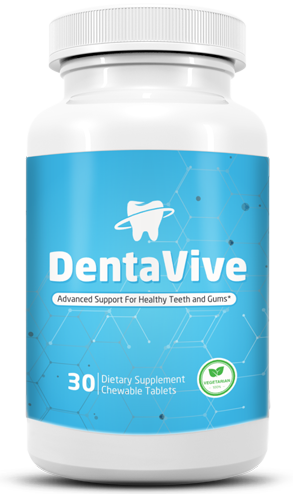
Seller product artwork. Packaging image is not proof of effectiveness or a complete ingredient label.
DentaVive’s seller promotes gum support, fresh breath and an oral-health ecosystem, but each outcome needs its own relevant clinical evidence.
A change in breath odor is not the same as reducing gingival bleeding, preserving periodontal attachment or preventing a new cavity. A study can support one endpoint without supporting the others. The seller’s ingredient list provides a starting point for checking plausibility; it does not measure what the finished blend does in a person.
This analysis concerns the chewable oral-probiotic offer with front artwork showing 30 tablets. The main DentaVive review covers the full buying decision. Do not borrow clinical claims from another similarly named capsule product or assume a familiar microorganism species identifies a particular studied strain.
| Claimed outcome | Evidence that would matter | Current product-specific conclusion |
|---|---|---|
| Gum-health improvement | Matching formulation tested against an appropriate comparator, with bleeding, plaque and periodontal outcomes defined | No matching finished-product trial identified in the inspected material |
| Fresher breath | Standardized odor/volatile-sulfur measurements and meaningful follow-up, with underlying causes considered | Other probiotic regimens provide indirect context, not an expected DentaVive response |
| Enamel or cavity benefit | Relevant human preparation, delivery and clinical dental endpoint—not only a laboratory material experiment | Cited resin research does not establish a chewable supplement repairs cavities |
| Wider metabolic or systemic benefit | Trials measuring that specific condition and clinically relevant outcomes | Oral microbiome associations and testimonials do not establish product benefits for diabetes or other disease |
NIDCR describes professional assessment and treatment for gum disease. Supplements should not turn a condition needing care into an open-ended experiment. NIDCR periodontal guidance
A controlled clinical trial clearly matching the finished DentaVive formulation was not identified in the inspected product references and targeted research.
That statement is narrower than “no trial exists” and different from “the product cannot work.” A useful study would identify the marketed preparation, current ingredients and amounts, route, duration, population and measured outcomes. Without that match, a paper about probiotics in general cannot supply a DentaVive effect size or success rate.
The complete current Supplement Facts panel, CFU per serving and several strain identifiers were also not verified. Even a promising ingredient study therefore leaves two separate gaps: whether this product contains the relevant preparation, and whether the complete formula produces the same outcome. A later label change would require the comparison to be revisited.
The pre-purchase evidence request is concrete: ask for the complete current label and an accessible trial report identifying the actual product. An abstract, patent, registration, testimonial or “clinically researched ingredients” statement is not interchangeable with that report.
The inspected references differ materially in strain identification, delivery or study setting; ingredient-name overlap alone cannot establish equivalence.
| Seller-listed component | DentaVive detail verified | Studied preparation/population | Finding and principal limitation |
|---|---|---|---|
| L. reuteri | Species listed; exact strains and CFU not verified | Trial in 45 women with pregnancy gingivitis; lozenges twice daily containing at least 10⁸ CFU of each ATCC PTA 5289 and DSM 17938 strain, approximately seven weeks | Favorable gingival/plaque findings in that setting; not DentaVive, not a general pregnancy-safety clearance |
| S. salivarius K12 | Seller strain wording; amount not verified | Halitosis reviews combine different probiotic regimens and delivery methods | Some short-term promise; do not assign a pooled finding to every strain or this blend |
| Tricalcium phosphate | Ingredient heading; quantity not verified | Amorphous calcium phosphate nanoparticles incorporated into restorative dental resin; in-vitro enamel specimens | Material/exposure mismatch: not a trial of swallowed or chewed tricalcium phosphate |
| L. paracasei, L. salivarius, B. lactis BL-04 | Seller headings, incomplete amounts/identifiers | No authenticated matching whole-product regimen established here | Cannot substitute another strain’s findings, including a different B. lactis strain |
| Inulin | Seller heading; amount not verified | No matching DentaVive regimen established | Presence does not quantify a prebiotic effect, synergy or clinical benefit |
Sources: L. reuteri trial, PMID 27461133, halitosis review and dental-resin experiment.
The pregnancy trial is a small, specific-population comparison. The resin study is laboratory material research, not human supplement research. These distinctions limit transfer even before considering dose, adherence and concurrent dental care. Unknown product amounts do not prove underdosing, and adding quantities arithmetically would not establish synergy.
The Oral Probiotics Guide explains strain, viable-count and delivery comparisons in a broader educational framework.
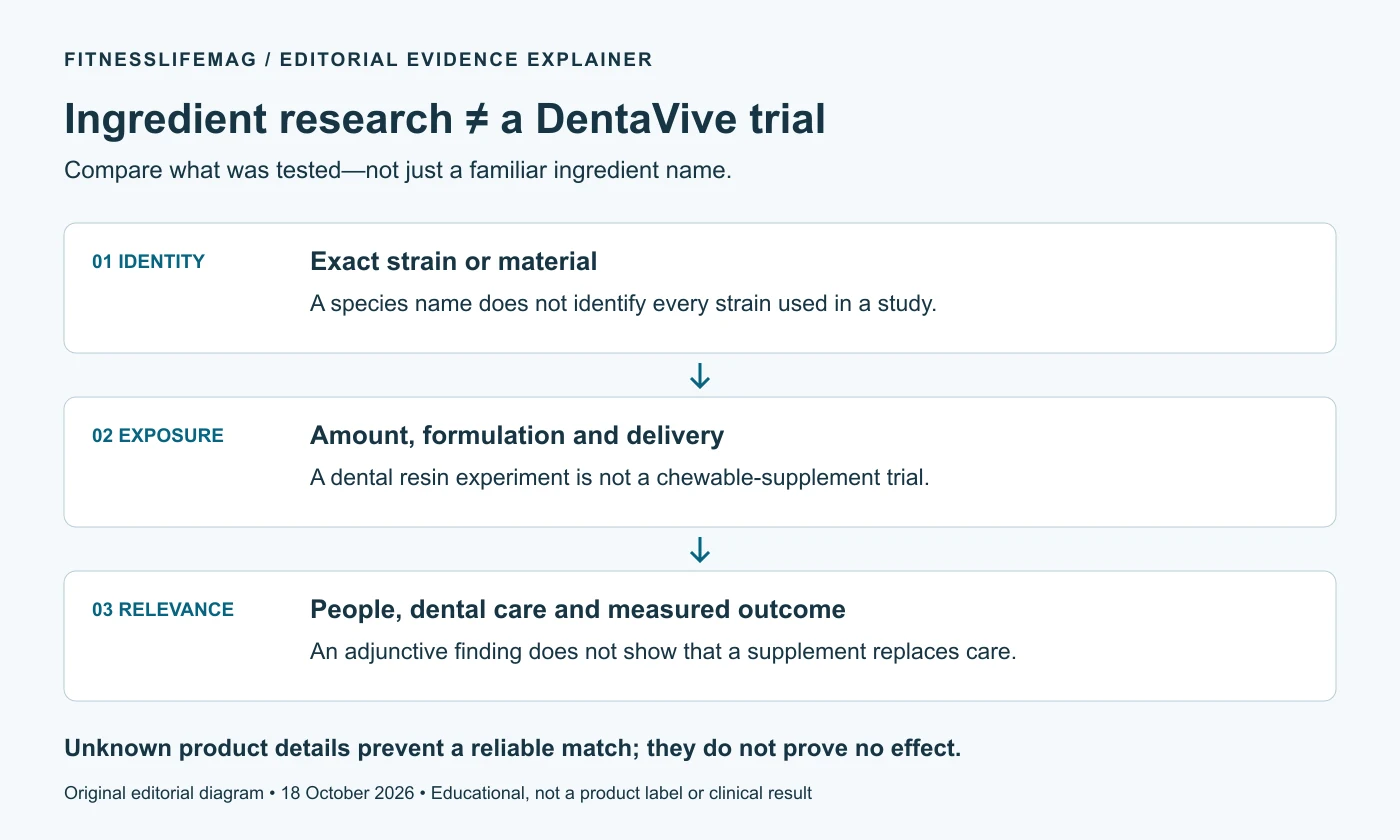
Some probiotic regimens have shown adjunctive short-term periodontal benefits, but the literature does not establish a universal regimen or DentaVive outcome.
A 2021 systematic review included 24 randomized trials of probiotics alongside scaling and root planing. Its abstract reported improvements in some short-term periodontal measures and no significant group difference at six months. The relevant comparison is additional benefit on top of professional treatment—not probiotic treatment instead of it. Systematic review, PMID 34391565
The available abstract does not permit this review to independently grade every trial’s allocation, funding or adverse-event reporting. Different strains, doses and treatment settings also make it inappropriate to extract one guaranteed effect for this blend. Publication in a journal is not itself a low-bias grade.
A 2025 scoping review mapped 66 studies with varied protocols. Mapping the literature can reveal heterogeneity, but it is not a pooled estimate proving that an unspecified commercial formulation works. The authors did not establish a uniform recommended clinical protocol. Scoping review, PMID 39952549
Selected oral-probiotic regimens have promising short-term halitosis findings, but this does not predict how DentaVive will affect a reader’s breath.
The 2022 systematic review included seven articles: one assessed as low risk of bias, one high risk and five with some concerns. Differences in interventions and outcome measurement limit generalization. The paper reported funding from the National Natural Science Foundation of China and no declared competing interests; neither fact removes the design limitations. BMJ Open halitosis review
A 2025 review included six randomized trials with 360 participants and also noted heterogeneity and limited long-term evidence. Those totals describe that review, not numbers of DentaVive users. 2025 review, PMID 40951721
Persistent odor can have causes that a supplement does not address. Improvement in perceived freshness is also not proof that periodontal disease has resolved. A dental assessment is more useful than repeatedly changing products when odor accompanies bleeding, pain or other symptoms. NIDCR symptoms and care
No reliable DentaVive-specific time-to-results estimate was established in the inspected evidence, and another product’s study duration is not a forecast.
A seven-week trial means investigators measured a particular intervention in a particular population over that period. It does not mean a different product will start working in seven weeks, or that improvement before then confirms the same mechanism. The duration of a multi-bottle package is not a validated treatment course.
If symptoms change, alternative explanations include a new brushing routine, professional cleaning, prescribed treatment, diet, natural fluctuation and expectation effects. Seller-selected stories do not control those factors. This review did not authenticate individual customer histories, so these are plausible confounders—not claims about what a particular customer did.
Do not postpone evaluation of persistent bleeding, pain or swelling to complete a bundle. See the DentaVive safety analysis for higher-risk situations and action guidance.
A readable current label and a well-controlled matching-product trial could strengthen the assessment; repeated marketing references without formulation matching would not.
Look for prespecified outcomes, an appropriate control, sufficient follow-up, transparent losses to follow-up, adverse-event reporting and disclosed funding. Whether improvement is clinically meaningful matters alongside statistical significance. Favorable, null and unfavorable results should receive the same scrutiny.
The current useful advantage is that some oral-probiotic research provides real hypotheses to examine. The principal limitations are unknown product exposure, indirect study applicability and absent verified product-level outcome data. These limitations justify a cautious decision, not a fabricated negative rating.
Keep established dental care in place. If you still consider buying, resolve the formula and relevant safety questions and inspect the DentaVive price and refund conditions rather than treating the guarantee as clinical evidence.
These answers separate plausible mechanisms from demonstrated product outcomes.
No. A mechanism can motivate a study, but the marketed preparation still needs outcome evidence in a relevant population and setting.
No. The inspected experiment used a restorative resin on enamel specimens, not DentaVive chewable tablets. It cannot establish cavity repair by this product. Original experiment
No. The available evidence does not establish an effect, but failure to identify a matching trial is not proof that no trial exists or that benefit is impossible.
No attributable representative product-outcome dataset was verified. Seller testimonials cannot supply a defensible success percentage.
This is a remote document-and-literature assessment, not hands-on product testing or a clinical recommendation from a qualified reviewer.
Seller materials and scientific sources were checked October 18, 2026. We compared strain/material identity, amount where available, route, population and outcome; missing values remained unknown. Abstract-only appraisals are identified above. No independent clinical review or product trial was performed. Biraj Health Care is the responsible editorial brand; this article used AI-assisted research and drafting.
Read our methodology, sources policy and affiliate disclosure. Send corrections through the publisher contact page.
Research Library
Use focused product analyses for specific decisions and published guides for the broader oral-health context.
Swipe or scroll horizontally to explore more topics →
Compare the cited research, outcome by outcome, with the preparation that would need to match.
Explore Does DentaVive work?Check formulation gaps, higher-risk groups and appropriate action for symptoms.
Explore DentaVive safetySeparate package prices from checkout totals and conflicting refund conditions.
Explore DentaVive costs and returnsPrevention, persistent symptoms and when a dental assessment takes priority.
Explore Oral Health GuideHow strain, viable count, delivery and measured outcome change an evidence comparison.
Explore Oral Probiotics Guide