
Does Genius Switch Really Work? Our Evidence-Based Verdict
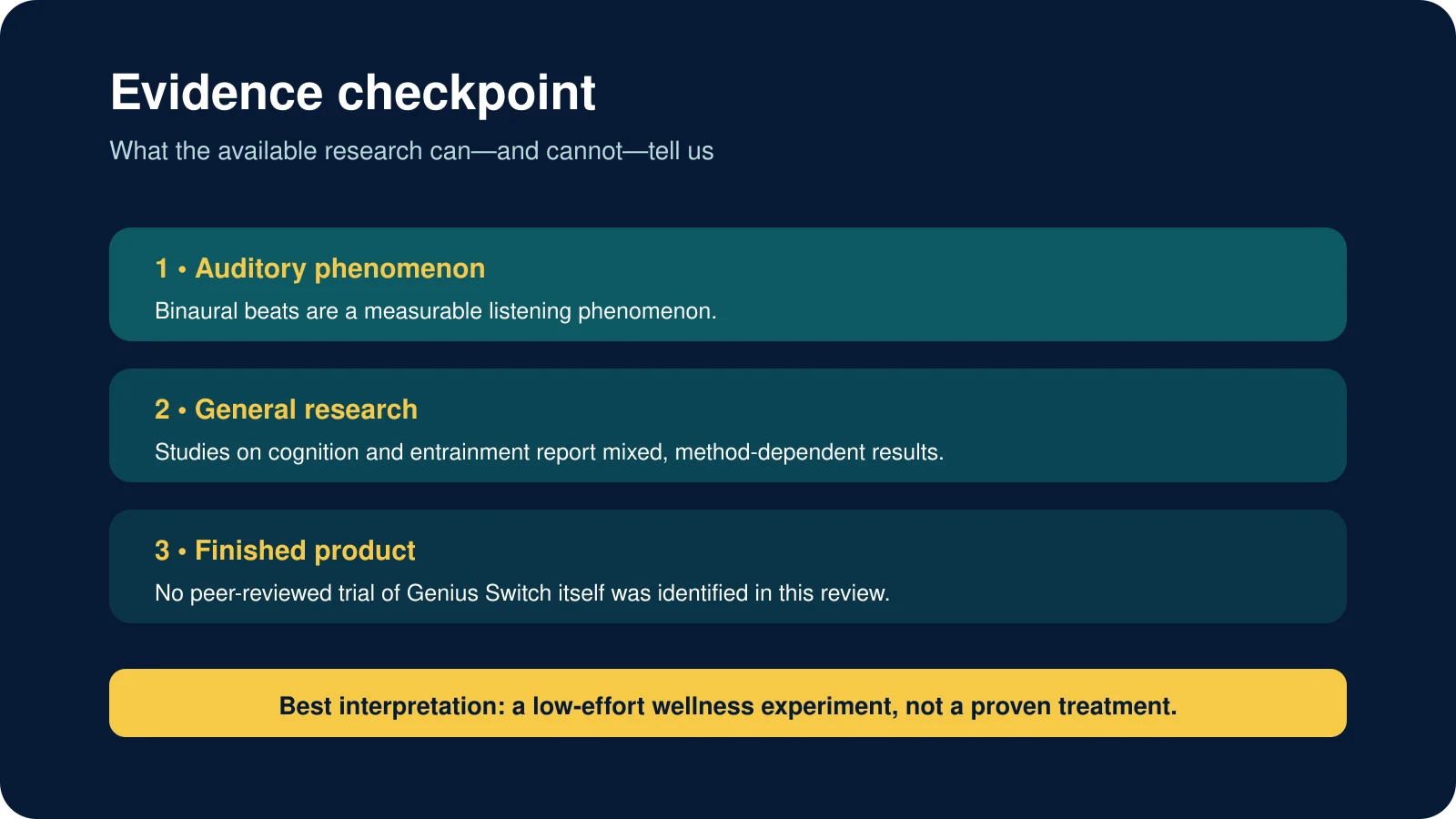
This conclusion separates three ideas that affiliate pages often blend together: the recording can be a real downloadable product; its proposed auditory mechanism can be plausible; and its strongest advertised benefits can still remain unproven. Product existence is not outcome evidence.
For the broader buying decision—including price, refund terms, safety and seller checks—see our complete The Genius Switch Review. This page owns the effectiveness question and does not repeat the pillar’s entire review.
The Evidence Ladder: What Would Actually Prove It Works?
| Evidence level | What it can show | What we found | Confidence for Genius Switch |
|---|---|---|---|
| Seller description | What the product claims and how it is intended to be used | Focus, clarity and brainwave-oriented positioning | Confirms marketing, not results |
| Technical audio analysis | Frequencies, modulation, channel separation and session structure | No complete independent specification identified | Low |
| General auditory research | Whether similar stimuli sometimes affect measured outcomes | Mixed studies with varied methods | Indirect |
| Finished-product controlled trial | Whether the exact commercial recording outperforms a credible control | No peer-reviewed trial identified | Not established |
| Replication and follow-up | Consistency, durability and responder differences | Not identified for this product | Not established |
The missing step is not merely “more testimonials.” A useful trial would randomly assign participants, conceal expectations where possible, use a credible comparison recording, predefine outcomes, report null findings and adverse experiences, and test the exact version customers receive.
Evidence that a category can influence an outcome is not evidence that every recording in that category produces the same effect.
Is There Clinical Evidence for the Finished Genius Switch Program?
We did not identify a peer-reviewed human study evaluating the final Genius Switch recording under its commercial name. We also did not identify public trial registration, a published protocol, participant flow, validated cognitive test results or an independently replicated effect size tied to the finished product.
That does not prove that no listener will notice a benefit. It means claims such as better memory, sharper focus or “whole brain activation” have not crossed the threshold from promotion to established product evidence. Testimonials cannot fill that gap because they do not control for expectation, selective reporting, changing routines, sleep, stress or regression toward an average day.
What Does Binaural-Beat Research Suggest?
Binaural-beat research examines a wide range of carrier tones, beat frequencies, exposure times, masking sounds, participant groups and endpoints. Some experiments report changes in anxiety, attention, memory or EEG activity; others find weak, inconsistent or null effects. Pooling those results is difficult because the stimulus and outcome can differ substantially from study to study.
A 2023 systematic review in PLOS ONE examined binaural-beat stimulation and brain oscillatory activity. Its central value for buyers is not a simple yes-or-no verdict. It shows how heterogeneous the field is: study design, stimulation parameters, EEG methods and results vary enough that broad claims should be treated cautiously.
Later parameter-focused work reinforces another point: results can depend on how the audio is built and delivered. Even a carefully controlled result for one combination of carrier frequency, beat frequency and duration cannot validate an undisclosed commercial track.
A measurable frequency-following response would support a mechanism, not automatically a cognitive benefit.
Feeling calmer or more prepared may be useful, but it is not the same as improved intelligence.
Attention or memory claims need validated tests, controls and reproducible effects.
Focus, Memory, Clarity and Productivity Are Not One Outcome
| Promoted outcome | What should be measured | Reasonable expectation | What is not established |
|---|---|---|---|
| Focus | Sustained attention, errors, reaction time or task persistence | A listening ritual may help some people begin a task | Reliable improvement caused by Genius Switch |
| Memory | Encoding, recall or working-memory performance using validated tasks | Relaxation could indirectly help when stress is distracting | Durable memory enhancement from the product |
| Mental clarity | A defined self-report scale plus objective performance | Some listeners may report a calmer subjective state | A standardized neurological “clarity” effect |
| Productivity | Completed work of acceptable quality over a defined period | Routine and fewer interruptions can improve output | Audio alone increases meaningful productivity |
| Intelligence | Validated cognitive testing with appropriate follow-up | No responsible expectation of transformation | An increase in general intelligence |
Commercial language often moves from “may help you feel focused” to “unlocks genius” without showing the intermediate evidence. Buyers should demand the outcome that matters to them, not accept one vague success story as proof of all five claims.
Confirm the delivered files, total charge and refund terms before purchasing.
How Long Would It Take to Notice a Difference?
No product-specific evidence supports a universal Genius Switch results timeline. An immediate feeling of calm, alertness or readiness is different from a durable improvement in attention or memory. A single unusually productive session can also reflect sleep, task interest, deadlines or expectation.
You may notice relaxation, annoyance, no change, or a shift in perceived alertness. These are subjective observations.
Tracking can show whether the routine repeatedly helps you start or complete a defined task.
Do not assume lasting memory or intelligence gains without controlled follow-up evidence.
A reasonable personal test should use comparable tasks and a simple baseline. If no repeatable practical benefit appears before the advertised refund deadline, that information is more useful than continuing because a sales page predicted delayed transformation.
Seven Factors That Can Make Genius Switch Seem Better—or Worse
- Expectation: believing a special audio is powerful can change subjective ratings.
- Sleep: one well-rested day can outperform several tired days regardless of audio.
- Stress and mood: both alter attention and perceived mental clarity.
- Caffeine or medication: changes in timing can overwhelm a subtle audio effect.
- Task difficulty: familiar work cannot be compared fairly with a demanding new task.
- Environment: headphones may help mainly because they block interruptions.
- Selective memory: people remember impressive sessions and overlook neutral ones.
These are not reasons to dismiss personal experience. They are reasons to track it carefully. Record one or two predefined outcomes, keep conditions reasonably similar and avoid changing several habits simultaneously.
Who May Find It Useful—and Who Should Skip It?
An adult who already likes focus audio, accepts uncertain outcomes, wants a brief structured ritual and understands the refund process.
Someone expecting guaranteed memory gains, a dramatic intelligence increase or identical results to a testimonial.
Anyone with new, persistent or worsening confusion, memory loss, concentration problems or disruptive mental-health symptoms.
Listening should occur at a comfortable volume and never while driving, cycling in traffic or operating machinery. Stop if the audio causes pain, dizziness, agitation, headache or other concerning effects. See the dedicated Genius Switch Safety and Side Effects guide for fuller precautions.
Does Genius Switch Really Work? FAQs
Is Genius Switch clinically proven?
We did not identify a peer-reviewed controlled human trial of the finished Genius Switch recording. General research on binaural beats does not clinically validate this specific product.
Can Genius Switch improve memory?
A product-specific memory benefit has not been established. Reduced stress or a better work ritual could indirectly help some people, but that is different from proven memory enhancement.
Does brainwave entrainment guarantee better focus?
No. A neural response, when measured, does not guarantee a meaningful improvement in sustained attention or real-world task performance.
Why are there positive testimonials?
Some customers may genuinely enjoy the routine, while expectation, selection and other lifestyle changes can also influence reports. Testimonials do not provide a representative response rate.
How should I judge my own results?
Compare several similar tasks, track one or two predefined outcomes and note sleep, stress, caffeine and interruptions. Do not rely on one unusually good session.
What if I notice no benefit?
Review the current refund terms and deadline. Do not continue indefinitely solely because promotional material implies everyone eventually responds.
Method, Sources and Limitations
We reviewed available seller descriptions and peer-reviewed work on binaural beats and neural entrainment. Seller claims were not treated as independent evidence. We did not personally complete a controlled trial, analyze the proprietary waveform, or identify a peer-reviewed study of the finished commercial program. Commercial facts were last checked September 15, 2026 and should be reverified when the offer changes.
- Ingendoh RM, Posny ES, Heine A. Binaural beats to entrain the brain? A systematic review. PLOS ONE. 2023.
- Parameter-focused binaural-beat research. Scientific Reports. This research concerns controlled auditory stimulation, not the Genius Switch finished product.
FitnessLifeMag Editorial Methodology · FitnessLifeMag Sources Policy · FitnessLifeMag Affiliate Disclosure
Final Verdict: Is Genius Switch Worth Testing?
Genius Switch may be worth a cautious personal trial for someone who values short focus audio and treats the purchase as an experiment. The evidence does not justify expecting a proven improvement in intelligence, memory or productivity. The most defensible potential value is behavioral: a repeatable pause that helps a willing listener settle into a task.
Keep expectations modest, track an outcome that matters, use safe volume and know the refund deadline. Return to the main Genius Switch review before making the final purchase decision.
Verify Current Price and Terms