
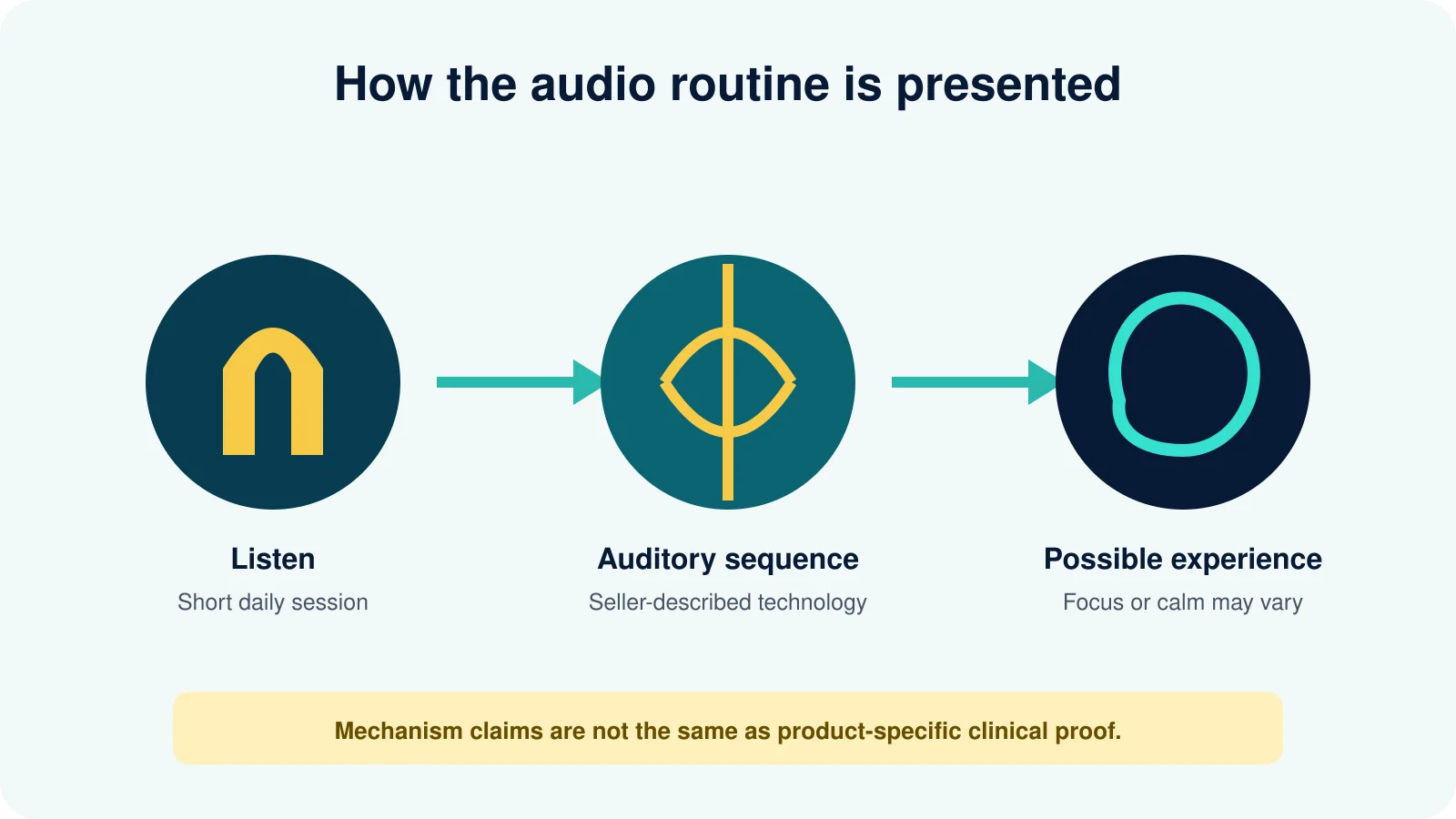
How Does Genius Switch Work According to the Available Evidence?
This distinction matters. A proposed mechanism explains how an effect might occur; it does not show that the promised outcome occurred, how large it was, or whether it will be meaningful for a particular listener. The complete buying decision—including evidence quality, price and limitations—is covered in our The Genius Switch Review 2026.
The product is not a supplement, medical device or intelligence test. It should be understood as a digital wellness audio routine. Promotional phrases such as “Neural Sync Technology” and “Whole Brain Activation” are seller-created descriptions. They are not, by themselves, recognized clinical outcomes or proof of increased intelligence.
The Genius Switch Process in Five Practical Steps
Sound enters each ear
The recording delivers tones, music, pulses or layered sound through speakers or headphones. The exact Genius Switch audio parameters have not been independently published.
The auditory system processes timing
The ears and brainstem detect differences in frequency, phase and rhythm. With conventional binaural beats, each ear must receive a different tone.
A repeating pattern may be perceived
The listener may perceive a beat corresponding to the frequency difference, even though that beat is not present as a single external tone.
State and attention may shift
Repetition, expectation, reduced distraction and the listening ritual can influence relaxation or task readiness, with or without measurable entrainment.
The listener judges an outcome
Perceived clarity or focus is influenced by sleep, stress, caffeine, environment, task difficulty and expectation—not only the recording.
This is a responsible explanatory model, not a reverse-engineering report. Without access to the audio waveform and production settings, no independent reviewer can confirm which acoustic technique, carrier frequencies, beat frequencies, modulation depth or session phases Genius Switch actually uses.
What Are Binaural Beats—and Are They the Same as Genius Switch?
A conventional binaural beat is an auditory perception created when two steady tones with slightly different frequencies are presented separately to the left and right ears. If one ear receives 200 Hz and the other receives 210 Hz, the listener may perceive a 10 Hz fluctuation. The 10 Hz experience is produced by auditory processing; a 10 Hz sound wave is not simply playing from a speaker.
That example explains the concept, not the product. We have not independently measured the Genius Switch recording, and the seller’s public-facing language does not provide enough technical detail to classify every part of it as binaural-beat stimulation. It could include binaural beats, monaural beats, isochronic pulses, amplitude modulation, music, spoken guidance, or a mixture. Those methods are related but not interchangeable.
| Audio method | How the rhythm is produced | Headphones needed? | What cannot be assumed |
|---|---|---|---|
| Binaural beat | Different steady tone reaches each ear; the auditory system perceives the difference | Normally yes, for true channel separation | That every listener entrains or gains a cognitive benefit |
| Monaural beat | Two tones combine before reaching the ears, producing a physical amplitude pattern | Not necessarily | That it acts identically to a binaural beat |
| Isochronic tone | A tone is switched or pulsed on and off at a regular rate | No | That a stronger audible pulse means a stronger useful outcome |
| Music or ambient sound | Tempo, harmony and soundscape affect experience and arousal | No | That relaxation equals improved memory or intelligence |
Scientific papers often use tightly specified stimuli and controlled conditions. A commercial recording can differ in frequency, duration, volume, carrier tone, masking music and instructions. Results from one setup cannot automatically be transferred to another.
Brainwave Entrainment: What the Term Actually Means
Electrical activity recorded from the scalp is often discussed in frequency bands such as delta, theta, alpha, beta and gamma. These labels summarize ranges observed in electroencephalography; they are not simple buttons for sleep, creativity, focus or genius. Several bands can be present at once, and their meaning depends on brain region, task, timing and measurement method.
“Entrainment” generally describes synchronization or increased alignment between a repeating external stimulus and a measured neural response. Researchers may look for frequency-following activity using EEG. Even when a neural response changes, two additional questions remain:
- Does the change reliably improve a meaningful outcome such as sustained attention, working memory or anxiety?
- Is the change large and consistent enough to matter outside a laboratory?
A changed EEG pattern is not automatically a changed ability. Mechanism evidence and outcome evidence answer different questions.
The 2023 PLOS ONE systematic review on binaural-beat entrainment found substantial variation in methods and results. Differences in carrier frequency, beat frequency, exposure time, masking, EEG analysis and participant characteristics make broad conclusions difficult. That uncertainty is why responsible analysis should not reduce the science to “play one frequency and activate one mental power.”
Confirm the current price, included files and refund terms at checkout before deciding.
“Neural Sync” and “Whole Brain Activation” Claims Explained
This may refer to rhythmic audio intended to encourage synchronized neural activity. The phrase does not disclose the actual stimulus or validation method.
The brain is already active across interconnected networks. A broad phrase like this needs a defined measurement and comparison condition to become testable.
These are different outcomes. Each requires an appropriate test, time window and control—not one general testimonial.
| Claim level | Evidence needed | Current conclusion |
|---|---|---|
| Audio contains an intended pattern | Waveform or technical documentation | Not independently verified from public specifications |
| Pattern changes neural activity | EEG study using the exact finished recording | No product-specific study identified |
| Change improves focus or memory | Controlled human outcome trial with validated measures | Not established for Genius Switch |
| Benefits persist after listening | Follow-up testing over a defined period | Not established |
| Works for most buyers | Representative results with responder rates and adverse events | Not established |
The fair interpretation is not that the product “cannot work.” It is that the strongest branded claims remain unverified. Some people may value the recording as a cue to pause, reduce distraction or begin focused work even if a special neurological mechanism is never demonstrated.
Do You Need Headphones for Genius Switch?
If Genius Switch relies on a conventional binaural-beat component, stereo headphones are needed to preserve separate left- and right-ear signals. If it relies on monaural beats, isochronic pulses, music or spoken guidance, speakers may still deliver the intended sound. Because the product’s exact method is not publicly documented in enough detail, follow the instructions supplied with the purchased recording.
Headphone quality is unlikely to compensate for poor sleep, severe stress or an unsuitable work environment. Expensive headphones also do not prove stronger entrainment. Channel separation, comfortable fit and safe volume matter more than exaggerated “brain audio” hardware claims.
What We Still Do Not Know About the Genius Switch Recording
The following information was not found in sufficiently detailed public technical documentation during this review:
- The complete frequency map, carrier tones and beat frequencies
- Whether the core stimulus is binaural, monaural, isochronic or mixed
- How the stimulus changes across the session
- The intended listening volume and exact headphone requirement
- EEG evidence using the final commercial recording
- A preregistered controlled trial measuring attention, memory or productivity
- Responder rates, null results and systematically collected adverse experiences
- Whether any perceived effect continues after the session ends
These gaps limit confidence in mechanism-specific claims. They do not mean the download is nonexistent or unusable. They mean buyers should judge it as an audio-based self-improvement experiment rather than a clinically established cognitive intervention.
How to Evaluate Whether the Audio Helps You
A simple personal tracking plan is more informative than listening once and asking whether you “feel smarter.” Choose one ordinary outcome—such as starting a 25-minute work block, completing a reading task, or recording the number of avoidable distractions. Keep the task and time of day reasonably consistent.
- Record a baseline for several comparable sessions without the audio.
- Use the delivered instructions rather than a third-party description.
- Keep volume, headphones, task length, caffeine and environment similar.
- Track one or two outcomes immediately after each session.
- Note sleep, stress and interruptions because they can explain large changes.
- Compare patterns after several sessions instead of overreacting to one good or bad day.
This is not a clinical experiment and cannot prove a neurological mechanism. It can help answer the practical question: does this routine make a noticeable, repeatable difference to a task that matters to you?
If you experience persistent memory loss, concentration problems, confusion, major mood changes or symptoms that disrupt daily life, an audio product is not an appropriate substitute for professional assessment.
Verify Current Price and TermsHow Does Genius Switch Work? FAQs
Is Genius Switch a binaural-beat program?
It is promoted as a brainwave-oriented audio program, but we did not identify sufficiently detailed independent technical documentation to confirm that every part of the recording is a conventional binaural beat. It may use multiple auditory methods.
Can an audio track activate the whole brain?
“Whole Brain Activation” is a broad seller phrase, not a standardized clinical outcome. The brain already uses distributed networks, and any meaningful activation claim needs a defined measurement and comparison condition.
Does hearing a beat prove brainwave entrainment?
No. Perceiving a rhythmic beat and measuring a corresponding neural response are different. A measurable response would still not automatically prove better memory, intelligence or productivity.
Why might someone feel more focused after listening?
Possible explanations include relaxation, expectation, fewer distractions, a repeated work ritual, music preference or an auditory effect. Without a controlled product-specific study, the contribution of each factor is unknown.
Are headphones necessary?
They are normally necessary for a true binaural-beat stimulus because each ear needs a separate tone. Follow the instructions delivered with Genius Switch because its complete audio design has not been independently disclosed.
How quickly should Genius Switch work?
The mechanism alone cannot establish a reliable timeline. Immediate subjective calm is different from a durable cognitive improvement. Treat dramatic or guaranteed timelines cautiously.
Method, Sources and Editorial Limits
We compared available seller descriptions with peer-reviewed research on binaural beats, auditory stimulation and neural entrainment. Seller-created terms were treated as marketing claims. We did not personally purchase or acoustically analyze the proprietary recording, perform EEG testing, or identify a peer-reviewed controlled trial of the finished Genius Switch product. Commercial facts were last checked September 15, 2026 and should be rechecked if the offer changes.
- Ingendoh RM, Posny ES, Heine A. Binaural beats to entrain the brain? A systematic review of the effects of binaural beat stimulation on brain oscillatory activity, and the implications for psychological research and intervention. PLOS ONE. 2023.
- Parameter-focused binaural-beat research in Scientific Reports. The study concerns controlled auditory stimulation, not the Genius Switch finished product.
FitnessLifeMag Editorial Methodology · FitnessLifeMag Sources Policy · FitnessLifeMag Affiliate Disclosure
Final Verdict on How Genius Switch Works
Genius Switch is best understood as a structured audio routine with a proposed brainwave-entrainment mechanism. Auditory rhythms can influence perception and may affect state or attention under some conditions, but the exact commercial recording has not been transparently characterized or validated in a peer-reviewed finished-product trial.
That leaves a reasonable but limited buying case: consider it if you enjoy guided audio, want a repeatable focus ritual and accept uncertain outcomes. Do not buy it expecting a proven shortcut to intelligence, treatment for cognitive symptoms or guaranteed “whole brain” transformation. Return to our complete The Genius Switch review for the broader decision, including price, refund terms, reviews and alternatives.