
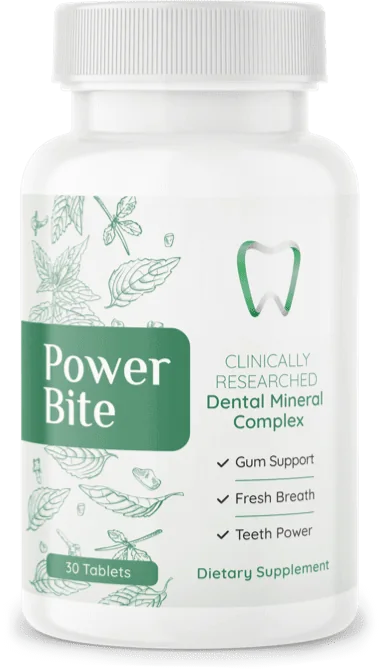
What would demonstrate that PowerBite works?
A credible human study would need to test the actual PowerBite formula and dose against a suitable comparator using a meaningful dental outcome.
The broad question “works” hides several different outcomes. Less plaque, fewer new cavities, fresher breath, less bleeding and restoration of damaged tooth structure are not interchangeable. A result on one measure does not establish all the others, and a short-term change in a laboratory marker is not automatically a clinically useful benefit.
The inspected seller material describes a dental mineral candy with calcium carbonate, myrrh, wild mint, xylitol, lysozyme, Mediterranean sea salt and clove oil. The complete current formula and quantities were not verified, preventing a reliable formulation match. The main PowerBite review covers the wider safety, usage and buyer decision; this page owns the detailed evidence assessment.
- Identity: the studied product must match the marketed formulation and route.
- Design: a suitable control, adequate sample and transparent methods matter more than a “clinically researched” label.
- Outcome: the result must address the actual reader goal, not a loosely related mechanism.
- Magnitude and uncertainty: statistical significance, clinical importance and bias all need assessment.
Did we identify a clinical trial of this finished dental candy?
No matched finished-product trial was identified in the documented brand searches; that conclusion is limited by search coverage and missing formulation information.
On October 20, 2026, an exact Title/Abstract PubMed query for “PowerBite” or “Power Bite” returned an unrelated surgical rapid-expansion paper. A ClinicalTrials.gov brand search returned no studies. An earlier unfielded search produced broadly mapped results; those were not counted as product trials. We did not treat the unrelated surgical device as evidence for an oral supplement.
These searches cannot prove that no trial exists. A study may be unindexed, unpublished or use another formulation name. Because a complete authenticated label and manufacturer/formula identity were unavailable, a thorough formula-specific search could not be reproduced. The appropriate wording is “not identified in these searches,” not “scientifically disproven.”
A supplier could materially change this assessment by providing a stable trial citation, the tested formulation, methods, results and a current label showing a match. Until then, seller references and ingredient papers should not be promoted into a finished-product efficacy claim.
What does xylitol research actually show?
Xylitol research is mixed and preparation-specific: favorable toothpaste findings coexist with uncertain evidence for other forms and a negative principal adult-lozenge result.
| Study and inspected access | Preparation, population and design | Finding and relevance |
|---|---|---|
| 2015 Cochrane review; abstract only | 10 trials; 5,903 participants analyzed overall. Key favorable comparison: fluoride toothpaste plus 10% xylitol in 4,216 children over 2.5–3 years. | Low-quality evidence suggested 13% less caries for that comparison. Seven studies had high risk of bias; other xylitol products lacked sufficient evidence. Not this candy. |
| 2013 X-ACT trial; relevant full-text sections | 691 US adults aged 21–80 at elevated caries risk; placebo-controlled trial. Five 1-g xylitol lozenges daily for 33 months versus sucralose placebo. | 11% lower caries increment, less than one-third of a surface per year, was not statistically or clinically significant. No established equivalent PowerBite dose. |
| 2022 meta-analysis; relevant full-text sections | 30 mixed-design studies involving varied ages, products and exposures; literature search through March 2020. | Authors favored xylitol overall, but substantial heterogeneity and reported model uncertainty limit a universal conclusion. |
Sources: Cochrane abstract; X-ACT full text; 2022 meta-analysis. The differences are important: toothpaste includes fluoride and brushing, while the adult trial repeatedly exposed the mouth to measured xylitol lozenges. Neither design matches an undisclosed amount in a multicomponent bedtime candy.
X-ACT participants often used fluoride. The trial also had an adherence run-in, enrollment below its original target and analysis issues involving one center discussed in the paper. These details limit generalization; they are not reasons to replace its nonsignificant principal finding with a success claim. The study was funded through NIDCR grants.
The 2022 paper included randomized and observational designs and reported I² of 95.8%, falling to about 79% after exclusions. Its reported random-effects interval included no effect, despite broader favorable wording elsewhere. We therefore do not recycle a pooled number as a reliable PowerBite benefit estimate. The paper declared no funding and no conflicts; that disclosure does not resolve heterogeneity or reporting limitations.
Do PowerBite’s ingredients match the studied doses and forms?
A quantitative match cannot be determined because verified PowerBite ingredient amounts and complete preparation details were not obtained.
| Product information | Studied comparator or evidence need | Applicability limit |
|---|---|---|
| Xylitol named; amount not verified | X-ACT: measured 5 g/day across five lozenges; Cochrane key comparison: 10% xylitol with fluoride toothpaste | Unknown grams, exposure and formulation; no equivalence or underdosing conclusion. |
| Calcium carbonate named; amount/preparation unknown | A relevant human trial would need the same preparation and a meaningful dental outcome | Presence of calcium alone does not establish structural tooth repair. |
| Myrrh, wild mint and clove oil named; species/strength unknown | Evidence would need relevant botanical preparations, concentrations and oral-use outcomes | Do not transfer an extract or mouthwash result to this candy. |
| Lysozyme and sea salt named; source/activity/amount unknown | Relevant preparation, dose, route and safety information are needed | Biological plausibility or the familiar ingredient name cannot establish the finished blend’s effect. |
This is a transparency analysis, not a claim that each component is ineffective. It identifies the inputs required before an ingredient study can inform a product decision. It also prevents an unsupported “synergy” claim: combining several plausible ingredients does not by itself demonstrate a greater clinical benefit.
A proprietary blend total, if later supplied, would still not reveal the distribution among ingredients. Arithmetic cannot recover an undisclosed dose, extract concentration or enzyme activity. A readable current label could improve transparency without, on its own, proving efficacy.
Can a mineral candy seal cracks or rebuild damaged enamel?
The inspected evidence does not establish that PowerBite seals tooth cracks, fills cavities or restores structurally lost enamel.
The seller’s thermal-calcium and enamel-fusing explanation is a proposed marketing mechanism. Establishing that saliva and minerals participate in normal remineralization is different from showing that this candy restores damaged tooth structure in people. A mechanism needs an applicable outcome study before it supports a treatment claim.
NIDCR distinguishes reversible early mineral loss from a permanent cavity. The ADA describes erosion as tooth-structure loss related to non-bacterial acids, a different process from plaque-acid decay. Conflating these conditions can make a broad “repair” promise sound more established than it is.
A useful clinical result would specify which condition was measured, how damage was assessed, how long follow-up lasted and whether the change mattered to patients. No such matched PowerBite result was located in the documented searches. This does not rule out a future study; it rules out presenting the present marketing explanation as proven repair.
What results and timeline are realistic to expect?
No reliable PowerBite success rate or time-to-benefit can be calculated from the sources inspected; symptom changes would not alone prove repair.
A pleasant taste or temporary sensation of freshness could be a consumer experience, but we did not test either. They are not equivalent to fewer cavities, recovery from periodontitis or restored enamel. Nor do seller-selected testimonials establish how frequently any outcome occurs.
If a person changes brushing, diet, fluoride use or dental treatment at the same time, improvement has several possible explanations. Normal fluctuation and expectations can also affect reported symptoms. That is why a comparator and a prespecified outcome are needed rather than a before-and-after story alone.
The seller’s suggested months of use should not be treated as an evidence-based timeline. It also creates a transaction problem when a return window is shorter. The price and refund analysis explains the three-month suggestion and conflicting 60-day start dates. Do not delay necessary assessment just to complete a suggested supplement trial.
How should this evidence change a buying decision?
Treat PowerBite as an optional product with unresolved efficacy and formula questions, not a substitute for evidence-supported prevention or indicated dental care.
For a reader seeking cavity repair or treatment of bleeding gums, the evidence gap is consequential: the required outcome has not been established for the finished formula. For a reader merely considering an optional dissolving supplement, the decision still depends on the complete label, suitability, total cost and realistic expectations.
The strongest lower-effort alternative is not another confident affiliate list. It is matching the problem to established care: fluoride-based decay prevention, interdental cleaning, dietary risk reduction and professional evaluation where appropriate. Our existing Oral Health Guide provides this prevention-versus-treatment context.
- Useful information: named ingredients and ingredient-level evidence can help formulate questions.
- Material limitation: no verified formula match, established PowerBite benefit magnitude or result timeline.
- What would change the conclusion: a credible matched trial and an authenticated current formulation.
- What would not change it: more testimonials, a discount, or repeating the word “clinically.”
Questions about studies and claims
The essential distinction is between evidence for an ingredient or another product and evidence for the actual formula being offered.
Does the adult xylitol trial prove PowerBite cannot work?
No. It tested measured xylitol lozenges, not PowerBite; its findings limit an automatic xylitol-benefit claim but do not test this blend.
Conversely, a favorable xylitol study would not prove this blend works either.
Are gum support, breath freshness and cavity prevention the same outcome?
No. Each requires an outcome-appropriate study; evidence about one cannot establish all the others.
Persistent symptoms also warrant assessment of their cause rather than inference from a product label.
Can you calculate an effective PowerBite dose from the ingredient list?
No. Amounts and preparation details are missing, and even a calculated match would not prove the whole blend’s effectiveness.
Do not increase use to imitate a research dose.
Evidence method and sources
This assessment used seller-document inspection and bounded research searches, not product testing, diagnosis or independent medical review.
Checked October 20, 2026. We inspected the Cochrane abstract only, plus relevant full-text methods/results/discussion and funding passages for X-ACT and the 2022 synthesis. Details not inspected were not inferred. The study designs, samples, forms and material limitations are distinguished above rather than collapsed into a “science-backed” label.
Biraj Health Care is the responsible editorial byline, not medical credentials. Read the methodology, sources policy, affiliate disclosure and publisher profile for standards and corrections. Our conclusions should be revisited if the formula, research or consequential safety information changes.