
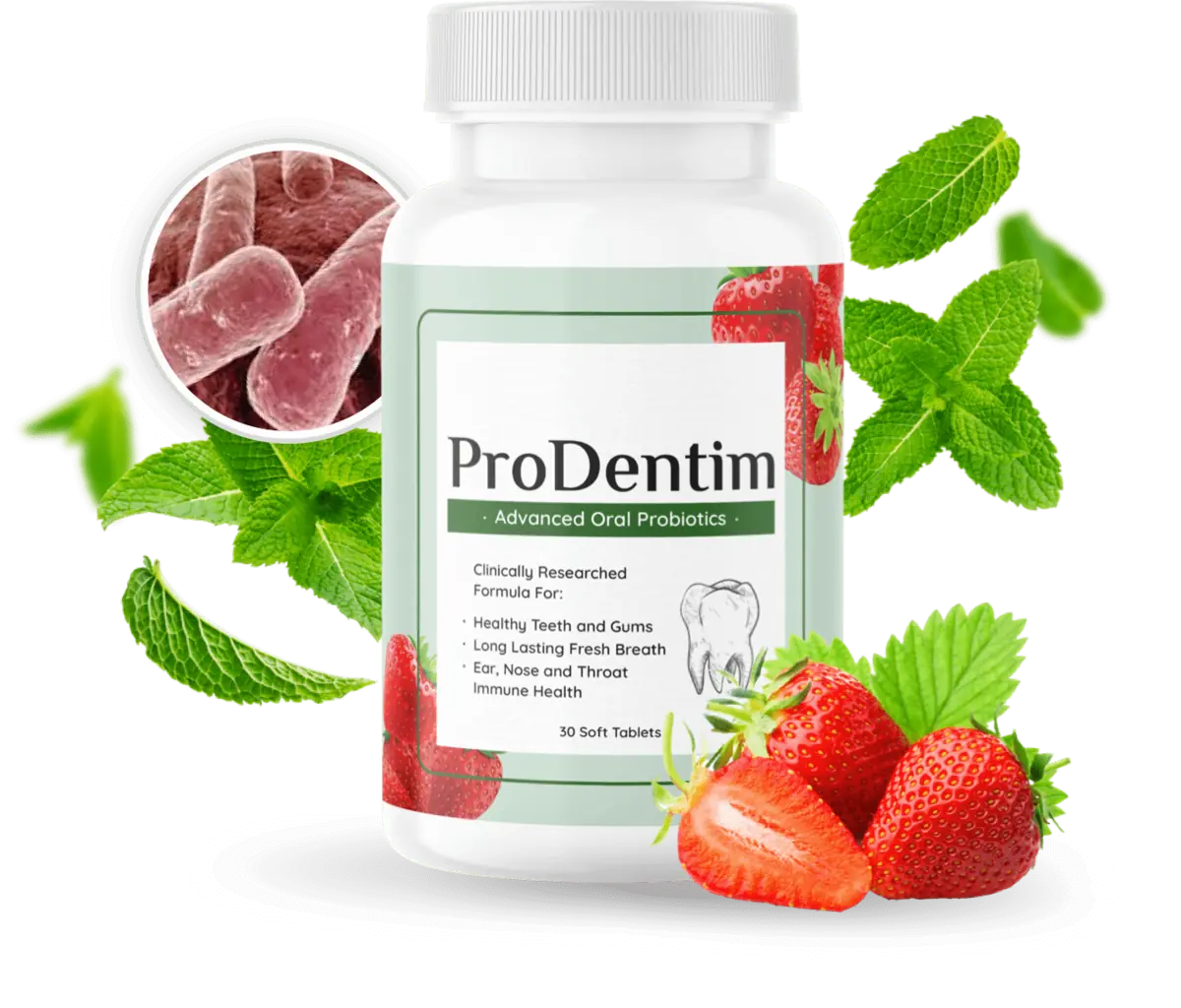
Does ProDentim work? Start with each claimed benefit
ProDentim’s advertised benefits are not interchangeable with evidence for individual probiotic strains. This assessment separates gum, breath and immune-related claims, then asks whether the studied preparation matches the published blend. For pricing, ingredients and the overall purchasing decision, return to the ProDentim review; the matrix below focuses specifically on effectiveness.
| Advertised benefit | Human evidence inspected | Match to ProDentim | Realistic expectation |
|---|---|---|---|
| Healthier gums and teeth | HN019 helped selected periodontal measures alongside scaling and root planing. Invernici et al. (2018) [1] | Panel names BL-04, not HN019; individual counts and two other strain codes remain unresolved. | A positive adjunctive trial does not establish this tablet’s benefit or repair existing decay. |
| Long-lasting fresh breath | A 28-person K12 trial found no significant between-group improvement after 30 days. He et al. (2020) [2] | The panel’s S. salivarius entry has no strain code or CFU count. | Do not promise lasting breath changes; persistent malodour needs an assessment of its cause. |
| Ear, nose, throat and immune support | A Bl-04 rhinovirus-challenge trial found no reduction in associated illness. Turner et al. (2021) [3] | A respiratory challenge outcome differs from dental outcomes and the finished multi-ingredient tablet. | This evidence does not support a broad infection-prevention or immune-health guarantee. |
Mechanism: plausible microbial effects are not product proof
Oral probiotics may influence microbial competition or host responses, but plausibility alone does not establish ProDentim’s effects. The mouth contains an interacting biofilm rather than a simple shortage of “good bacteria.” A strain must reach the site in a suitable preparation, and any change must improve a meaningful outcome rather than merely alter a count.
A mechanism can suggest a research question without answering it. For example, a salivary bacterial change in an SD1 milk-powder study does not show that an unspecified L. paracasei strain in this soft tablet prevents cavities. The organism, delivery system and measured outcome all differ. Teanpaisan and Piwat (2014) [4]
The panel’s inulin may supply a fermentable substrate, but 100 mg in this formulation has not been shown by the inspected evidence to produce the advertised oral benefit. Likewise, “3.5 billion” does not prove durable oral colonization or a better clinical response. Strain identity and condition-specific evidence matter. NIH Office of Dietary Supplements [5]
Our oral probiotics guide explains the broader microbiome and delivery questions. Those educational mechanisms should not be read as validation of a commercial blend.
Clinical trials: finished formula versus ingredient studies
The documented name searches found no indexed finished-product trial record, while the inspected human studies examined other preparations. PubMed and ClinicalTrials.gov were searched on November 1, 2026 using ProDentim, Pro Dentim and Pro-Dentim variants. This is a bounded finding about those searches, not proof that every study or unpublished dataset has been ruled out.
Favorable but indirect: Invernici et al. studied 41 adults with chronic periodontitis. Both groups received scaling and root planing; the test group used HN019 lozenges containing 1 billion CFU twice daily for 30 days. Additional periodontal improvements were reported through 90 days. The study does not test the BL-04 blend or replacement of professional care. Invernici et al. (2018) [1]
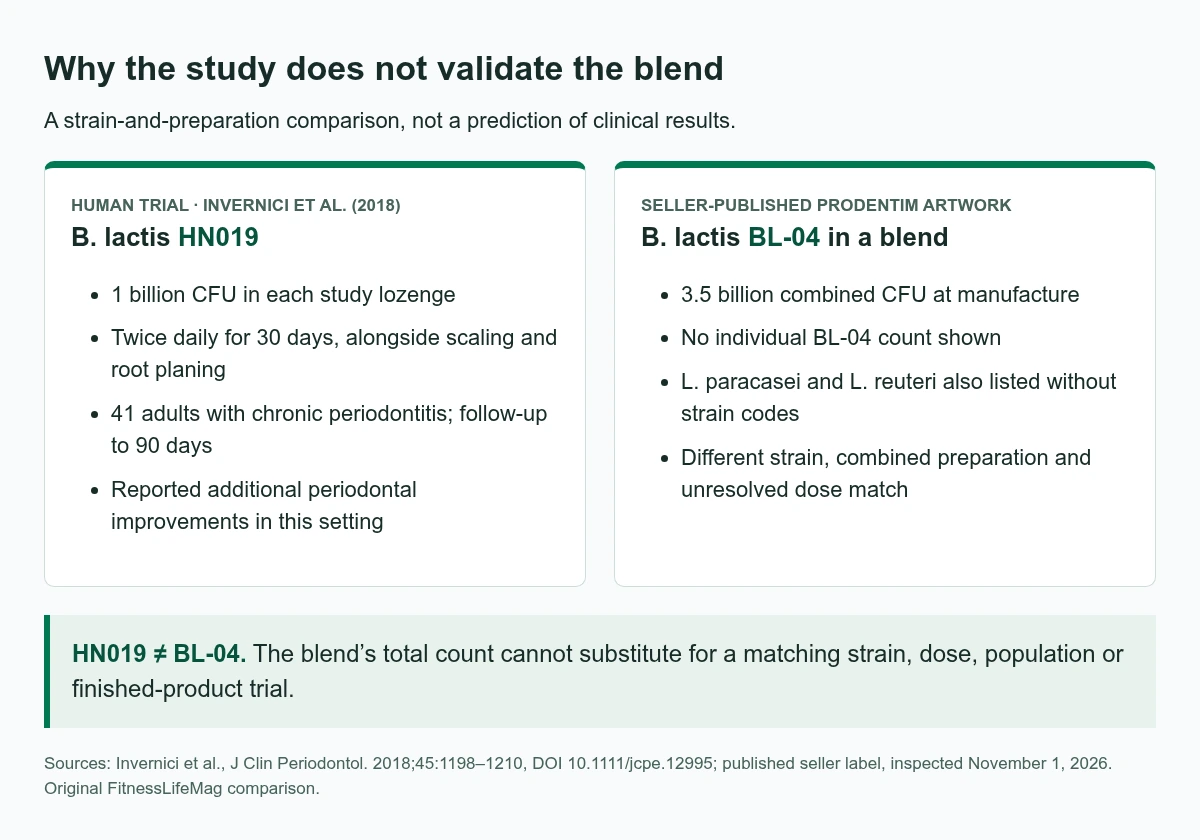
Mixed class-level evidence: Benavides-Reyes et al. reviewed 24 studies. Some periodontitis outcomes improved, but gingivitis endpoints and the overall probing-depth result were not consistently significant. Differences in strain, regimen and follow-up prevent a single success rate from being assigned to all probiotics, let alone this product. Benavides-Reyes et al. (2025) [6]
| Study and outcome | Finding | Material limit |
|---|---|---|
| He et al., K12 for halitosis | The 28-person, 30-day trial found no significant between-group difference in assessed malodour measures. He et al. (2020) [2] | Improvement within a treated group alone is not evidence that it outperformed placebo; K12 identity is not shown on this panel. |
| Turner et al., Bl-04 and rhinovirus illness | 334 participants were randomized; the primary analyzed groups totaled 232. Associated illness occurred in 56% versus 50%, with no preventive effect established. Turner et al. (2021) [3] | Respiratory challenge, not a dental endpoint; industry-funded trial with disclosed industry relationships. |
| Teanpaisan and Piwat, SD1 milk powder | Forty young adults used test or standard milk powder once daily for four weeks; the report describes reduced mutans-streptococci counts. Teanpaisan and Piwat (2014) [4] | A short-term microbial endpoint and different strain/form do not establish clinical cavity prevention by ProDentim. |
The HN019 paper was small and treatment-specific; the authors reported CNPq funding and donated DuPont/Danisco probiotics. The other studies above were inspected at abstract level, so unreported dosing or funding fields were not invented. This mixture of positive, negative and uncertain findings is more informative than selecting only favorable marketing citations.
How long might a benefit take?
No reliable ProDentim-specific response timeline was established by the inspected clinical evidence. A 30-day intervention or a 90-day study visit describes a research schedule, not a promise that this blend will change your gums or breath within that period. Seller estimates and individual testimonials should therefore remain distinct from tested product outcomes.
| Timeline statement | What it describes | How to use it |
|---|---|---|
| HN019: 30-day course, follow-up to 90 days | A different strain used beside periodontal treatment. Invernici et al. (2018) [1] | Not a ProDentim onset or duration guarantee. |
| K12: 30-day assessment | A halitosis trial without a significant between-group benefit. He et al. (2020) [2] | Duration alone cannot turn an inconclusive result into proof. |
| Seller advice to use for months | A commercial recommendation, not a demonstrated finished-product timeline. | Do not delay diagnosis or assume a return window extends to match it. |
Bleeding, pain, swelling or persistent malodour should prompt a dental assessment rather than waiting for an advertised milestone. Purchase-window details belong in the pricing and refund section; they are not measures of clinical response.
What could explain improvement—or no change?
A change after starting ProDentim does not by itself identify the cause. Professional treatment, better brushing, interdental cleaning, changes in diet and ordinary symptom variation can all affect oral outcomes. Before crediting or dismissing the supplement, distinguish a subjective impression from a dentist-measured change and check whether the underlying condition was diagnosed.
- Concurrent scaling, root planing or other dental care can produce improvement independently; the positive HN019 trial deliberately included professional treatment in both groups.
- Strain identity, preparation, storage and viable counts may affect applicability, but the current panel does not resolve every one of those variables.
- A symptom such as bad breath can have several causes. A product aimed at microbial balance may be irrelevant to the actual reason it persists.
- Testimonials are vulnerable to selection, expectation and recall effects. They do not supply a controlled comparison or an average response.
Brush twice daily for two minutes with fluoride toothpaste, clean between teeth daily and arrange appropriate dental care. A probiotic is not an alternative to treating decay, periodontal disease or an abscess. American Dental Association [7]
The safety page addresses suitability; the ingredient audit explains why an apparently similar species name does not establish a matching clinical preparation.
Questions about ProDentim effectiveness
The current evidence supports cautious, strain-specific interpretation rather than a yes-or-no promise for everyone. These answers distinguish finished-product validation from ingredient research and separate study timing from an individual result. An optional supplement should not displace an established diagnosis, a preventive routine or treatment that has a clearer role for the condition being addressed.
Is ProDentim clinically proven as a finished formula?
Does the positive HN019 trial prove the blend works?
Does more CFU mean a stronger result?
Should I wait months before seeking care for bleeding gums?
Can a favorable customer review fill the evidence gap?
Complete ProDentim assessment series
The overall product, evidence and purchase assessment.
Amounts, strains, excipients and label discrepancies.
Benefit claims, human trials and realistic expectations.
Tolerability, medication questions and higher-risk use.
Attributed feedback, return friction and alternatives.
Sources and references
- Invernici et al. (2018). Bifidobacterium animalis subsp. lactis HN019 as an adjunct to periodontal treatment. J Clin Periodontol. 45:1198–1210. DOI:10.1111/jcpe.12995. Full-paper methods/results inspected via PMC6221043.
- He et al. (2020). Streptococcus salivarius K12 for oral malodour: randomized placebo-controlled clinical trial. Abstract inspected.
- Turner et al. (2021). Effect of B. animalis subsp. lactis Bl-04 on rhinovirus-induced colds. EClinicalMedicine 43:101224. Abstract inspected; industry-funded challenge trial.
- Teanpaisan and Piwat (2014). Lactobacillus paracasei SD1 reduces mutans streptococci in human volunteers. Clin Oral Investig. 18:857–862. Abstract inspected.
- NIH Office of Dietary Supplements. Probiotics: Health Professional Fact Sheet. Strain specificity, potency labeling and safety.
- Benavides-Reyes et al. (2025). Probiotics as adjunctive therapy for gingivitis and periodontitis: systematic review and meta-analysis. Abstract inspected; protocols and effects varied.
- American Dental Association. Home Oral Care. Fluoride toothpaste, interdental cleaning and professional care.
Affiliate disclaimer: Marked purchase links may pay FitnessLifeMag a commission. This relationship does not turn independent research citations into paid links. Read our affiliate disclosure.
Educational information: This assessment is not diagnosis, treatment or personalized medical advice. Consult a qualified dental or medical professional about symptoms, suitability and treatment decisions.