
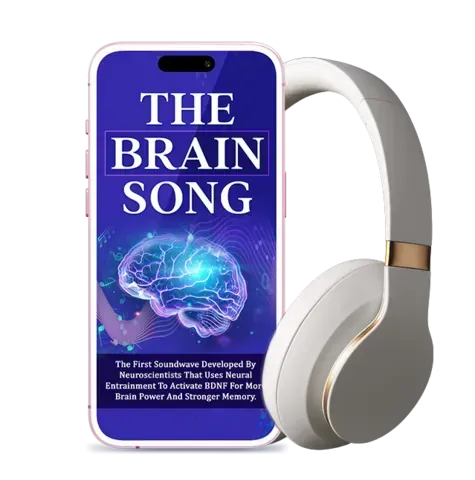
Does The Brain Song work?
The honest answer is that The Brain Song may help some people create a repeatable focus or relaxation routine, but there is not enough product-specific evidence to conclude that it reliably improves memory, increases BDNF, or produces lasting cognitive enhancement.
That distinction matters. A listener can genuinely feel calmer, less distracted, or more ready to begin a task without proving a biological mechanism. Quiet time, expectation, music preference, reduced multitasking, and habit formation can all influence the experience.
What is plausible
A short audio session may provide a useful behavioral cue, alter subjective mood or attention, and encourage a structured break.
What is not established
That this exact recording raises BDNF, repairs memory, treats cognitive problems, or works reliably for most users.
What does the seller actually claim?
The current sales page describes The Brain Song as a 12-minute digital audio using advanced sound patterns intended to guide the brain toward gamma frequencies. It connects gamma activity with BDNF, learning, focus, and overall brain wellness.
The wording creates a chain of implied benefit: sound patterns → gamma activity → BDNF support → improved mental performance. Each arrow in that chain needs evidence. Establishing that gamma activity exists or that BDNF is important does not establish that a particular commercial audio produces a meaningful change.
| Claim layer | Available support | Allowed conclusion |
|---|---|---|
| The product is a 12-minute digital audio | Current seller page | Verified current product fact |
| The audio guides gamma activity | Seller statement; technical protocol undisclosed | Unverified product mechanism |
| Gamma relates to cognition | Broad neuroscience literature | Biologically relevant research area |
| The product raises BDNF | No product-specific biomarker trial identified | Not established |
| The product improves memory or focus | No independent finished-product trial identified | Cannot be generalized or guaranteed |
How might auditory stimulation affect the brain?
Auditory beat stimulation presents rhythmic sound intended to influence neural timing or a listener’s mental state. Binaural beats use slightly different tones in each ear, creating a perceived difference frequency. Monaural beats and amplitude-modulated or isochronic sounds use different acoustic methods. These are not interchangeable protocols.
A measurable neural response does not automatically produce a useful behavioral outcome. A study can observe changes in electrical activity without showing better memory, daily function, or lasting benefit. The effect can also depend on frequency, carrier tone, volume, exposure length, whether stimulation occurs before or during a task, and individual characteristics.
What does independent binaural-beat research show?
The supportive evidence
A 2019 meta-analysis covering 22 studies reported an overall effect across cognition, anxiety, and pain perception. The authors also found that outcomes varied with exposure timing and duration. This supports continued study of auditory beats, but it does not validate every recording sold under a brainwave label.
Some later laboratory studies have reported benefits for selected attention, working-memory, or language tasks under particular frequencies and controlled conditions. These findings show possibility, not universal effectiveness.
The neutral or negative evidence
A 2023 systematic review of entrainment studies found substantial heterogeneity and inconsistent results. Differences in stimulation design, EEG methods, controls, and outcomes made broad conclusions difficult.
A 2023 home-use study of 1,000 participants did not find improved fluid-intelligence performance from binaural beats in its tested conditions and reported worse performance. This is a useful counterweight to simple “sound equals smarter” marketing.
Why studies disagree
- Different frequencies and carrier tones
- Audio delivered before versus during a task
- Short exposures versus repeated sessions
- Different cognitive tasks and outcome measures
- Small samples and weak controls in some studies
- Expectation, music preference, fatigue, and baseline attention
- Variation between healthy adults and clinical populations
The correct conclusion is not that all brainwave audio works or that none of it can work. It is that effects are specific, inconsistent, and difficult to transfer to an undisclosed consumer track.
Want to verify the current offer?
The broader evidence is mixed. If you still want to evaluate the product, confirm the current price, billing type, delivered contents, and refund terms before paying.
Verify Current Price and TermsDoes gamma sound stimulation increase BDNF?
BDNF is a genuine neurotrophic protein involved in neuronal survival, plasticity, and learning-related processes. The seller’s use of the term therefore sounds scientifically grounded. The missing link is direct measurement.
Research on 40 Hz sensory stimulation is active, particularly in cognitive-decline models. A 2025 systematic review described promising findings alongside varied protocols and limited human evidence. It also noted that animal findings involving pathology and inflammation were not consistently reproduced in people.
Even if a controlled 40 Hz protocol changes a biomarker or cognitive outcome, that would not prove The Brain Song does the same. The seller page does not establish that its track is precisely 40 Hz, that exposure matches the study, or that BDNF was measured after product use.
Has The Brain Song itself been clinically tested?
We did not identify a peer-reviewed randomized trial of the finished commercial product, a registered protocol naming the product, or a human study measuring BDNF before and after using the delivered audio. Absence from our search is not proof that no study exists, but it prevents a strong efficacy conclusion.
A product-specific trial should identify the exact file, frequency structure, duration, listening equipment, participant population, control audio, prespecified outcomes, adverse events, funding, and statistical plan. Ideally, an independent team would replicate the result.
| Evidence level | What it can show | Status for The Brain Song |
|---|---|---|
| Seller explanation | Intended mechanism and use | Available |
| Ingredient/class analogue | Related auditory methods may affect selected outcomes | Mixed broader evidence |
| Exact-product laboratory response | The delivered track produces a measurable short-term response | Not identified |
| Randomized product trial | Outcome difference versus control | Not identified |
| Independent replication | Result is more likely robust and generalizable | Not identified |
What results are realistic—and how soon?
Immediate subjective effects are possible: a listener may feel calmer, more focused, irritated, sleepy, or unchanged. These reactions say more about the current listening experience than long-term cognitive change.
| Time | Reasonable outcome to track | Unsupported leap |
|---|---|---|
| First session | Comfort, calm, distraction, readiness to work | Instant memory repair |
| First week | Whether the routine is usable and repeatable | Proven brainwave retraining |
| Two to four weeks | A specific behavior such as starting a focus block on schedule | Confirmed BDNF increase |
| Persistent symptoms | Seek appropriate professional evaluation | Replacing diagnosis or treatment |
Track one practical outcome before starting, keep other variables reasonably stable, and avoid interpreting normal day-to-day fluctuation as product effect. If the routine adds no useful value within the seller’s refund window, use the documented support route rather than extending the test indefinitely.
Who may notice value—and who should look elsewhere?
May find it useful
- Adults who enjoy structured sound routines
- People seeking a short cue for work or relaxation
- Buyers comfortable treating results as an experiment
- Listeners who can use low, comfortable volume
Should not rely on it
- Anyone seeking treatment for memory loss or ADHD
- People expecting guaranteed biological change
- Anyone with worsening cognitive symptoms
- Listeners who develop headache, dizziness, tinnitus, or distress
New confusion, progressive memory decline, impaired daily function, or major attention changes deserve professional assessment. A consumer audio cannot determine the cause.
Our evidence verdict and limitations
The strongest defensible verdict is plausible as a personal routine, unproven as a cognitive intervention. The product has a low-effort format and a verifiable transaction route, but its technical specifications and finished-product outcomes remain insufficiently documented.
We inspected the public seller page and current research landscape. We did not buy or analyze the waveform, access the member area, run a listening trial, or commission a clinician review. Seller statements were treated as claims. Research on related stimulation methods was assessed for frequency, protocol, population, and outcome mismatch.
Still considering the audio?
Check the current price, billing type, delivered contents, and refund terms before paying.
Verify Current OfferFrequently asked questions
Is The Brain Song clinically proven?
No independent finished-product clinical trial was identified. Research on related auditory methods cannot prove this exact track works.
Does it use 40 Hz?
The seller refers to gamma frequencies, but the current public page does not clearly disclose an exact 40 Hz specification.
Can it increase BDNF?
No product-specific human biomarker evidence was identified. The claim should remain unverified.
Can binaural beats improve focus?
Some studies report selected benefits while others report null or negative outcomes. Results depend on protocol, task, timing, and listener.
How long should results take?
Subjective comfort or focus may be noticeable during a session. Longer-term cognitive or biological changes have not been established for this product.
Is a positive feeling proof that it worked?
No. It may reflect sound preference, a quiet break, expectation, or routine. A useful experience can still be real without proving the advertised mechanism.
Method, sources, and disclosures
Commercial facts were checked September 22, 2026. Important scientific claims link to the relevant research near the discussion. This page adds a product-to-study applicability analysis rather than treating every gamma or binaural-beat paper as product proof.
Editorial Methodology • Sources Policy • Affiliate Disclosure
Affiliate disclaimer: FitnessLifeMag may earn a commission through marked purchase links. Research and policy links are not affiliate links.
Educational information only: The Brain Song is a digital audio product. This guide is not a substitute for professional diagnosis or treatment.