
Lymph Flow Ingredients
Affiliate disclosure: purchase-information buttons may earn FitnessLifeMag a commission. Research citations are editorial links.
Formula transparency, not a guessed label.
Internal editorial link—not a purchase button.
Lymph Flow ingredients are best assessed by separating the seller’s six named highlights from the claimed 13-component mixture. This page examines disclosure, preparation and dose arithmetic—not package value. For the broader buying assessment, return to the Lymph Flow review. A complete current label remains necessary for a full formula audit.
| Component / disclosure | Inspected identity | Amount / specification | Evidence relevance | Buyer implication |
|---|---|---|---|---|
| Horse chestnut | A seller highlight. | Individual amount and aescin specification unverified. | Standardized seed extracts, not arbitrary plant material, were reviewed. Pittler & Ernst (2012) [PMID: 23152216] [1] | Ask for plant part, extract ratio and aescin per serving. |
| Gotu kola | A seller highlight, also called Centella asiatica. | Individual amount and TECA equivalence unverified. | A 94-person trial used titrated extract, not this blend. Pointel et al. (1987) [PMID: 3544968] [2] | Do not treat shared plant naming as pharmaceutical equivalence. |
| Curcumin | A seller highlight. | Enhancement system and amount unverified. | Formulation matters to safety as well as absorption. NCCIH [4] | Ask which preparation is actually supplied. |
| Boswellia, quercetin phytosome, ginger | Three further seller highlights. | Exact forms and individual quantities unverified. | A mechanism description does not establish product outcomes. | Request the full ordered panel rather than extrapolating. |
| Remaining formula / base | 13 actives claimed; water, glycerin and flavoring mentioned. | Full panel and complete excipients unverified; soy disclosed. | A front bottle image is not a Supplement Facts panel. | Review allergens and every active before judging suitability. |
What 600 mg divided by 13 really means
The Lymph Flow blend arithmetic supplies bounds, not individual doses. If the advertised 600 mg total covers 13 ingredients, an equal-share calculation gives 46.15 mg per ingredient. The actual distribution could be unequal, so neither this average nor the total establishes that any named extract matches a studied preparation.
Calculation: 600 ÷ 13 = 46.153846 mg. Under the stated total, an ingredient cannot exceed the 600 mg blend mass; that mathematical ceiling says nothing about its actual share, extract strength or biological effect. Adding milligrams across unlike preparations is not an efficacy comparison.
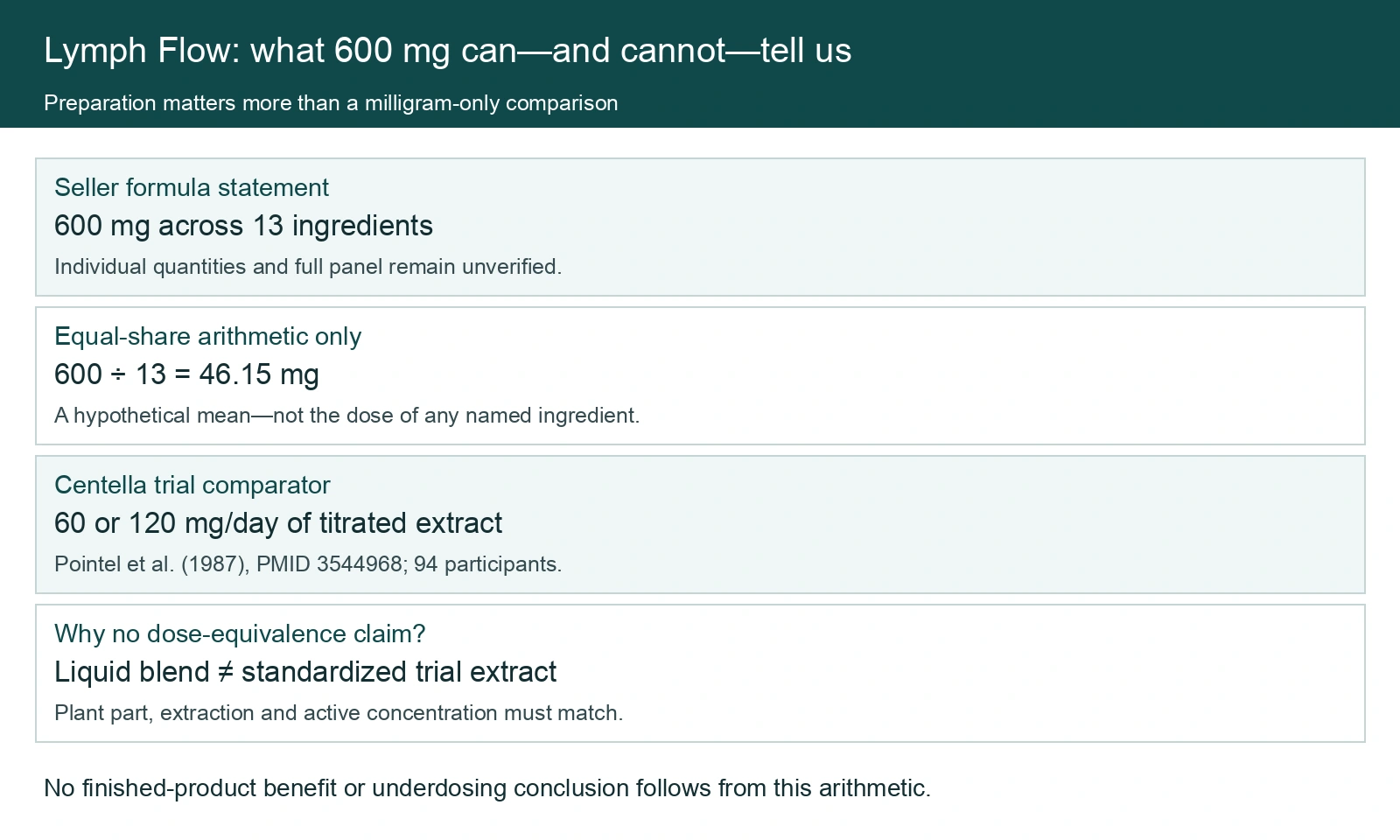
The figure’s 60/120 mg comparator refers to titrated Centella extract in Pointel’s trial. It must not be relabeled as a recommended dose of Lymph Flow or as proof the blend is sufficient. Pointel et al. (1987) [PMID: 3544968] [2]
Which ingredient evidence transfers—and which does not?
Plant identity is only the first step in applying research to Lymph Flow. A useful match also needs the same preparation, route, amount, population and outcome. The inspected studies provide limited venous-symptom evidence, while the liquid mixture’s exact specifications and advertised broader benefits remain unresolved.
Horse chestnut review trials used standardized oral seed-extract monotherapy and excluded combination preparations. This is a material difference from a 13-ingredient liquid: a positive result in one preparation does not demonstrate that the mixed product reproduces it. Pittler & Ernst (2012) [PMID: 23152216] [1]
Pointel compared two doses of titrated Centella extract against placebo over two months. Chong and Aziz’s later systematic review found reporting and bias limitations across eight trials, including three without quantitative data. This supports cautious interpretation rather than a blanket claim that gotu kola is proven. Pointel et al. (1987) [PMID: 3544968] [2] Chong & Aziz (2013) [PMID: 23533507] [3]
- Ask whether “quercetin phytosome” refers to a specified preparation with a stated amount; do not infer a proprietary brand relationship.
- Ask which Boswellia species/extract and ginger preparation are used, rather than importing doses from unrelated research.
- Keep a seller’s absorption claim separate from demonstrated improvement in the outcome you care about.
The effectiveness assessment owns benefit and timeline conclusions; ingredient naming alone cannot answer those questions.
Soy, carriers and the missing full panel
The disclosed soy warning is actionable even though the complete Lymph Flow panel remains unverified. Seller prose mentions purified water, vegetable glycerin and natural flavoring, but those names do not establish the full inactive list. A person checking allergies needs the current complete bottle label, not a reconstructed ingredient list.
- Do not assume “alcohol free” means allergen-free or interaction-free.
- Ask whether the soy warning comes from a carrier or another component; the inspected prose does not resolve its source.
- Check botanical names, plant parts and added flavor ingredients against your individual allergy history.
The six highlighted names are not presented here in a supposed full label order. No label image has been recreated, and the unresolved panel is not treated as evidence that the manufacturer omitted it. For clinical cautions, use the safety owner.
What to bring to a pharmacist or clinician
A useful Lymph Flow consultation starts with the actual full formula and your medication list. The key question is not whether a familiar herb sounds natural, but whether the specific mixture is appropriate for the cause of your symptoms. These questions make the missing specifications concrete without prescribing a dose.
- Can the current label identify every active, its botanical form and the amount per measured serving?
- Does the horse chestnut extract specify seed processing and aescin standardization?
- Is the Centella preparation comparable to titrated extracts, or a different whole-herb product?
- Does any ingredient or carrier conflict with your medicines, allergies, pregnancy status or liver history?
- Would evaluation of the swelling change whether any supplement is appropriate?
Lymph Flow ingredient FAQs
Ingredient transparency questions should end in a verifiable label detail, not a guessed answer. Lymph Flow’s total blend mass and six highlights can inform further questions, but they cannot disclose the remainder or establish extract equivalence. The following answers keep arithmetic, plant identity and formula evidence separate.
Are all 13 Lymph Flow ingredients verified here?
No. Six names were inspectable in the seller’s highlights, while the complete linked panel could not be recovered as a readable image. This assessment does not invent the other seven, assert an order or claim that the inaccessible panel omits information.
Is gotu kola the same as the studied TECA extract?
Gotu kola is a common name for Centella asiatica, but a plant name does not define a preparation. The trial used titrated extract at specified doses. Lymph Flow’s individual amount and extract equivalence remain unverified, so clinical transfer cannot be assumed.
Does 46.15 mg show how much of each herb I get?
No. That number is 600 divided by 13 under a hypothetical equal distribution. A proprietary mixture may allocate very different amounts to each component. Only a reliable serving-level disclosure could establish the actual quantity of a particular Lymph Flow ingredient.
Does liquid delivery prove better effectiveness?
Liquid delivery describes the format, not the demonstrated clinical result. A claim of absorption needs evidence for the specific preparation, and improved absorption alone would not establish relief of swelling or another advertised outcome. The reviewed Lymph Flow mixture has not been matched to the cited trials.
Can the bottle front replace the Supplement Facts panel?
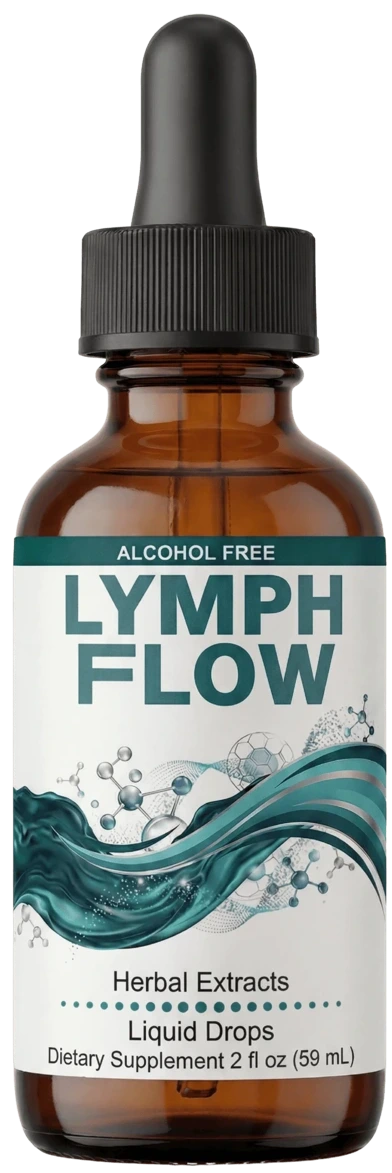
The front artwork identifies the product, liquid format and 59 mL volume, but does not supply the complete active and inactive list or warnings. For medication and allergy review, request a legible current panel rather than relying on a marketing image or ingredient highlights.
Continue the Lymph Flow assessment
References
- Pittler & Ernst (2012). Horse chestnut seed extract for chronic venous insufficiency.
- Pointel et al. (1987). Titrated extract of Centella asiatica in venous insufficiency.
- Chong & Aziz (2013). Centella asiatica and chronic venous insufficiency: systematic review.
- NCCIH. Turmeric: Usefulness and Safety.