
ProvaDent Ingredients: Label, Strains and Dose Gaps
What does the two-tablet label disclose, and what does it leave uncertain?
Affiliate disclosure: Fitness Life Mag may earn a commission if you buy through our marked product links at no added cost. Compensation does not change the evidence assessment. Read our disclosure.
Answer at a glance
The published panel has unusually useful quantities, yet it also contains a botanical-name conflict and two blends whose component doses are not stated. Those exact gaps determine what can responsibly be concluded from the ingredient list. See the complete ProvaDent review for the broader decision.
What does the published label actually list?
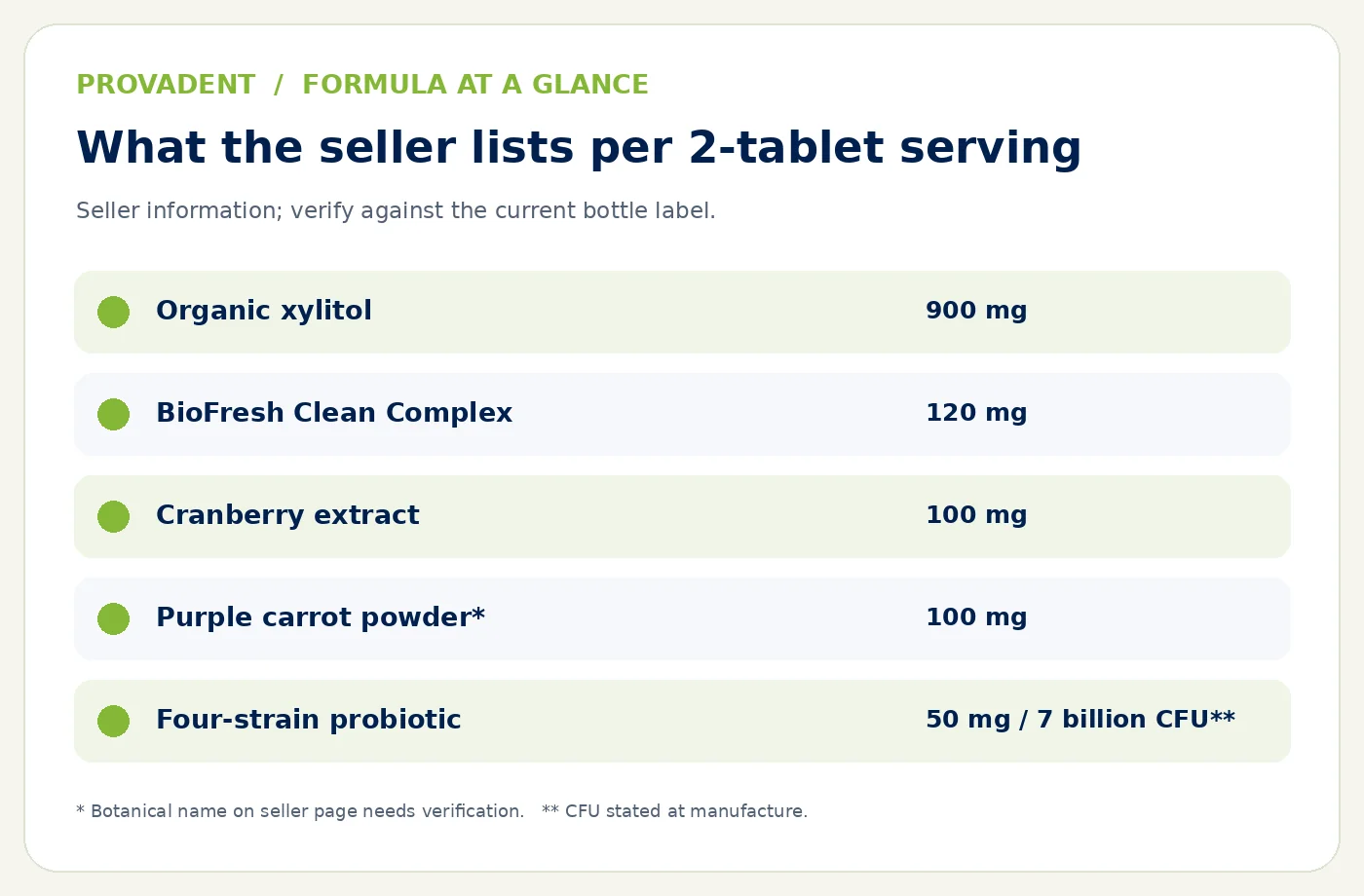
The seller-published Supplement Facts sets one serving at two chewable tablets and 30 servings per bottle. It lists organic xylitol 900 mg, BioFresh Clean Complex 120 mg, cranberry extract 100 mg, “Purple Carrot Powder (Raphanus sativus)” 100 mg, and a four-organism probiotic blend of 50 mg with seven billion CFU at manufacture. These are seller-label figures, not our own chemical assay. A customer should compare the delivered bottle with the current label before treating a page screenshot as an unchanging specification.
The cranberry entry reports 30% proanthocyanidins. If that standardization accurately applies to the stated 100 mg extract, the nominal arithmetic is 30 mg of proanthocyanidins. This calculation cannot establish absorption in the mouth, batch purity, or a dental outcome.
ProvaDent ingredients: label amounts per serving
| Label entry | Per two tablets | Limit of the number |
|---|---|---|
| Organic xylitol | 900 mg | Does not establish cavity prevention at this dose. |
| BioFresh Clean Complex | 120 mg total | Individual enzyme amounts are not given. |
| Cranberry extract | 100 mg; stated 30% PAC | Not a finished-product efficacy study. |
| “Purple Carrot Powder (Raphanus sativus)” | 100 mg | Common and botanical names conflict. |
| Four-organism probiotic blend | 50 mg; seven billion CFU at manufacture | Per-strain and expiry counts not listed. |
What does the 50 mg probiotic blend hide?
The printed names are L. salivarius LS97, L. paracasei LC86, L. acidophilus LA85 and S. salivarius without a strain code shown in the image. Seven billion CFU is a combined count at manufacture. It does not mean seven billion CFU for each strain, or that the same count remains at expiry. The combined 50 mg mass cannot be divided into strain doses without a stated distribution. Nor does arithmetic show which organism can survive manufacturing and storage.
The 120 mg enzyme blend similarly does not assign a quantity to each listed enzyme. This is dose uncertainty; it is not proof of underdosing or of a synergistic effect.
Why the purple carrot name matters
“Purple carrot” is ordinarily classified as Daucus carota; Raphanus sativus names radish. The seller image joins the first common name to the second Latin name. We cannot identify the material that went into a bottle from this conflict. A responsible seller can clarify its raw-material specification and provide corrected labeling. Until then, we present both printed terms without silently choosing one.
Someone avoiding a particular plant ingredient should obtain a written answer before purchase rather than infer identity from a promotional illustration.
Can ingredient studies validate the formula?
Not automatically. The Cochrane review of xylitol products examined different formulations and exposures, finding limited evidence for many approaches. The 2026 probiotic review assesses studies with other strains and populations; it does not test the ProvaDent blend. A measured bacterial change, fewer cavities and overnight enamel repair are three different endpoints. A finished-formula trial with relevant outcomes would be needed to support the strongest product claim.
Compare the seller’s current price and terms, and ask for clarification of the unresolved label discrepancy before purchasing.
Check current price and terms ↗What should a buyer ask for?
Request an up-to-date Supplement Facts panel matching the delivered lot, clarification of the carrot/radish discrepancy, CFU count at expiry and per-strain disclosure if available, and independent batch testing if the seller claims it. A refusal does not itself prove the product is unsafe; it leaves those aspects unverified. If those unknowns matter to your decision, defer purchase.
Ingredient-by-ingredient evidence boundaries
Xylitol: the dose is printed, but the Cochrane evidence about other vehicles and long use cannot establish an outcome from these chewables. Enzymes: the product names the components of its BioFresh mixture, but does not give separately testable enzyme quantities or clinical endpoints at this serving. Cranberry: the PAC standardization on a label is a compositional statement, not proof that bacteria adhesion in a mouth decreases or that teeth stay healthier.
Purple plant powder: before discussing antioxidant effects, identity must be resolved because the common and botanical names disagree. Probiotics: species and three strain identifiers narrow down what could be searched, but a blend total cannot be used as if it were the dose tested in a study on a single strain. Evidence for one strain in a child sample cannot be transplanted to this four-organism adult-marketed combination. The order of these uncertainties matters: knowing the actual material and dose comes before extrapolating mechanisms.
How to use the label and ingredient overview
The seller-published Supplement Facts wording lets a reader reproduce the discrepancy and serving arithmetic; the ingredient overview image is illustrative and does not confirm what a particular shipped bottle contains. If a buyer receives a newer revision, the physical bottle and lot documents should supersede an old webpage screenshot for identity. Likewise, an ingredient drawing in this article illustrates categories; it cannot prove ingredient origin, measured amount or how long the bacteria stay alive.
The published panel also names nonactive ingredients including peppermint oil and flavors. If any exclusion is medically or personally important, ask for a complete current specification rather than assuming an illustrated cranberry or carrot photo captures the complete composition. This is a practical reason to preserve a photograph of the bottle received and the seller description as of purchase.
Questions readers ask
Is each strain given seven billion CFU?
No. The label states a combined seven-billion-CFU count at manufacture per serving.
Does the label prove tooth repair?
No. A product ingredient list and a clinical enamel outcome are different kinds of evidence.
Is the plant carrot or radish?
The printed common and botanical names conflict. Ask the manufacturer for a corrected specification.
Sources, method and related guides
We transcribed the current seller-published Supplement Facts, checked amounts per two-tablet serving and tested the logic of its blended doses and botanical wording. We compared ingredient-specific claims with the Cochrane xylitol review and the cited probiotic literature. Neither source is a trial of this finished product. Primary product sources: seller label and packages, seller offer, seller return policy (checked September 19, 2026). This remains document research; we did not personally purchase, assay or clinically test the tablets. Material new evidence and current seller terms require a dated recheck.
Fitness Life Mag Editorial Methodology · Sources Policy · Affiliate Disclosure
What to do next
Use the evidence limits above when deciding. If a material question remains unresolved, ask the seller for written clarification; consult a dentist for symptoms requiring examination. Check the live price, shipping and return terms before any purchase.
Check current offer ↗