
Does ProvaDent Work? Trials, Mechanisms and Realistic Results
Which outcomes are supported, and what would actually test the seller's overnight enamel promise?
Affiliate disclosure: Fitness Life Mag may earn a commission if you buy through our marked product links at no added cost. Compensation does not change the evidence assessment. Read our disclosure.
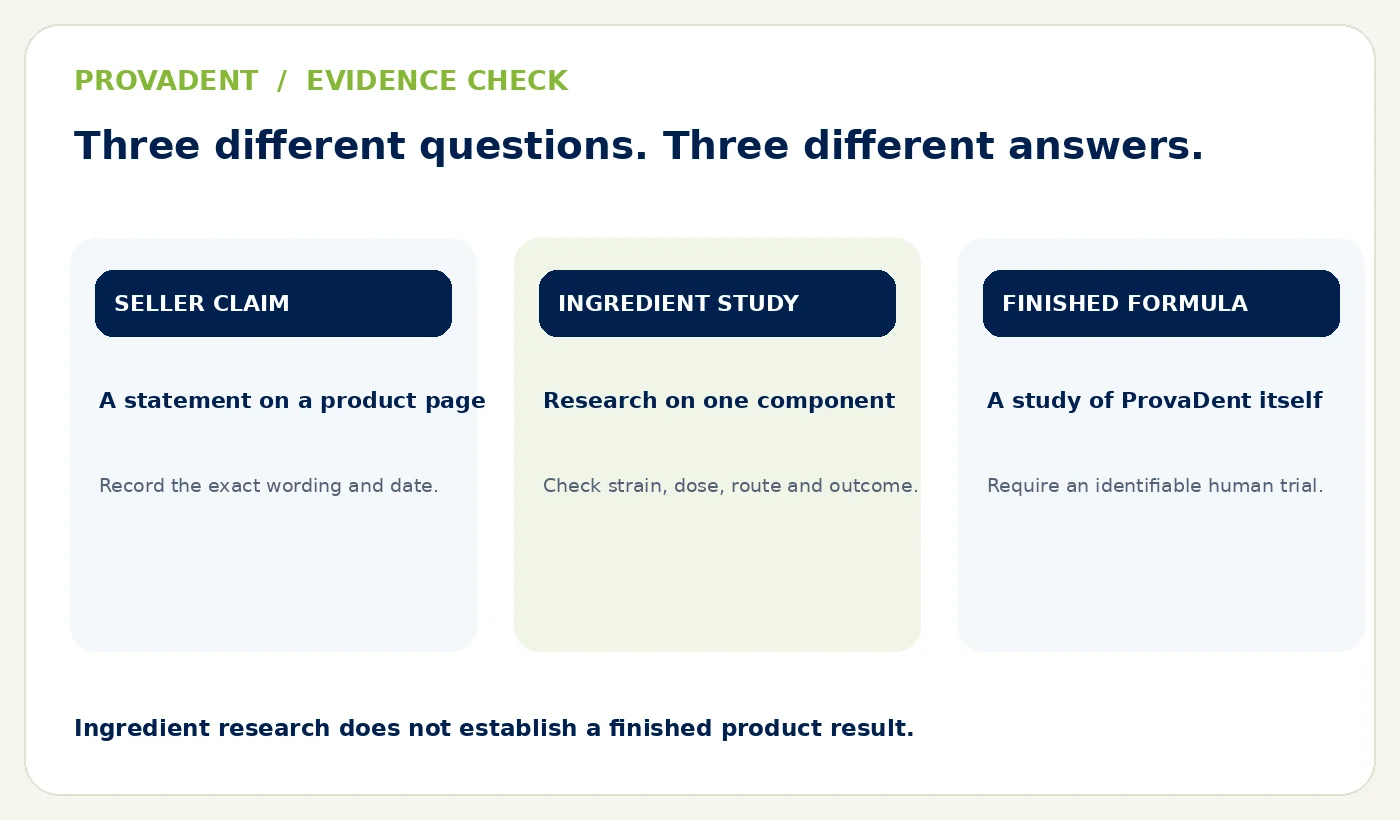
Answer at a glance
Our review of the seller's product information and the research cited below cannot verify that this complete chewable formula repairs enamel overnight, prevents cavities, or produces a predictable lasting change in oral health. That is a statement about the evidence we could identify, not a laboratory finding that every component is inert. The distinction matters when a sales page moves from a plausible oral-health mechanism to a promise about a person's teeth.
Does ProvaDent work? The direct answer
It might affect some intermediate conditions in the mouth, but the available material does not tell us whether taking this exact product improves a patient's measured enamel, decay rate, or gum outcomes. The seller's offer emphasizes a red chewable and an overnight remineralization idea. The published label describes xylitol, an enzyme mixture, cranberry, a plant powder and a probiotic mixture. Neither a list of components nor a demonstration of a proposed mechanism measures the finished tablet's clinical benefit.
The narrower question “can someone experience fresher breath?” has a different answer: peppermint and chewing may change perception briefly, yet an individual's report cannot isolate cause or establish enamel repair. Someone with a cavity, tooth pain, swelling or persistent bleeding needs an examination, since delaying dental care to test an overnight supplement promise can leave a treatable problem untreated. Our full ProvaDent review covers the overall buying decision.
What evidence would actually support an effectiveness claim?
Start with an endpoint: a measured change in enamel mineral status, a lower rate of new cavities, or a validated gum-health outcome. Then ask which people were studied, what they took, how long they took it, what the comparison group received, and whether the outcome was specified before looking at the data. A person who says their mouth feels clean is describing an experience; a controlled examination comparing new decay over time tests a different, more consequential claim.
| Question | Useful evidence | Current limitation |
|---|---|---|
| Do the sold tablets contain the listed ingredients? | Current delivered lot, matched label and credible composition testing. | Seller-published panel examined; no independent assay performed. |
| Does the formula change the microbiome? | Prespecified, controlled comparison using these tablets and measured changes. | Mechanism asserted; no matching finished-formula study identified. |
| Does it improve dental outcomes? | Relevant patient outcomes, adequate follow-up and blinded assessment. | Ingredient research cannot fill this gap. |
| Does enamel repair overnight? | Valid enamel measure before and after the claimed interval with appropriate controls. | We found no publicly accessible matching clinical result. |
Even a positive ingredient trial needs careful transfer: amount per dose, strain identification, route, duration, participant age and baseline dental care can differ. A tested gum, rinse or toothpaste is not interchangeable with a particular two-tablet chewable. Outcomes such as bacterial counts should not be quietly relabeled as fewer cavities.
What do oral-probiotic studies tell us about ProvaDent?
A 2026 systematic review and meta-analysis of probiotic caries studies considered different organisms, formats, participants and study designs. Its pooled adult analysis of six randomized trials did not find a statistically clear reduction in caries risk (risk ratio 0.94; 95% confidence interval 0.79–1.12). The pediatric pooled estimate was more promising, but the authors reported substantial differences across trials; it does not predict an adult purchaser's result from this blend. Those are findings about the included interventions, not a ProvaDent experiment.
On the seller's label, the probiotic blend is listed as 50 mg with a combined seven billion colony-forming units at manufacture. That wording does not tell us the viable count of each organism at the end of shelf life, which strain supplies which amount, or how the chewable was stored before use. A dose measured in milligrams for the whole blend is also not the same as a measured living count for each named strain. These missing numbers block a direct comparison with a trial that used an individually specified dose.
A microbiome effect would still be an intermediate result. To claim a consumer benefit, a study would need to show that the change persisted and improved an outcome people care about, with appropriate examination and follow-up. Read the label and strain analysis if you need the separate ingredient identities and dose gaps.
What about xylitol, enzymes and cranberry?
The seller lists 900 mg of xylitol per two-tablet serving. The Cochrane review of xylitol-containing products evaluates other formulations, doses and longer prevention periods. It found limited dependable evidence for many comparisons; it cannot establish a cavity reduction or a one-night effect from the marketed ProvaDent tablets. Reading “xylitol” on two labels does not make those regimens equivalent.
The label lists a 120 mg BioFresh Clean Complex, without individual enzyme amounts. A lab experiment showing an enzyme can act on an oral substrate would test a biochemical possibility; it would not tell us whether this blend survives storage, reaches the intended site at a useful concentration, or changes a dental outcome. A controlled product study could answer some of those questions. The same logic applies to the cranberry extract: a standardized botanical entry describes composition as published, while an observed reduction in cavities would require separate patient data.
There is also a label identity issue: the published text pairs “Purple Carrot Powder” with Raphanus sativus, a botanical name associated with radish. Until the manufacturer clarifies the underlying material in writing, research on a supposed “purple carrot” ingredient cannot safely be treated as research on what is actually in these tablets. That inconsistency concerns evidence transfer as well as ingredient transparency.
Can enamel really remineralize overnight?
NIDCR describes tooth decay as a process in which acid removes minerals and saliva and fluoride can help replace minerals during early stages. Early mineral changes may sometimes be reversed; a formed cavity requires dental treatment. This biological process makes the words “remineralization” and “overnight repair” meaningfully different. A biological capacity of enamel does not establish that this specific supplement restores it after one use or repairs a hole in a tooth.
Testing an overnight claim would require a clear definition of repair, valid baseline and follow-up mineral measurements, relevant controls, and a way to separate saliva and ordinary fluoride exposure from the tablet. Photos, customer stories, a changing saliva marker, or a report of a smoother tooth would not by themselves measure restoration of lost enamel. We found no publicly accessible human test of the full marketed formula meeting the described claim in the sources reviewed on September 20, 2026.
For routine prevention, WHO oral-health guidance and the ADA's fluoride guidance address established measures. This product has not earned an equivalent recommendation on the evidence described here. Dental advice should account for a person's age, exposure and medical history.
Could breath or gums improve without proving the big claim?
Yes, a temporary feeling of fresh breath is possible. Peppermint flavor, chewing and increased saliva offer ordinary explanations even if there is no lasting microbial shift. A consumer would need to know whether a result lasts beyond the immediate flavor window and whether objective breath measurements changed compared with a plausible comparison tablet. Self-reported freshness may still matter personally, but should be reported as a subjective effect rather than enamel repair.
Gum bleeding is a different endpoint with multiple possible causes. If brushing technique changes when a buyer starts a new supplement, a later improvement cannot be assigned to the supplement from timing alone. Persistent bleeding or swelling warrants a dentist's assessment. We have not verified a controlled finished-product gum outcome, so we do not advertise one. For use-related cautions, the side effects guide covers questions to raise before trying these tablets.
Check the seller's current label, final checkout total and return terms; treat the overnight repair promise as unverified.
See current offer and terms ↗A claim-to-evidence ladder for this formula
Evidence is strongest when the tested product, population, dose and endpoint match the claim. The seller's panel is direct evidence of what the seller publishes, while a controlled trial of the exact tablets would bear much more directly on an efficacy claim. These categories should stay separate even when the page displays them together.
- Published specification: we can quote what a seller lists, while independently measured content and the current shipped lot remain unverified.
- Mechanistic plausibility: a named organism or enzyme might influence an oral process under specified conditions; that does not yet show patient benefit.
- Related intervention studies: xylitol and probiotic research can frame hypotheses, but different products, doses or participants cannot be silently substituted for these tablets.
- Finished-product clinical evidence: a controlled, accessible trial with relevant outcomes would provide the most direct test; we did not identify one for the claims discussed.
Our original analysis here is the mapping from each seller-facing promise to the minimum relevant test, the mismatch between component research and a finished-formula claim, and the specific missing dose details on the published label. The ladder does not grade unknown studies as negative; it shows exactly what has and has not been substantiated in this document review.
How quickly could a result appear, and what can confuse the picture?
No reliable product-specific timeline follows from the current evidence. The taste and the act of chewing are immediate, but those impressions tell us nothing about long-term cavity prevention. To detect a dental benefit, investigators would set a relevant follow-up interval and objective outcome in advance. Promising that a dental change happens by morning skips that measurement step.
Imagine beginning ProvaDent on the same week you switch to fluoride toothpaste, improve brushing, floss more often, change diet and book a cleaning. A later improvement in symptoms may be real, but the bundle of changes makes its cause impossible to identify from one person's story. Expectations, natural symptom variation and selective publication of enthusiastic testimonials add further uncertainty. A randomized comparison and blinded dental measurement would help separate them.
One negative anecdote is similarly inadequate to demonstrate that no person could benefit. The question is what evidence can support a population-level sales promise. Anyone seeking help for a painful tooth should not use an unmeasured supplement timeline as a reason to postpone care.
What information would change our assessment?
A public protocol and independently reviewable, controlled human study of the sold formula could materially narrow this gap. We would look for a specified dose and formulation, participant selection, comparison treatment, prespecified dental outcomes, appropriate duration, adverse-event reporting and complete results including those that did not favor the product. A preregistration or credible full report is more informative than a slide saying “clinically tested.”
We would also need a corrected ingredient identity, per-strain details and viability information sufficient to compare any probiotic claim with its cited evidence. A seller could provide such documents later. Until then, our editorial conclusion is conditional and specific: we cannot substantiate the advertised overnight enamel result for this finished product.
Common questions
Does the absence of a trial mean ProvaDent cannot work?
No. It means the reviewed public materials do not establish the claimed benefit for this marketed formula.
Are seven billion CFU enough?
A combined count at manufacture alone cannot establish an effective dose or a clinical outcome. Counts per organism and at expiration are not established by that label line.
Would a fresher mouth in the morning prove enamel repair?
No. A sensation of freshness and a measured gain in tooth mineral content are different outcomes.
Sources, method and related guides
We compared the seller offer's wording and published panel with the 2026 probiotic systematic review, Cochrane xylitol review, NIDCR tooth-decay explanation, WHO guidance and ADA fluoride information. The Cochrane link above uses its official page path; the cited interventions are not trials of ProvaDent. Search and source review checked September 20, 2026. We did not buy, clinically test, or assay the product. A new published product study or label revision requires a dated recheck.
Editorial Methodology · Sources Policy · Affiliate Disclosure
Next step
Discuss worrying symptoms with a dentist. If you still want to consider ProvaDent, read the seller's current ingredients, checkout amount and written refund terms before deciding.
Check current offer ↗