
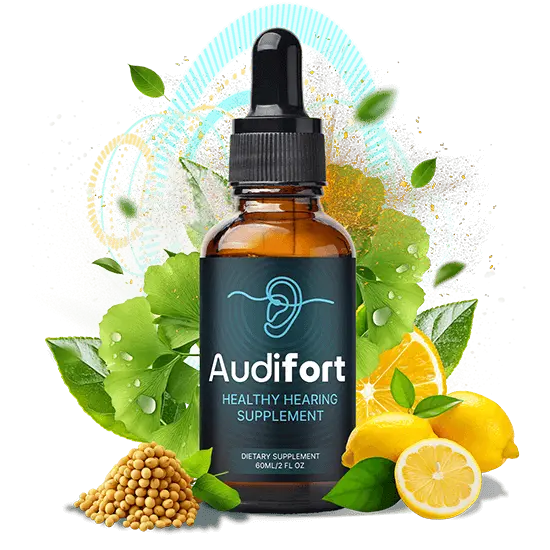
Audifort ingredients: quick answer
The supplied Audifort label lists chromium plus a 200 mg proprietary blend containing 22 components per 1 mL serving. The blend includes botanicals, amino acids and other named substances. Its individual component amounts are not declared. A formula list therefore answers what the supplier says is included, but does not establish the exposure to each component or a hearing benefit.
The readable source is a supplier label asset marked REV 04/24, inspected October 7, 2026. It shows 60 mL per bottle and 60 labeled servings. We have not tested a bottle or confirmed that a current shipment carries this same revision. Compare the physical label before use; this transcription should not override a different current panel.
For the integrated decision, including evidence and buying limitations, see our Audifort review. This page focuses on formula identity, quantities, how to interpret the panel and questions to resolve before purchase or use.
Formula verdict: the ingredient list is available, but dose transparency is incomplete. We can transcribe the shared total and chromium amount. We cannot reconstruct the individual doses, confirm potency or declare the finished product effective from its label.
Supplement Facts: what the panel actually declares
| Label field | Supplied panel | How to interpret it |
|---|---|---|
| Product form | Liquid dietary supplement | Ingested supplement, not a hearing device |
| Net volume | 60 mL / 2 fl oz | Bottle volume printed in the artwork |
| Serving size | 1 mL | Basis for the listed amounts |
| Servings per container | 60 | Labeled servings, not automatically 60 days |
| Chromium | 0.7 mcg as chromium picolinate | Separately declared mineral amount |
| Chromium Daily Value | 2% | Printed nutrient reference percentage, not an efficacy score |
| Proprietary blend | 200 mg | Combined amount for the 22 listed components |
| Individual blend amounts | Not declared | No component-by-component dose comparison possible |
| Blend Daily Value | Not established | Does not indicate that the blend meets a nutritional target |
| Artwork revision | 04/24 | Supplier asset revision, not confirmation of a current shipment |
Keep the units separate. Chromium is listed in micrograms (mcg), while the blend is in milligrams (mg). These are different scales; neither the blend total nor the chromium percentage identifies a clinically effective hearing dose.
The text version below makes the panel easier to read on a phone. It remains a transcription of supplier information. It is not an independent chemical analysis, verification of every constituent or certification of manufacturing quality.
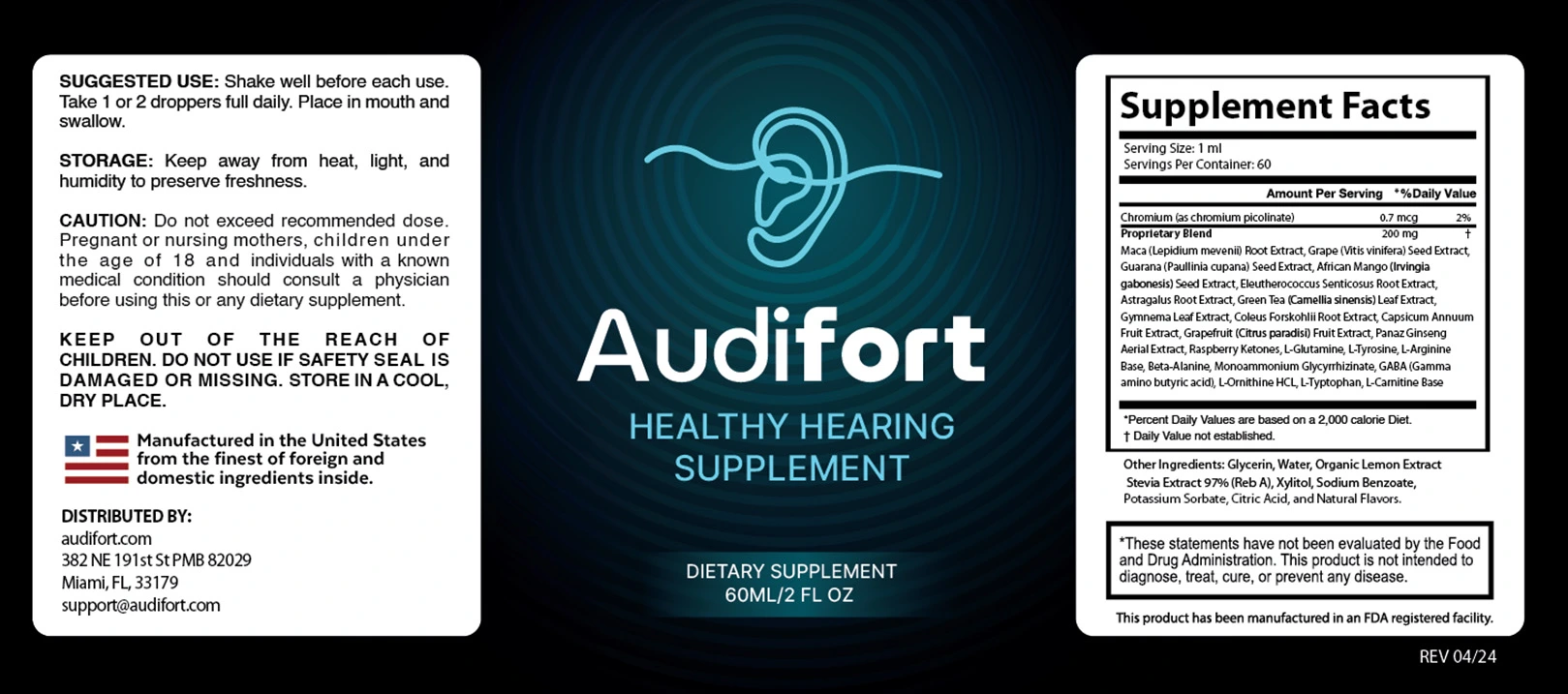
Complete Audifort proprietary blend ingredient list
All components in this table belong to the same 200 mg total per 1 mL serving. Each row does not contain 200 mg, and each is not known to have an equal share. The numbering follows the supplied panel’s sequence for checking against the image.
| No. | Listed component | Identity detail shown on the panel |
|---|---|---|
| 1 | Maca root extract | Lepidium meyenii; root |
| 2 | Grape seed extract | Vitis vinifera; seed |
| 3 | Guarana seed extract | Paullinia cupana; seed |
| 4 | African mango seed extract | Irvingia gabonensis; seed |
| 5 | Eleutherococcus senticosus root extract | Root extract |
| 6 | Astragalus root extract | Root; species not specified in this panel |
| 7 | Green tea leaf extract | Camellia sinensis; leaf |
| 8 | Gymnema leaf extract | Leaf; species not specified in this panel |
| 9 | Coleus forskohlii root extract | Root extract |
| 10 | Capsicum annuum fruit extract | Fruit extract |
| 11 | Grapefruit fruit extract | Citrus paradisi; fruit |
| 12 | Panax ginseng aerial extract | Aerial material, not described as root |
| 13 | Raspberry ketones | Named substance; source and amount not declared |
| 14 | L-glutamine | Named amino acid |
| 15 | L-tyrosine | Named amino acid |
| 16 | L-arginine base | Base form specified |
| 17 | Beta-alanine | Named amino acid |
| 18 | Monoammonium glycyrrhizinate | Named compound; amount not declared |
| 19 | GABA | Gamma-aminobutyric acid |
| 20 | L-ornithine HCl | Hydrochloride form specified |
| 21 | L-tryptophan | Named amino acid |
| 22 | L-carnitine base | Base form specified |
A short sales-page ingredient list should not replace this complete transcription. Equally, another review’s formula should not be merged into this one. If a component appears on a different website but not on the panel inspected here, it needs a separate source and a matching label revision before being treated as part of this formula.
Names, plant parts and chemical forms matter when comparing research. For example, a paper studying ginseng root is not an automatic match for a label describing aerial extract. A generic “ginseng research” heading can hide that mismatch. This observation does not prove that either preparation is better; it identifies a verification question.
What a 200 mg shared blend tells us—and what it cannot tell us
The combined weight is one useful piece of information, but it leaves several decisions unresolved. We cannot calculate the amount of GABA, grape seed extract or any other component from the label. We also cannot confirm a particular extract ratio, standardization target or active-constituent concentration unless it is separately supplied and verified.
Dividing 200 by 22 gives approximately 9.1 mg as a hypothetical equal-share average. This is arithmetic, not a dose estimate. The actual allocation could differ substantially. Do not use that number to claim that every ingredient has a 9.1 mg dose, or to declare the product clinically underdosed.
Nor does counting 22 components measure strength. A larger list can make dose matching harder when the individual amounts remain undisclosed. An ingredient may be present without being supplied at the preparation and exposure used in a study.
Five checks before borrowing an ingredient study
- Identity: Is it the same botanical species, plant part or named compound?
- Preparation: Is the extract or chemical form comparable?
- Exposure: Is the actual daily amount known and comparable?
- Population: Were the participants relevant to the reader’s question?
- Outcome: Did the study measure hearing, tinnitus burden or something else?
If the exposure is unknown, the comparison remains incomplete even when the names match. Combining components also creates a different intervention from studying each separately. The exact finished mixture requires its own appropriate evidence.
Our Does Audifort Work? analysis examines that evidence boundary in depth (file prepared; live publication unverified). It distinguishes ingredient research, another supplement’s tinnitus trial and a trial of Audifort itself.
Affiliate link. Offer inspection only; this link does not establish treatment benefit. Seek assessment for unexplained symptoms.
Other ingredients: read this list too
The supplied label separately lists glycerin, water, organic lemon extract, stevia extract 97% (Reb A), xylitol, sodium benzoate, potassium sorbate, citric acid and natural flavors.
This list belongs alongside the Supplement Facts when reviewing a product. A person checking an ingredient sensitivity needs the entire panel, rather than only the botanicals highlighted in marketing. The quantities of these other ingredients are not shown in the supplied artwork, and “natural flavors” does not identify every flavour constituent.
FDA explains that dietary supplements may contain other ingredients such as sweeteners, flavourings and preservatives. Their presence should not be treated as proof of a hearing effect. FDA dietary supplement questions and answers.
The word “organic” here modifies the listed lemon extract. It does not establish that the whole formula is certified organic. Likewise, this transcription does not confirm gluten-free, vegan, allergen-free or caffeine-free status. If one of those characteristics matters to you, request a specific current statement and supporting information for the actual product.
Audifort directions: the label and FAQ do not match
The supplier artwork says to shake before use, take one or two full droppers daily, place the liquid in the mouth and swallow. The seller FAQ inspected on October 7, 2026 describes one full dropper daily. We report both statements because selecting one ourselves would turn a documentation discrepancy into an unsupported instruction.
The Supplement Facts serving is 1 mL. However, a “full dropper” has not been independently verified as a calibrated 1 mL measure. A serving unit and an informal dropper description are not automatically interchangeable. Ask the supplier to confirm the current directions and the delivered volume of the supplied dropper.
What to ask for in writing
- Which directions apply to the bottle currently shipped?
- What measured volume does “one full dropper” mean?
- How does the daily instruction correspond to the 1 mL Supplement Facts serving?
- Has the formula or warning panel changed since revision 04/24?
- What should a pharmacist or clinician use as the daily ingredient exposure for an interaction review?
Do not double the amount to imitate a study or pursue a faster effect. This article provides no individualized dose or evidence-based response timeline. The physical product directions should be clarified with the supplier and, where relevant, reviewed with a health professional.
Does one bottle last 30 or 60 days?
The label contains 60 servings; the duration depends on the clarified daily use and measured volume. If a matching 60 mL bottle supplied exactly one 1 mL serving daily, simple arithmetic gives 60 days. At exactly two 1 mL servings daily, it gives 30 days. These are conditional scenarios, not directions to follow.
| Hypothetical measured use | Arithmetic for a 60 mL bottle | Boundary |
|---|---|---|
| 1 mL each day | 60 ÷ 1 = 60 days | Requires confirmation that this is the actual instructed daily volume |
| 2 mL each day | 60 ÷ 2 = 30 days | Not a recommendation to increase the dose |
| An unmeasured “full dropper” | Cannot calculate reliably | Dropper volume must be established first |
This distinction matters when judging a package advertised as several months of supply. The bottle count alone cannot resolve unclear daily volume. It also affects the apparent cost per day: the same bottle price spread over 30 days is twice the daily cost of spreading it over 60 days. That arithmetic cannot determine which directions are appropriate.
Keep price and return decisions with our Audifort price and refund guide (file prepared; live publication unverified). The larger package’s lower unit price should not be confused with a more suitable dose or better evidence.
Label warnings and suitability questions
The supplied artwork advises against exceeding the stated dose and recommends physician consultation for pregnancy or nursing, children under 18 and people with a known medical condition. It also directs users to keep the product away from children, avoid a damaged or missing safety seal, and store it in a cool, dry place away from heat, light and humidity.
These printed cautions do not prove that use is suitable for any of those groups after a brief check. Nor can an ingredient list alone establish a finished product’s safety. Individual amounts, medicines, other supplements and personal medical circumstances matter.
NCCIH advises discussing supplement use with health professionals and notes that interactions and adverse effects are possible. Take a clear image of the entire label and a complete medicines/supplements list to that discussion. Using dietary supplements wisely.
A separate Audifort side effects and interactions page is linked and published. This formula page should not be mistaken for a complete interaction clearance. We have not assigned a “safe for everyone” rating or tested contaminants.
Formula advantages and limitations
Useful information the supplied panel provides
- A readable complete list, including components omitted from short promotional summaries.
- A declared serving unit, bottle volume and total blend amount.
- A separately stated chromium quantity and reference percentage.
- Other ingredients, storage instructions and cautions that a buyer can show to a professional.
Information still missing for a confident comparison
- The individual amounts of the 22 blend components.
- Verified dropper calibration and consistent current daily directions.
- Confirmation that a delivered bottle matches the supplier artwork revision.
- Product-specific chemical testing and clinical results demonstrating a relevant benefit.
This page is useful for someone comparing labels or preparing questions before a purchase. It does not provide sufficient information for someone requiring exact component dosing, a clinician’s interaction assessment or a clinically established hearing treatment.
Physical-bottle verification checklist
Before use, compare the product name, net volume, serving unit, entire blend, other ingredients and warnings against the actual delivered label. Check the seal and any printed expiry or batch details; the artwork cannot show the condition of your particular bottle.
If anything differs, keep clear photographs and ask for clarification before relying on this transcription. A different label is a reason to verify the current formula, rather than assume the website or the physical bottle is automatically correct. A professional needs the version you actually have.
Remember that the panel is supplier information. A claim on packaging is not independent confirmation of manufacturing, identity or effectiveness. FDA states that supplements are not approved before marketing; a facility-registration statement should not be read as product approval. The label’s own disclaimer also distinguishes the supplement from a product intended to diagnose or treat disease.
For broader context, the linked tinnitus and hearing-support guide will explain assessment and management pathways independently of this formula. Publication is published. Our main Audifort review remains the product-level starting point.
Affiliate link. Offer inspection only; this link does not establish treatment benefit. Seek assessment for unexplained symptoms.
Frequently asked questions
What are the main Audifort ingredients?
The supplied panel includes chromium and a shared blend of 22 components, including maca, grape seed, guarana, green tea, gymnema, capsicum and GABA. The complete table above includes the additional botanicals, amino acids and other compounds rather than presenting the highlights as the whole formula.
Is the 200 mg amount for every ingredient?
No. It is the combined proprietary-blend amount per 1 mL serving. The individual component amounts are not shown. An equal-share calculation cannot reconstruct them.
How much GABA does Audifort contain?
The supplied label does not declare an individual GABA quantity. It is one component of the 200 mg blend. We cannot infer its amount from research about another GABA preparation.
Does Audifort contain chromium?
Yes, the supplied artwork lists 0.7 mcg of chromium as chromium picolinate, with 2% Daily Value. This is a declared label amount, not independent confirmation from a laboratory test.
Is Audifort caffeine-free or allergen-free?
We have not verified those classifications. The complete list and supplier confirmation are needed; an ingredient name or the absence of a marketing warning is insufficient to certify either status.
Should I take one or two droppers?
This article cannot choose a dose for you. The supplier label and seller FAQ differ, and dropper volume is not confirmed. Obtain current consistent directions and appropriate professional advice before use.
Does a bottle contain 60 days of supply?
It contains 60 labeled 1 mL servings in the inspected artwork. Calendar duration depends on the clarified daily volume. The 30- and 60-day calculations on this page are scenarios, not dosing recommendations.
Do these ingredients prove Audifort works?
No. Formula identity, dose information and clinical outcomes are different questions. Ingredient research cannot establish the effect of this exact mixture without an adequate preparation, exposure and outcome match.
Method and sources
Checked October 7, 2026 by Biraj Health Care. The formula transcription comes from the permitted supplier label asset, REV 04/24, visually inspected alongside the seller FAQ. We have not received a physical bottle, performed a chemical assay or obtained clinician review. Supplier documentation establishes what was printed, not what a particular shipment contains.
Independent context: FDA dietary supplement questions and answers and NCCIH supplement-use guidance. The blend arithmetic, unit distinctions and comparison checklist are editorial analysis. Commercial research addresses remain private rather than becoming purchase routes in this article.
See our editorial methodology and sources policy. Topic links prepared ahead of publication remain marked published until the publisher confirms their availability. The visible supplier label can be opened below for a closer comparison; it contains manufacturer statements, not an independent endorsement.