
Does Neuro Serge Work? 3 Trial Comparisons and Key Gaps
Independent editorial analysis. Commercial links below may earn a commission.
Neuro Serge is sold for brain health, memory and focus, yet the central question is whether research tests the actual blend. This analysis separates human ingredient trials from finished-product evidence. Read the main Neuro Serge review for the overall assessment; here, the focus is study design, relevant populations, meaningful outcomes and the limits of proposed response timelines.
| Claim | Relevant evidence | Confidence for Neuro Serge | Reader decision |
|---|---|---|---|
| Improves memory | Ingredient studies are mixed. | Product efficacy is unestablished. | Do not substitute a testimonial for a trial. |
| Works rapidly | No product response curve identified. | A predictable onset is unsupported. | Do not defer assessment for a promised date. |
| Protects brain health | The blend is not clinically characterized. | Disease prevention is not established. | Separate general health habits from product claims. |
A plausible mechanism is only the first step
A botanical antioxidant story does not identify a proven memory treatment. Neuro Serge’s affiliate material uses dramatic brain-sludge and rapid-restoration narratives, but the reviewed sources do not establish those mechanisms for this finished formula. A credible chain needs a defined preparation, a tested dose and meaningful human outcomes rather than an appealing biological explanation.
Mechanism claims often skip several steps: a substance can affect a laboratory marker without reaching a relevant concentration in people, and a measurable biological change may not improve daily function. That is why a clinical comparison must ask what was measured, in whom, against which control and for how long.
- A metabolic outcome is not automatically a memory outcome.
- An ingredient trial is not a test of a multi-ingredient commercial blend.
- A subgroup signal should not be presented as a benefit for every participant.
- A seller’s university imagery is not verification of institutional endorsement.
The product’s listed references focus largely on sleep, obesity and metabolic physiology. They may supply background context, but they do not demonstrate efficacy of Neuro Serge. No finished-formula randomized trial was identified in the reviewed sources. That leaves efficacy uncertain rather than proving either a guaranteed benefit or universal failure.
What the human trials actually tested
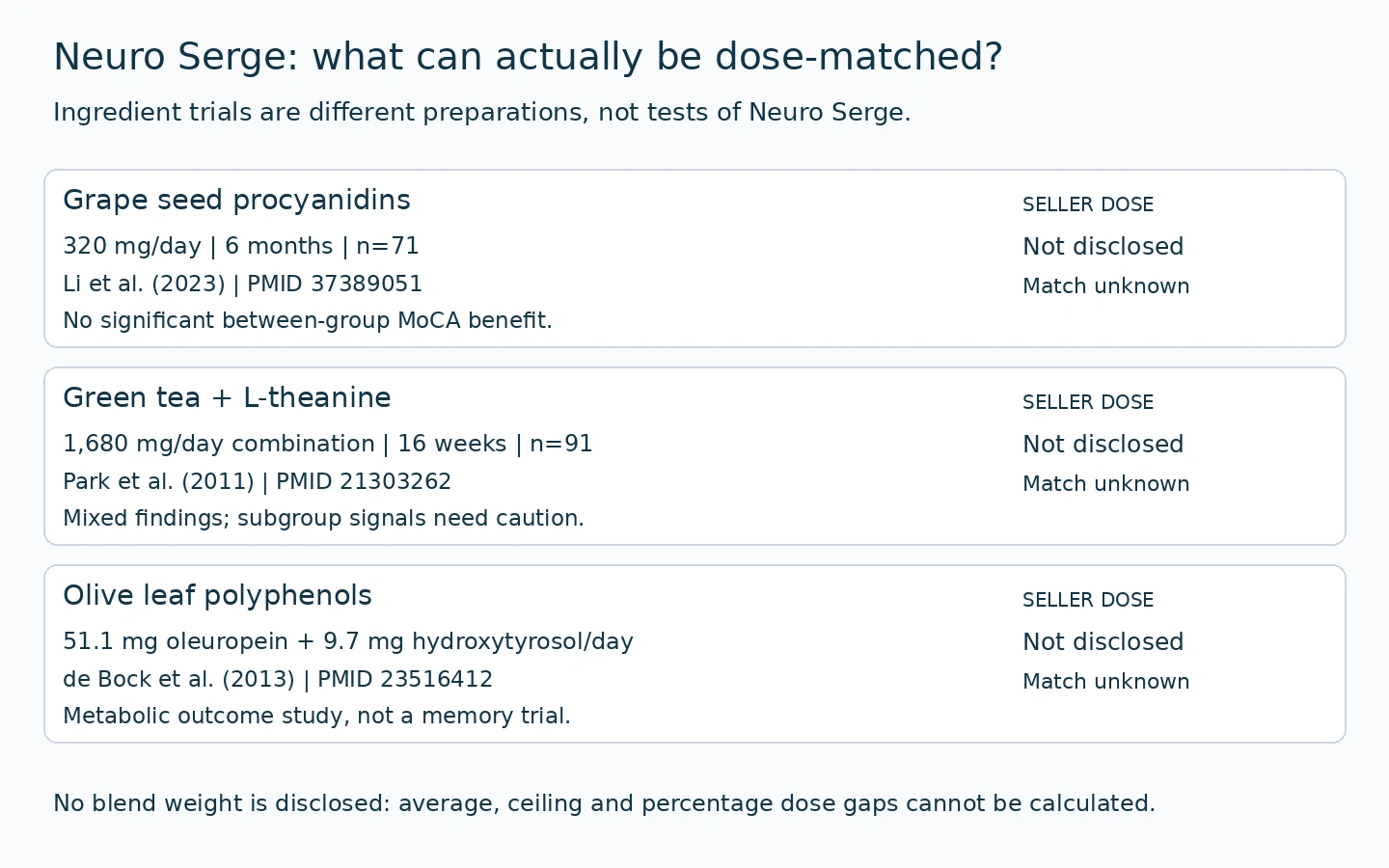
The most relevant studies point in different directions and use different preparations. Li and colleagues tested 320 mg/day grape-seed procyanidins for six months; Park and colleagues tested 1,680 mg/day of a tea/theanine combination for 16 weeks. Neither study tested Neuro Serge, and its undisclosed quantities prevent a meaningful product-to-study exposure match.
Li et al. (2023) randomized 71 older adults with mild cognitive impairment. The primary overall cognition comparison did not show a statistically significant advantage over placebo. Li et al. (2023) PMID: 37389051 [1] Bell et al. (2022) also reported no consistent cognitive benefit from 400 mg/day grape-seed polyphenols in 60 younger adults over 12 weeks. Bell et al. (2022) PMID: 31942838 [2]
| Study | Outcome question | Result boundary | What it means here |
|---|---|---|---|
| Li, 2023 | Overall cognition in older adults with MCI. | No significant between-group MoCA change. Li et al. (2023) PMID: 37389051 [1] | Do not promise broad memory improvement from grape seed. |
| Park, 2011 | Memory/attention with tea plus theanine in MCI. | Overall delayed-recognition result was marginal; small subgroup signals were positive. Park et al. (2011) PMID: 21303262 [3] | The combination and subgroup cannot represent all users. |
| de Bock, 2013 | Insulin sensitivity in overweight men. | The study concerns metabolic endpoints. de Bock et al. (2013) PMID: 23516412 [4] | It does not supply a Neuro Serge memory outcome. |
A positive grape study must also be identified correctly. Amone et al. (2024) examined 250 mg of standardized grape juice extract in 96 healthy older adults, reporting cognitive improvements. It was not grape seed extract, and an industry affiliation was disclosed. Amone et al. (2024) PMID: 39335927 [5] That result does not cancel the preparation-matching problem or establish Neuro Serge efficacy.
There is no verified product response clock
A 21-day marketing promise cannot be inferred from these trials. The ingredient studies span 12 weeks, 16 weeks or six months, and their populations and outcomes differ. No product-specific response curve was identified for Neuro Serge. More months of use do not automatically transform an untested blend into an established treatment.
Before starting any elective supplement trial, define what improvement would actually mean. A vague impression of “clarity” is vulnerable to changing sleep, workload, mood and expectation. A diary can document context, but it cannot substitute for a blinded trial or diagnose the cause of a memory complaint.
- Record the symptom that matters in daily life, without using an affiliate quiz as a diagnosis.
- Note changes in sleep, medicines and other supplements that could affect interpretation.
- Seek assessment when changes persist or impair function rather than waiting for a promised timeline.
The Brain & Memory Guide explains why symptom context matters. The NIA discusses reasons for memory changes and when a medical assessment is appropriate. National Institute on Aging NIA source [6] A seller recommendation to use several months does not override that clinical priority.
Who was studied—and who was not?
Age, baseline impairment and formulation affect whether a study is relevant. The 71-person grape-seed trial involved older adults with MCI, while the 60-person polyphenol trial enrolled adults aged 18–30. Neither population represents every shopper. The tea/theanine study’s small subgroup should be interpreted with particular restraint rather than generalized to all memory complaints.
A result in people with a defined cognitive assessment cannot be assumed to apply to a person whose concentration changed after a poor week of sleep. Conversely, a product advertised for everyday clarity should not be promoted as a replacement for assessment of progressive symptoms. The same word “memory” can conceal very different clinical and practical questions.
| Question | What would improve confidence |
|---|---|
| Is the shipped formula identical to the tested intervention? | A complete label, preparation specifications and product-specific study documentation. |
| Was a meaningful outcome measured? | A prespecified validated measure and a relevant comparison group. |
| Was the trial long and large enough? | A design capable of detecting a clinically meaningful difference, with transparent limitations. |
| Can the result be replicated? | Independent work with consistent product identity and outcomes. |
Our methodology weighs these issues separately from purchase terms. The ingredient analysis owns formula identity, while the safety page addresses interactions. It is reasonable to conclude that current confidence is low without declaring the product incapable of helping anyone.
Questions specific to does it work?
These answers distinguish trial findings from claims about the commercial product. The evidence includes a 320 mg grape-seed intervention and a 16-week combination trial, but neither tests Neuro Serge. The goal is to understand what was measured and where uncertainty remains, without converting a research quantity into a personal dosing instruction.
Is Neuro Serge itself clinically proven?
Did the 320 mg grape-seed study demonstrate a benefit?
Why does the green-tea trial need qualification?
Can a better blood-sugar marker prove better memory?
What evidence would change the conclusion?
References
- Li et al. (2023). The effect of grape seed procyanidins extract on cognitive function in elderly people with mild cognitive impairment. Heliyon 9:e16994. PMID: 37389051
- Bell et al. (2022). Grape seed polyphenol extract and cognitive function in healthy young adults. Nutr Neurosci 25:54–63. PMID: 31942838
- Park et al. (2011). A combination of green tea extract and L-theanine improves memory and attention in subjects with mild cognitive impairment. J Med Food 14:334–343. PMID: 21303262
- de Bock et al. (2013). Olive leaf polyphenols improve insulin sensitivity in middle-aged overweight men. PLoS One 8:e57622. PMID: 23516412
- Amone et al. (2024). Standardized grape extract improves short- and long-term cognitive performances in healthy older adults. Foods 13:2999. PMID: 39335927
- National Institute on Aging. Memory loss and forgetfulness. Accessed October 30, 2026. NIA source
Seller documents and offer checked October 30, 2026. Prices are advertised, not a completed checkout. Research comparisons are based on the cited abstracts and official health resources.