
Neuro Serge Review 2026: 6 Highlights, Doses & Returns
Neuro Serge review: the quick audit
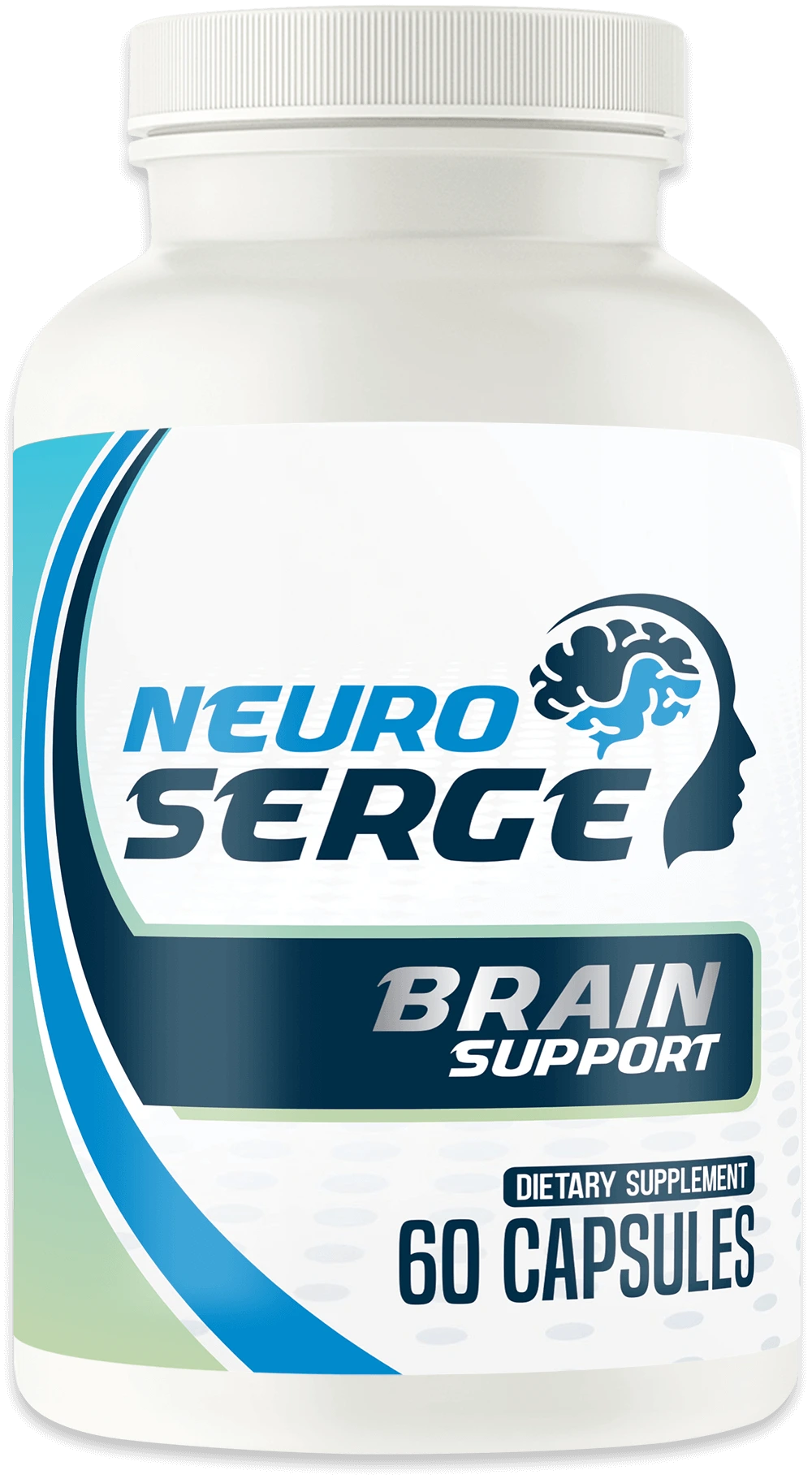
Neuro Serge needs a clearer label before it earns a confident buying recommendation. The inspected bottle artwork shows 60 capsules, while the offer lists six ingredient highlights, $49–$79 per bottle and a 90-day return window. Those details establish an offer, but they do not establish a clinically effective memory formula.
| Audit attribute | Verified finding |
|---|---|
| Product format | The seller markets an oral brain-support supplement in capsule form. |
| Container | The genuine front-bottle artwork displays 60 capsules. |
| Advertised supply | The package cards imply 30 days per bottle; this does not verify serving directions. |
| Ingredient disclosure | Six botanicals are highlighted, despite separate references to 20+ ingredients and four plants. |
| Dose transparency | Individual quantities and the complete blend weight were not located. |
| Product trials | No product-specific randomized trial was identified in the reviewed sources. |
| Quality verification | Independent batch testing and product certification were not established. |
| Advertised price | Two bottles cost $158, three $207 and six $294 before any applicable extras. |
| Shipping | Three- and six-bottle offers advertise free US shipping; two bottles incur shipping. |
| Billing | The FAQ describes a one-time payment; optional upsells are promoted to affiliates. |
| Returns | The policy requires all bottles to arrive within 90 days of purchase, with buyer-paid postage. |
| Best next step | Request the complete current label and written return terms before deciding. |
This is an independent document-based assessment for adults comparing a memory supplement. It evaluates disclosures, research relevance and purchasing conditions. It does not report personal use, laboratory testing or a medical examination. The Brain & Memory Reviews hub provides related product analyses.
Our five-dimension editorial score: 2.8/10
The 2.8/10 score reflects evidence and disclosure weaknesses rather than a measured chance of benefit. Clinical research carries 30% of the rubric, ingredient plausibility 25%, transparency 20%, safety 15% and buying terms 10%. Missing dose information affects several decisions, but each dimension is scored separately for a stated reason.
| Dimension | Available points | Awarded | Reason |
|---|---|---|---|
| Finished-product clinical evidence | 3.0 | 0.0 | No finished-formula randomized trial was identified in reviewed sources. |
| Ingredient research and plausibility | 2.5 | 1.0 | Some relevant human studies exist, with mixed outcomes and different preparations. |
| Label and dose transparency | 2.0 | 0.3 | Six names and a front bottle are available, without a full quantified panel. |
| Safety and warnings | 1.5 | 0.7 | General cautions exist, but extract doses and product-specific tolerability are unresolved. |
| Pricing and refund fairness | 1.0 | 0.8 | Package prices are explicit, while returns impose time and postage conditions. |
| Total | 10.0 | 2.8 | 0.0 + 1.0 + 0.3 + 0.7 + 0.8 = 2.8. |
These are editorial judgments using the review methodology. They are neither customer-star averages nor a finding that nobody can benefit. A complete, verifiable label and a well-designed product trial could materially change this assessment.
Advantages and limitations to weigh
The offer is easier to understand financially than clinically. Advertised bundle totals and a written 90-day return policy provide useful starting points, but the ingredient quantities, full formula and product evidence remain unclear. The advantages below concern available information; they do not convert seller statements into verified health benefits.
Advantages
- Genuine bottle artwork identifies the capsule format.
- Three package totals allow straightforward arithmetic.
- A physical return procedure is published.
- Several highlighted ingredients have human research worth examining.
Limitations
- The complete quantified label was not located.
- Ingredient and bonus counts conflict across sections.
- Ingredient trials do not test this finished formula.
- A six-month supply extends beyond the return deadline.
Does Neuro Serge really work? Claims versus trials
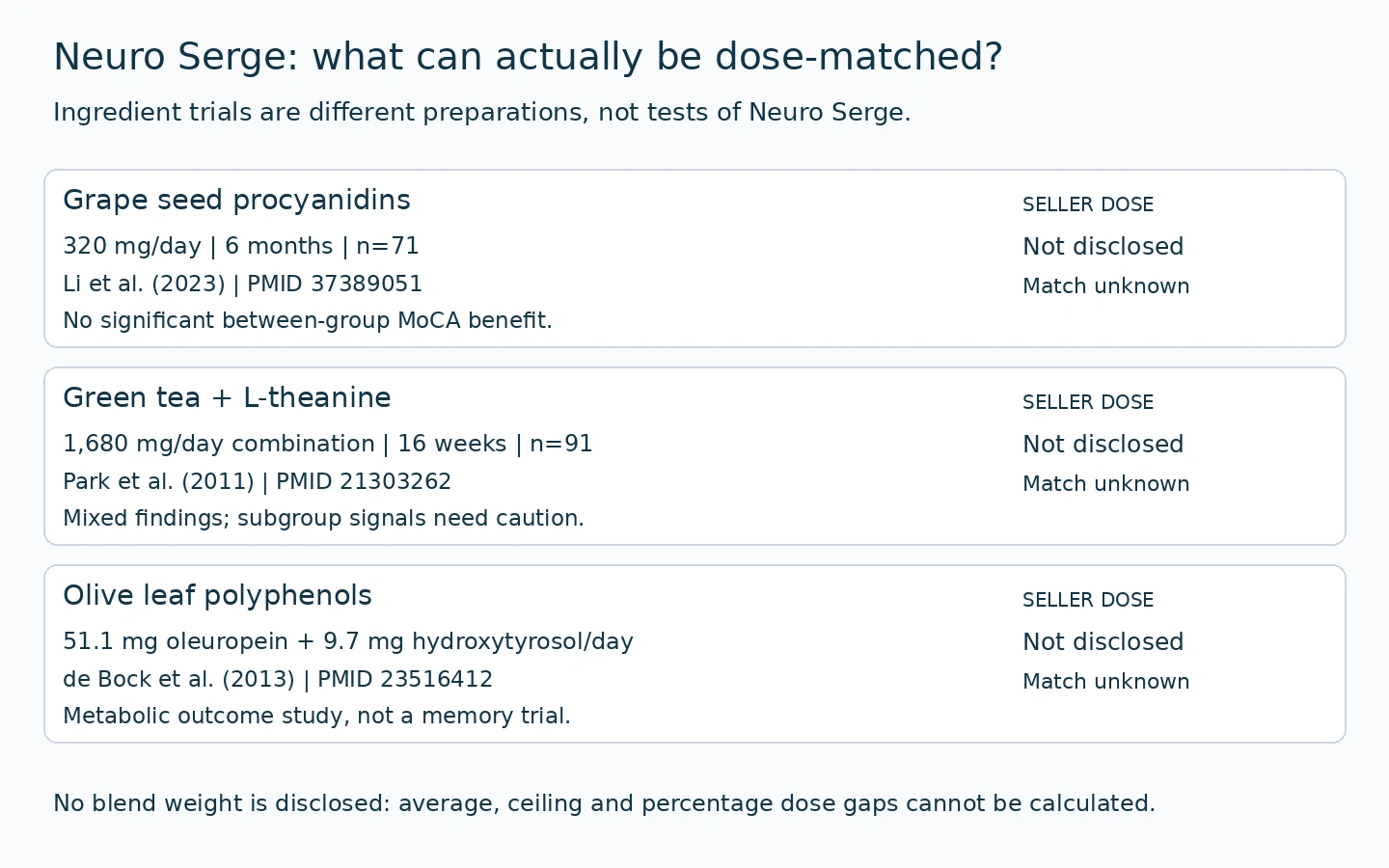
The available research does not establish a Neuro Serge memory benefit. A 320 mg grape-seed trial and a 1,680 mg green-tea/theanine trial examined different preparations, with different limitations. Neither supplies a result for this capsule blend, whose amounts are undisclosed. An absent product trial also does not prove universal ineffectiveness.
Li et al. (2023) found no significant between-group improvement in overall cognition after six months of grape-seed procyanidins in 71 older adults with mild cognitive impairment. Li et al. (2023) PMID: 37389051 [1] Park et al. (2011) reported mixed findings with a tea/theanine combination, including signals in a small subgroup. Park et al. (2011) PMID: 21303262 [2]
The seller’s reference list largely concerns obesity, sleep and metabolism. That background cannot establish that this blend improves memory. Read the effectiveness analysis and the Brain & Memory Guide for the evidence boundaries.
Neuro Serge ingredients and the Supplement Facts gap
Six highlighted botanicals are identifiable, but their amounts are not. The reviewed page mentions 20+ ingredients elsewhere and also includes a four-plant heading. Without a complete Supplement Facts panel or total blend weight, neither ingredient count reconciliation nor average-dose and maximum-ceiling calculations can be completed responsibly for this product.
| Ingredient/preparation | Seller amount | Studied human dose | Audit interpretation |
|---|---|---|---|
| Grape seed extract | Not disclosed. | Li et al. (2023): 320 mg/day procyanidins. Li et al. (2023) PMID: 37389051 [1] | No significant overall cognition advantage; formulation equivalence is unknown. |
| Green tea extract | Not disclosed. | Park et al. (2011): 1,680 mg/day combined tea/theanine preparation. Park et al. (2011) PMID: 21303262 [2] | Combination dose is not a green-tea-only dose. |
| Olive leaf | Not disclosed. | de Bock et al. (2013): 51.1 mg oleuropein plus 9.7 mg hydroxytyrosol daily. de Bock et al. (2013) PMID: 23516412 [3] | Metabolic research does not demonstrate memory efficacy. |
| Cassia, DGL and bilberry | Not disclosed. | No matching memory-study dose established for this product. | Do not substitute culinary quantities or unrelated extracts for a verified formula. |
No legible complete panel was located for inactive ingredients, botanical standardization, caffeine, capsule shell or allergens. The front label confirms 60 capsules, not the number to take. See the ingredient disclosure analysis and ingredient library.
Neuro Serge side effects and interaction cautions
A natural-ingredient description is not enough to assess safety. Green tea extract, cassia cinnamon and licorice preparations raise different questions, and this product does not disclose the quantities needed to individualize that screen. There is no verified Neuro Serge adverse-event rate, so ingredient-level cautions must remain clearly separated from product-specific findings.
NIH sources associate concentrated green tea extracts with uncommon liver injury and describe several medicine interactions. NCCIH NIH source [4] NIH LiverTox (2020) LiverTox [5] Cassia can contain coumarin relevant to susceptible people, especially those with liver disease. NCCIH NIH source [6] DGL is different from ordinary licorice, but residual glycyrrhizin and product composition still matter. NCCIH NIH source [7]
- Ask a pharmacist to review the complete label alongside all medicines and supplements.
- Pregnancy, breastfeeding, existing liver disease and prior herbal reactions warrant particular caution.
- Stop use and seek medical assessment for jaundice, dark urine or other concerning symptoms.
Do not increase capsule intake to imitate an ingredient study. Our safety analysis explains what can and cannot be inferred.
Neuro Serge reviews and complaints: what is documented?
The strongest documented concerns are inconsistencies in the offer rather than a verified complaint rate. Ingredient counts, bonus descriptions and return wording differ across seller sections. Testimonials and a large review-count claim are seller-controlled material; no independently verified dataset was established that would support a typical-result estimate or customer-satisfaction percentage.
This distinction matters when reading negative claims too. A document conflict is not evidence that every shipment is problematic, and anonymous praise or criticism does not establish a clinical outcome. Keep an order receipt, current offer screenshot and written support responses. The complaints and alternatives page separates observed friction from unverified allegations.
Price, bundle discounts and the real return window
The lowest advertised unit price requires the largest upfront purchase. Six bottles cost $294 for 180 advertised supply days, yet physical returns must arrive within 90 days from purchase. Three bottles cost $207 and two $158. Delivery time, return transit and postage make the usable trial shorter than the headline guarantee suggests.
| Package | Arithmetic | Advertised supply | Daily product cost | US shipping representation |
|---|---|---|---|---|
| 2 bottles | $79 × 2 = $158 | 60 days | $2.63 | Additional fee, not verified. |
| 3 bottles | $69 × 3 = $207 | 90 days | $2.30 | Advertised free. |
| 6 bottles | $49 × 6 = $294 | 180 days | $1.63 | Advertised free. |
Daily costs divide advertised product totals by advertised days; they exclude taxes or unverified extras. No coupon code was verified. A lower per-bottle price is not an independently verified saving against a routine market price.
The shipping policy requires every bottle, including empty or partly used bottles, and identifying order details. Buyer-paid tracked postage reduces net recovery. For illustration only, a full $294 product refund less hypothetical $8–$12 return postage leaves $282–$286. Other nonrefunded charges would reduce that amount further; the postage range is not a carrier quote.
Where to buy: verify the seller and final checkout
The supplied offer uses ClickBank as retailer, but retailer involvement does not validate medical claims. Before paying, confirm the exact product, bottle count, final total and return conditions. Marketplace authorization was not established for Amazon or Walmart listings, and an unfamiliar listing cannot be declared counterfeit solely because it appears elsewhere.
- Check that the checkout identifies Neuro Serge and the package you selected.
- Review shipping, tax, optional additions and any separate upgrade before payment.
- Save your order number and the applicable return terms.
The sales FAQ describes a one-time payment without autoship. Affiliate materials mention upsells, which are not proof of a required subscription. No payment was completed for this review, so displayed offer arithmetic should not be mistaken for a verified billed transaction.
Dosage and how to use: follow a verified label
A numeric daily capsule dose could not be verified from the reviewed directions. The seller says to take the product with water, while front artwork lists 60 capsules and package cards imply 30 days per bottle. Dividing those figures would create an inferred regimen, which is not an acceptable substitute for explicit directions.
Request a readable current Supplement Facts and directions panel before taking it. Confirm serving size, frequency, food instructions, storage and warnings with the seller and a pharmacist. Do not use the study quantities above as a dosing target, double doses after a missed serving or continue through new symptoms merely to finish a bundle.
Alternatives: compare the decision before another bottle
The most useful comparison starts with why memory or concentration has changed. Assessment, practical routines and a clearly labeled supplement address different needs. There is no verified like-for-like certified generic memory treatment price in this review, so comparing Neuro Serge with an invented low daily benchmark would give a misleading impression of value.
| Option | What it addresses | Evidence boundary | Buying decision |
|---|---|---|---|
| Clinical assessment | New, persistent or function-limiting changes. | It can investigate causes; it is not a guaranteed diagnosis from a checklist. | Prioritize assessment over a supplement trial when symptoms interfere with daily life. National Institute on Aging NIA source [8] |
| Sleep and routine support | Everyday organization and health habits. | Useful care context does not guarantee prevention of dementia. | Use practical supports alongside appropriate healthcare. National Institute on Aging NIA source [8] |
| Targeted nutrient replacement | A clinically established need, if present. | No assumption that every memory complaint reflects a deficiency. | Choose it with professional guidance rather than as a universal nootropic. |
| Another transparent product | Ingredient identity, dose and quality comparison. | A clear label is assessable, but not proof of cognitive benefit. | Check exact preparation and independent testing before comparing price. |
No competing capsule is declared superior here without a matched population, dose and outcome. That protects against replacing one unsupported promise with another.
Final verdict: is Neuro Serge worth buying in 2026?
For evidence-focused buyers, waiting for a complete label is the more defensible decision. The 2.8/10 editorial score reflects mixed ingredient research, missing quantities and demanding return logistics. Someone still considering the offer should first obtain the full formula and written terms, then review personal safety questions with an appropriate healthcare professional.
The product may appeal to adults who prefer a capsule-based botanical blend, but the current evidence does not justify a promise of restored memory or a predictable timeline. Persistent cognitive symptoms deserve assessment rather than a six-month commitment based on a testimonial. Recheck the live offer because pricing and policies can change.
Frequently asked questions about Neuro Serge
These answers summarize the practical purchase questions that remain after the research audit. The offer advertises 60 capsules per bottle artwork, $158–$294 package totals and a 90-day return policy. None of those numbers establishes a safe serving size, a typical memory result or a guarantee that every buyer will receive the same outcome.
Is Neuro Serge FDA approved?
What is the cheapest advertised Neuro Serge package?
Does a 180-day supply mean a 180-day guarantee?
Can I rely on the seller’s customer-review total?
Is the serving size definitely two capsules?
Does this article include personal product testing?
Should memory problems wait until the supplement trial ends?
References
- Li et al. (2023). The effect of grape seed procyanidins extract on cognitive function in elderly people with mild cognitive impairment. Heliyon 9:e16994. PMID: 37389051
- Park et al. (2011). A combination of green tea extract and L-theanine improves memory and attention in subjects with mild cognitive impairment. J Med Food 14:334–343. PMID: 21303262
- de Bock et al. (2013). Olive leaf polyphenols improve insulin sensitivity in middle-aged overweight men. PLoS One 8:e57622. PMID: 23516412
- NCCIH. Green Tea: Usefulness and Safety. Accessed October 30, 2026. NIH source
- NIH LiverTox (2020). Green Tea. LiverTox: Clinical and Research Information on Drug-Induced Liver Injury. LiverTox
- NCCIH. Cinnamon: Usefulness and Safety. Accessed October 30, 2026. NIH source
- NCCIH. Licorice Root: Usefulness and Safety. Accessed October 30, 2026. NIH source
- National Institute on Aging. Memory loss and forgetfulness. Accessed October 30, 2026. NIA source
- FDA. Questions and Answers on Dietary Supplements. Accessed October 30, 2026. FDA source
Seller documents and offer checked October 30, 2026. Prices are advertised, not a completed checkout. Research comparisons are based on the cited abstracts and official health resources.